On this page · 4 sections
Key takeaways
- 1One sheet: six pieces, how they move, teaching values, castling, pawn specials. No openings, no tactics.
- 2Print A3 for the wall, A4 for the home printer, PNG for a slide or Pin.
- 3Free classroom and club print. Keep the credit. Not for resale.
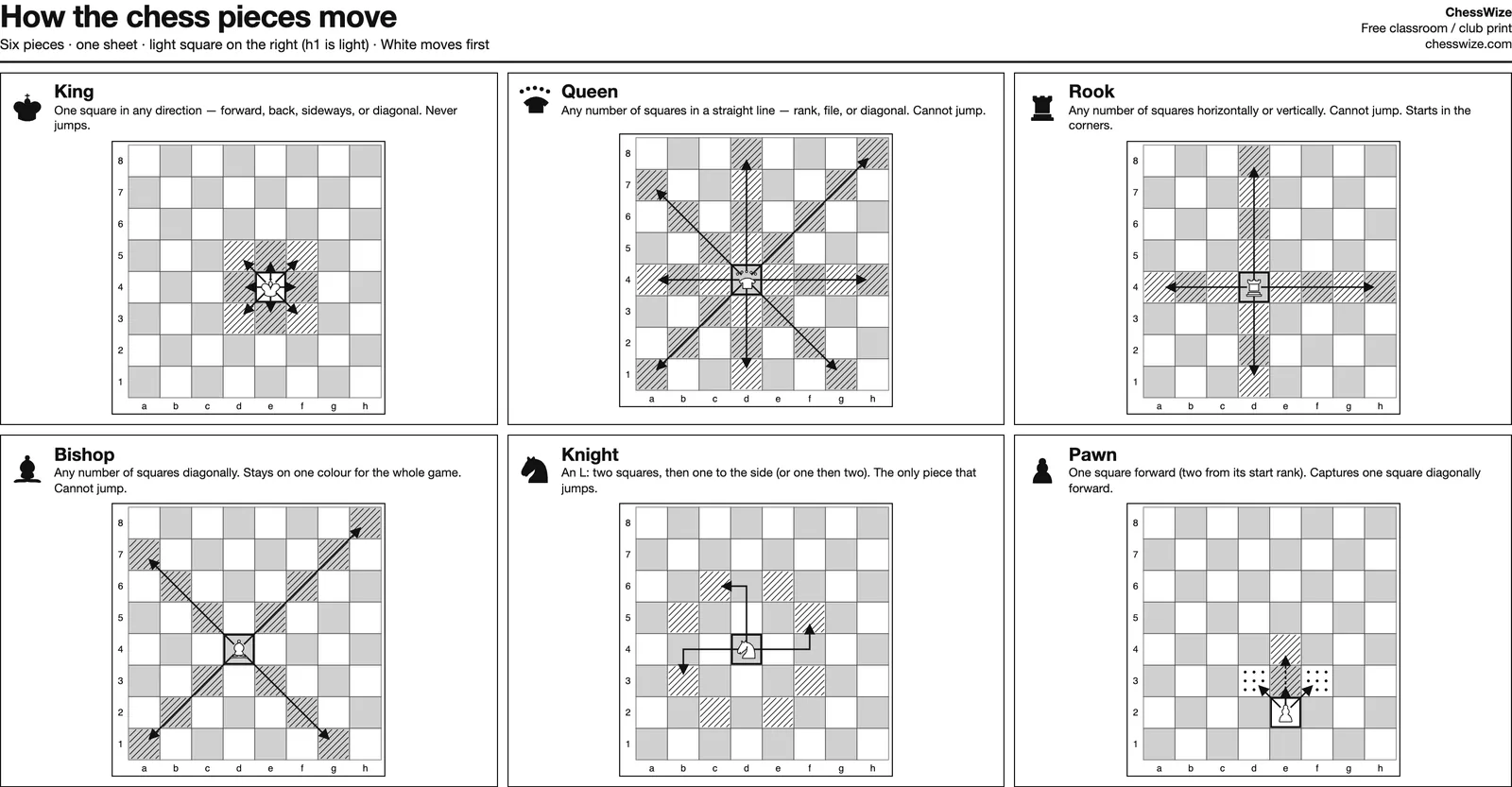
A single-sheet classroom poster: six pieces, how each one moves, teaching values, castling, plus pawn specials. Chess.com already gives away a multi-page cheat sheet. This is the wall chart a school copier can do in one job. Hatched squares are empty landings; dotted squares are pawn captures; arrows mark the line of travel.
The diagrams use 2D Staunton pieces and algebraic labels (a to h, 1 to 8). Every mini-board has a light square at the bottom-right. Moves match our kid-friendly chess rules page. Values on the footer are common teaching values, not official points.
En passant is a short “your coach will show you” line so the sheet stays complete without lying by omission. The full trigger is on the rules page: the opponent’s pawn just moved two squares and landed beside yours; you may capture it as if it had moved one, and only on the next move.
Teacher 30-minute club#
Hang this at child height. Then play “name the piece / show the squares” for ten minutes: one child points at a piece on the poster, another shows those squares on a real board. Spend ten minutes on “legal or not” with two pieces. Finish with five minutes packing up. Keep a spare A4 at the desk for anyone who wants the chart at home. No openings and no tactics on this sheet. It features only how each piece moves, until that is automatic.
For the classroom wall#
Light square on the right is the setup error this poster also fixes. Pair it with board setup and notation when the group starts writing moves, and with the classroom score sheet for the first recorded game.
How to use the poster at home#
Do not ask a child to memorise all six movement patterns before touching the board. Pick one piece, place it near the centre, and ask the child to point to every legal empty square. Then add one friendly piece and one opposing piece. The child now has to notice that most pieces cannot jump and that a capture ends on the occupied square. This small change turns the chart from something to read into something to test.
Keep the first practice short. Five accurate minutes with a rook and bishop are more useful than a long session in which every rule starts to blur. On the next day, add the queen and king. Leave the knight and pawn for their own round because jumping, forward movement, and diagonal captures need separate attention. Once each piece is secure, set up a tiny position with three or four pieces and ask for one legal move at a time.
Parents do not need to correct every move immediately. Ask, “Which line on the poster are you using?” or “Is another piece blocking that square?” The child then checks the rule instead of waiting for the answer. If the same mistake keeps returning, mark that piece for the next practice and tell the coach. A recurring rule error is useful placement information, not a reason to rush into openings.
Common movement mistakes to watch for#
Beginners often move a pawn backward after reaching the middle of the board, let a bishop change square colour, or slide a rook through another piece. Knights create the opposite problem: children sometimes stop them at a blocker even though a knight can jump. The king also needs a safety check. A square may be one step away and still be illegal because an opposing piece attacks it.
Castling and en passant are special moves, so introduce them after ordinary movement feels comfortable. Promotion is easier to explain early: when a pawn reaches the farthest rank, it must become a queen, rook, bishop, or knight. The poster is a reference for these rules, but a real board is where the child learns to recognise when each rule applies.
Paste into a staff email: “Free A3 chess-piece movement poster, one sheet, six pieces. Photocopy-ok, keep the credit, not for resale. chesswize.com/downloads/chess-piece-movement-poster-a3.pdf”
How we research and correct articles: Editorial policy · Corrections

Aryan Pal
ChessWize's content lead and coach for early learners. Specialises in making chess feel intuitive for first-time players. Designs the explainer videos, exercise sets, and parent-facing learning materials every student receives.
References & Sources · 3
- [01] FIDE Laws of Chess define piece movement, castling, en passant, and promotion — https://handbook.fide.com/chapter/E012023, 2023
- [02] Standard rules summary for piece movement and board orientation — https://en.wikipedia.org/wiki/Rules_of_chess, 2026
- [03] Point values 1/3/3/5/9 are a teaching convention, not a FIDE law — https://en.wikipedia.org/wiki/Chess_piece_relative_value, 2026