
Best Online Chess Classes for Kids in India: 5 Compared (2026)
Compare five online chess classes for kids in India by published fees, coach credentials, group size, trial, reporting, and the type of family each may suit.
On this page · 18 sections
Key takeaways
- 1There is no honest universal winner: the useful shortlist changes with your child's level, preferred group size, budget, and how much parent reporting you need.
- 2Provider facts come from dated first-party pages where available; anything we could not verify is labelled rather than guessed.
- 3Compare per-session cost and batch size, not monthly headlines — package maths hides more than it reveals.
- 4Whatever you shortlist: take a real trial class and verify the coach's FIDE rating yourself — this guide shows how.
The useful shortlist for online chess classes in India depends on the child. ChessWize focuses on same-coach continuity and weekly parent reports. ChessGaja publishes monthly group pricing and batch limits. CircleChess foregrounds a GM-led curriculum and a conditional FIDE-rating pathway. Kingdom of Chess shows parents how a 45-minute class works. KaabilKids publishes a long, level-based curriculum, while ChessKid is a self-paced practice app rather than a live class.
Disclosure: ChessWize runs this website and appears in the comparison. We do not award ourselves a rank. The criteria are stated first, provider facts carry verification dates, and our own limitations are shown beside the alternatives.
How did we compare these online chess classes?#
Method (desk research, not a paid trial at every academy): we compared each academy on four criteria a parent can independently check: whether coach credentials are verifiable (named coaches with FIDE ratings you can look up), whether prices are published, what the live class format and group size are, and how progress is reported to parents.
Two rules governed the research. First, a fact only counts if it appears on the academy’s own website. We rechecked the provider pages on 30 August 2026 and label dated brochures separately. Second, “we could not verify it” is stated plainly rather than papered over; one well-known academy is excluded from the table for exactly that reason (see the FAQ). Where a provider’s own pages disagree, this guide shows the conflict and tells you what to get in writing.
For credentials and tournament context, parents can cross-check a coach in the official FIDE rating search and use the All India Chess Federation for national federation information. Those independent checks matter more than the badges or testimonials on any academy website, including ours.
Five academies, matched to different family needs#
There is no meaningful universal winner. A beginner who needs a patient, consistent coach has a different requirement from a rated player preparing for tournaments. The reviews below separate the facts each provider publishes from our assessment. Prices and policies can change, so use the source link on each card before paying.
ChessWize
Best for: families who want one consistent coach and a short weekly parent update
ChessWize teaches children aged 5 to 15 in live online classes. The same coach stays with the child rather than rotating between sessions. A complimentary level check comes before enrolment, and parents receive a weekly WhatsApp report after regular classes.
- Published price
- Group ₹375 per session, 2:1 ₹550, 1:1 ₹1,000 (ChessWize list as of 4 September 2026)
- Group size
- Maximum 6 students
- Trial
- Complimentary 30 minute level check
- Parent visibility
- Weekly WhatsApp progress report for every student
- Refund
- 48-hour full refund (monthly); 7-day pro-rated (term packages)
Reasons to shortlist
- The same coach can see patterns in a child's mistakes over time instead of reassessing the child every week.
- Named coach profiles describe teaching experience, specialities, and documented student outcomes.
- Pricing and the starter pack are visible before a parent speaks with sales.
Limits to understand
- ChessWize does not promise that a child will reach a particular rating within a fixed period.
- The academy is smaller than the largest providers in this guide, so the number of simultaneous batch choices is lower.
- This is ChessWize's website. Our ownership is disclosed, and we do not give ChessWize a score or a universal first-place claim.
Ask before paying
- Who will teach the regular class, and can I verify that coach's FIDE profile?
- Which group and time slot match my child's current level?
- How long is each regular session, how often is my report, and which refund terms apply to this package?
Our assessment
Shortlist ChessWize if coach continuity and frequent, plain-language feedback matter more than a large content library or a rating guarantee. Families comparing several providers should take the level check and judge the actual coach, not this article.
Checked against the provider's own public pages.
ChessGaja
Best for: parents who want published monthly group prices and rating-based batches
ChessGaja is led by GM Priyadharshan Kannappan. Its India group schedule is organised by Chess.com Rapid rating, from absolute beginner to 1750, and publishes the monthly fee, timetable, number of classes, and maximum batch size for each level.
- Published group price
- From ₹3,250 per month plus 18% GST (ChessGaja group classes page, checked 30 August 2026)
- Frequency
- 8 classes per month for listed India batches
- Group size
- Maximum 12 students
- Before enrolment
- Free level check and sample recordings, but no group demo
Reasons to shortlist
- Parents can compare a real timetable and price before contacting sales.
- Class recordings are available when a student misses a group session.
- The published pathway covers beginners and stronger online players, with higher fees clearly shown for advanced batches.
Limits to understand
- Group fees are non-refundable and non-transferable once enrolled, unless ChessGaja cancels the programme.
- A group may contain up to 12 students, so speaking time per child can be lower than in a smaller batch.
- There is no live demo for group classes. Parents can watch sample recordings, but those do not show how a coach responds to their own child.
Ask before paying
- Will the named coach remain with this batch for the full month?
- How is individual feedback delivered in a 12-student class?
- What happens to missed sessions and mid-month enrolment?
Our assessment
ChessGaja is one of the easiest providers here to price without a sales call. It suits a family comfortable with a larger fixed group and a no-refund group policy. Watch the sample class, confirm the assigned coach, and read the cancellation terms before paying.
Checked against the provider's own public pages.
CircleChess
Best for: families seeking a structured FIDE-rating pathway with mentor and app support
CircleChess's Caissa School of Chess publishes a curriculum led by GM Vishnu Prasanna, group and 1:1 options, an AI-supported practice app, and a personal mentor layer. Its current India page lists beginner group classes from ₹9,000 for three months and includes monthly parent-teacher meetings.
- Published group price
- Beginner ₹9,000 and Intermediate ₹10,800 for 3 months of 24 sessions; Advanced ₹10,800 for 36 sessions; GST included
- Published 1:1 price
- From ₹24,000 for 3 months
- Frequency
- 2 live classes per week in the beginner plan
- Trial
- Paid 1:1 trial or 7 day refund window after joining
- Parent visibility
- Monthly parent-teacher meeting
Reasons to shortlist
- The curriculum lead and a large roster of titled coaches are named publicly.
- The programme combines live instruction, assignments, tournaments, mentor guidance, and an app rather than treating class as a standalone video call.
- The Intermediate programme's one-year FIDE-rating promise has a published refund process for eligible students who meet every condition.
Limits to understand
- The group-size cap is not stated on the India programme page we reviewed.
- The FIDE guarantee is tied to the Intermediate pathway and is conditional. It requires attendance, assignment completion, regular games and reviews, plus offline and rated tournament participation.
- A free demo is not the default. Parents choose between a paid 1:1 trial and enrolling under the seven-day refund policy.
Ask before paying
- Which coach teaches the weekly batch, and which sessions are GM or IM masterclasses?
- How many children are in the exact batch being offered?
- Can our family realistically meet every condition of the FIDE guarantee?
Our assessment
CircleChess is a strong shortlist for a family that wants a broad training system and plans to pursue an over-the-board FIDE rating. Treat the guarantee as a commitment contract, not a passive promise. Ask for the full conditions and the exact group size before enrolment.
Checked against the provider's own public pages.
Kingdom of Chess
Best for: parents who want to see a clear class structure, practice cycle, and level pathway
Kingdom of Chess publishes four levels from beginner to elite. Its beginner page shows what happens during each part of a 45-minute class, while the wider programme includes assignments, tournaments, recordings, assessments, and regular feedback.
- Age range
- Ages 4 to 18
- Session length
- 45 minutes
- Group size
- 6 to 8 on beginner and advanced pages; advanced may also be private
- Trial
- One free live class
Reasons to shortlist
- The published beginner lesson flow shows warm-up, teaching, practice game, review, and an assignment rather than a vague curriculum label.
- Parents can review progress through feedback, a relationship manager, and an available parent-teacher meeting.
- The site publishes named titled coaches and offers a progression route through beginner, intermediate, advanced, and elite levels.
Limits to understand
- The current course pages do not surface the package price beside the enrolment decision. A separate January 2026 beginner brochure lists package fees, so confirm that those figures are still valid.
- The format varies by level: published course pages show groups of 6 to 8, while advanced can also be private. Confirm the exact batch being sold.
- Several achievement and scale figures are provider claims. We use them only as self-reported context, not proof of an individual child's likely result.
Ask before paying
- Which group-size cap applies to my child's exact level?
- Is the quoted package price the same as the January 2026 brochure?
- Who writes the progress report, and how often will we receive it?
Our assessment
Kingdom of Chess gives parents a clearer view of the teaching process than many academy pages. It is worth shortlisting when lesson structure and tournament practice matter. Confirm the current India price and the exact batch cap because those details are spread across different pages.
Checked against the provider's own public pages.
KaabilKids
Best for: families who want a long curriculum, monthly PTMs, and age-aware teaching support
KaabilKids lists GM Tejas Bakre as chief mentor. Its demo form groups children into ages 5–7, 8–10, and 11–15, while its public curriculum spans foundation through FIDE-rating preparation with assignments, puzzles, tournaments, platform access, assessments, and monthly parent-teacher meetings.
- Age signal
- Demo form uses age bands 5–7, 8–10, and 11–15
- Course length
- 24, 48, or 96 sessions depending on level
- Parent visibility
- Regular feedback and monthly PTM
- Individual-class packages (as read 5 August 2026)
- ₹9,600 for 12 sessions at Levels 1–3, up to ₹36,480 for 48; Level 4 from ₹30,000 for 12
- Group price
- Not shown as a readable fixed figure on the public pricing page
Reasons to shortlist
- The curriculum pages list concrete topics, assignments, puzzle counts, assessment sessions, and tournament opportunities by level.
- Parents get recurring PTMs rather than relying only on a final certificate or dashboard score.
- The programme combines a GM-designed curriculum with input from a child psychologist, which may suit younger or less confident learners.
Limits to understand
- The public pricing interface does not expose a clear, crawlable group fee, so families cannot complete a like-for-like cost comparison without selecting options or contacting the academy.
- The site uses both age bands and level-based pathways across different pages. Parents should ask which structure governs the class being sold.
- Claims about broader cognitive benefits are promotional context, not evidence that a particular child will see those outcomes.
Ask before paying
- What is the total payable fee, including tax, for the exact class type and session count?
- How many students will be in the assigned group?
- How often does the named GM or psychologist interact directly with the child?
Our assessment
KaabilKids may suit a parent who values a detailed curriculum and regular PTMs. The main buying friction is commercial clarity: get the total fee, group size, assigned coach, and the direct role of specialist mentors in writing before committing.
Checked against the provider's own public pages.
A useful supplement, but not a live academy#
ChessKid
Best for: safe self-paced puzzles, lessons, bots, and extra practice between coached sessions
ChessKid is a child-focused chess platform, not a live coaching academy. A free Basic account provides limited puzzles, beginner lessons, videos, bots, workouts, and a 30-day game archive. Gold unlocks the full library.
- Format
- Self-paced app and website
- Live coach
- Not included
- Free plan
- Limited access, including 3 puzzles per day
- Gold price
- About $10 per month per child as of July 2026 (ChessKid help centre and a licensed reseller); the live price is shown at checkout
Reasons to shortlist
- A child can practise independently without waiting for the next class.
- The product is designed around child accounts and linked parent or coach accounts.
- Gold removes limits across puzzles, lessons, bots, videos, workouts, and game history.
Limits to understand
- It does not include a coach who can diagnose recurring mistakes or adapt a lesson to the child's behaviour.
- The Basic plan is useful for trying the product but does not provide unlimited access.
- Tournament preparation, accountability, and individual feedback still need a coach, club, or involved parent.
Ask before paying
- Will my child use it independently between classes?
- Does the current Gold checkout price justify the features we will actually use?
Our assessment
Use ChessKid as structured practice, not as a direct substitute for live coaching. It makes the most sense when a child already has an adult or coach who can turn app activity into a focused practice plan.
Checked against the provider's own public pages.
Our ChessWize vs ChessKid comparison explains when a self-paced tool is enough and when a live coach becomes useful.
Which provider should your family shortlist first?#
| Your main concern | Start by comparing | Why |
|---|---|---|
| The same coach and a weekly parent update | ChessWize | Coach continuity and weekly WhatsApp reporting are explicit programme features. |
| A published monthly group fee | ChessGaja | The timetable, fee, class count, and maximum batch size are visible before enquiry. |
| A structured route toward a first FIDE rating | CircleChess | The programme combines classes, mentor support, practice requirements, and a conditional guarantee. |
| A visible lesson flow and free live trial | Kingdom of Chess | The beginner page breaks down the 45-minute class and publishes the batch range. |
| A long curriculum with monthly PTMs | KaabilKids | The public curriculum lists session counts, assignments, tournaments and parent meetings. |
| Independent practice between classes | ChessKid | It is a practice platform rather than a coaching academy. |
This matrix is a starting point, not a verdict. The final decision should depend on the actual coach, the exact batch, your child’s response in a trial, the written refund terms, and whether the weekly workload fits school and family life.
Also worth knowing#
Chess Gurukul is not included in the like-for-like cards because we could not verify its current online format, batch size, price, trial and reporting on the same first-party basis on 30 August 2026. Competitive-track families can still enquire directly, but this guide will not fill missing buying details with reputation or old coverage.
MindMentorz (Bengaluru) is omitted from the table entirely. See the FAQ for the honest reason.
Comparison table: what each academy publishes (August 2026)#
The table below covers four providers in our structured, dated competitor dataset. Every cell was checked against the provider’s own site, and “Not published” means we did not find the detail on the cited page. ChessWize is shown separately because this is our site. KaabilKids sits outside the dataset because its current pricing controls do not expose a stable, readable group fee for a like-for-like table.
Swipe sideways to compare all 4 options.
| Compared detail | ChessGaja | CircleChess | Kingdom of Chess | ChessKid |
|---|---|---|---|---|
| Pricing | Group classes ₹3,250/month + 18% GST (India, ≈₹3,835 payable) · 1-on-1 ₹1,700/hour + GST; international pricing in SGD/USD also published | Beginner ₹9,000/3 months (24 sessions) · Foundation from ₹9,000/3 months · Intermediate ₹10,800/3 months (24 sessions) · Advanced ₹10,800/3 months (36 sessions); GST included | Current course page does not show a fee. January 2026 beginner brochure: ₹13,999 for 32 live classes + 16 masterclasses over 4 months, inclusive of GST. Confirm before paying. | Limited Basic plan is free; current Gold price is shown after sign-in or in membership checkout |
| Live classes | Yes
| Yes
| Yes
| No
|
| Group size | max 12 students (group classes) | Small-group and 1:1 options available (exact group size cap not published) | 6–8 for beginner and advanced groups; advanced may also be private |
Not published by this provider |
| Age range | Not published as a fixed range on the group-classes page | All age groups; no kids-only age band published on the current programme page | 4+ (beginner through elite tiers) | Designed for ages 13 and under (older kids can still use it; content spans beginner to ~1600 rating) |
| Free trial | Free level check and sample recordings; no live demo for group classes | Paid 1:1 trial available; otherwise a 7-day refund window after enrolment | Free trial class, "no payment or commitment required" |
Not published by this provider |
| Parent progress reports | Monthly GM review calls (1-on-1 tier) + AI-generated class summaries + LMS progress tracking | Monthly PTMs (parent-teacher meetings), included in all plans | Relationship-manager feedback; parents can arrange a PTM with the coach | "Child activity reports" for parents (safety/monitoring, not a coaching progress report) |
| Refund / guarantee | Group fees are non-refundable and non-transferable unless ChessGaja cancels the programme | 7-day money-back window · conditional one-year FIDE Rating Guarantee requiring attendance, assignments, games, reviews and tournament participation |
Not published by this provider |
Not published by this provider |
And ChessWize, on the same rows (our programme, with facts from our own published site copy, checked 30 August 2026):
| Compared detail | ChessWize |
|---|---|
| Pricing | Group ₹375/session, 2:1 ₹550/session, 1:1 ₹1,000/session; starter pack ₹2,500 for 8 classes |
| Live classes | Yes, same coach every session, no rotation |
| Group size | Up to 6 students |
| Coaching model | Experienced coaches; named profiles with teaching experience on /coaches |
| Age range | Ages 5-15 |
| Free trial | Complimentary 30-min level check before you commit |
| Parent progress reports | Weekly WhatsApp report for every student |
| Refund / guarantee | 48-hour full refund (monthly); 7-day pro-rated (term packages) (see our refund policy) |
What do these academies actually charge per month?#
Among the academies on this list that publish prices, ChessGaja’s beginner and intermediate India groups start at ₹3,250 per month plus 18% GST, or ₹3,835 payable. CircleChess currently lists Beginner at ₹9,000 and Intermediate at ₹10,800 for three months of 24 sessions each, and Advanced at ₹10,800 for 36 sessions, inclusive of GST, which works out to ₹300-₹450 per listed session (checked 3 September 2026). Kingdom of Chess’s current course page does not show the package fee beside the class details; its January 2026 beginner brochure lists ₹13,999 for 32 classes plus 16 masterclasses, inclusive of GST. Confirm that brochure price before relying on it.
What changed since our August check: CircleChess’s earlier intermediate tiers (₹12,150 for 3 months up to ₹44,550 for 12 months, about ₹4,050 a month) are no longer on its India page, and the Kingdom of Chess landing page that listed ₹406-₹687 per session returned a 404 error on 3 September 2026, so neither set of figures is treated as current.
For private coaching, ChessGaja publishes India rates from ₹1,700 per hour plus GST, with higher prices for more highly rated coaches, and CircleChess lists 1:1 classes from ₹24,000 per three months. Package structures are not directly comparable, so divide the total by the promised live session count and check whether masterclasses, assignments, or app access are being counted as classes.
Confirm taxes, validity, group size, and refund terms before comparing headline figures. For the full market picture, including what drives 1-on-1 rates up to titled-coach levels, see our dedicated guide to chess class fees in India.
How do you verify a chess coach’s FIDE rating?#
Any parent can verify a coach’s FIDE credentials in under two minutes, free, at ratings.fide.com: ask the academy for the coach’s FIDE ID, search it, and confirm the name, federation (IND for India), current rating, and any title. An academy that refuses to share IDs has failed the most basic transparency test.
What the numbers mean: a coach rated 1800+ Elo can teach beginners and intermediates effectively; for a competitive-track child aiming at state and national events, look for 2000+ or a title (CM, FM, IM, GM). Also check the coach’s activity. Someone who has not played a rated game in years may be out of touch with current competitive play. “FIDE-certified trainer” is a coaching certificate, not a playing strength; both matter, and neither substitutes for the other. Our full guide to finding a chess coach for kids goes deeper.
Can kids take chess classes at home?#
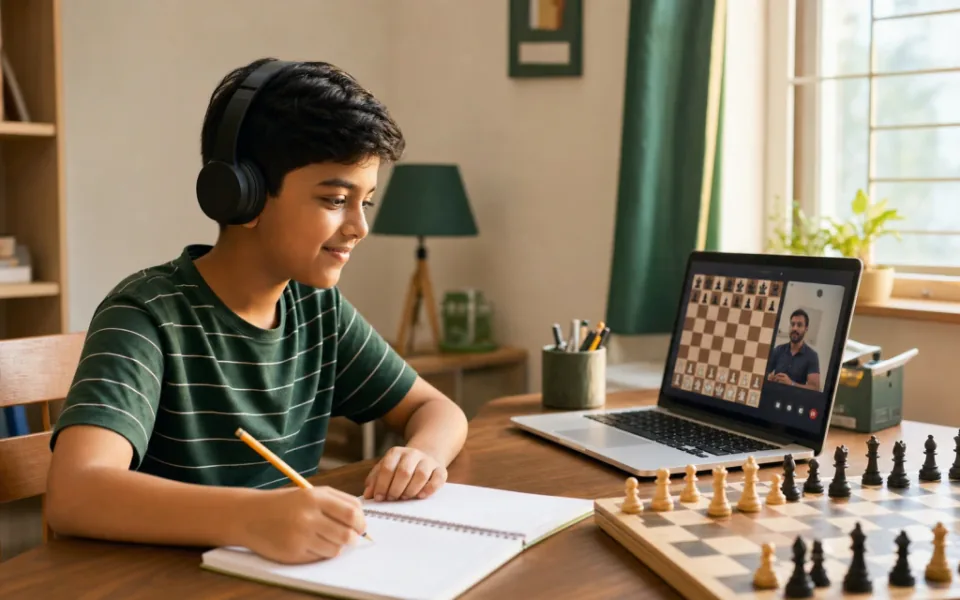
Yes. The live providers compared here teach over a video call with a shared digital chessboard. Your child needs a laptop or tablet with a webcam, a stable connection, and a quiet spot. Ask whether parents may sit in on a trial before assuming that access continues in regular classes. That matters most beyond the big metros. Families in Nagpur, Solapur and Bikaner widen their coach options beyond their city this way; see our city guides for Nagpur, Solapur and Bikaner.
Home-based online classes remove the commute, widen your coach options beyond your city, and let you observe teaching quality directly. Our explainer on online chess lesson walkthrough walks through a real session, and the online vs offline comparison covers when an in-person club still makes sense. Parents in smaller Maharashtra cities read the same trade-off. Our Chandrapur, Dhule and Ratnagiri pages walk through it city by city.
What should a good trial class show you?#
A good trial class shows the coach assessing your child before teaching them: the first 5-10 minutes should establish what the child already knows through questions and a quick puzzle check, and the session should be interactive: your child solving positions and making decisions, not watching a lecture.
Watch for these specifics: the coach adjusts explanations when your child does not understand; the session is live, not a recorded demo; the pitch takes minutes, not the majority of the class; and the coach ends by outlining what your child’s first month would cover. A serious academy also follows up within a day or two with specific feedback about your child, not a generic brochure.
Which red flags should make you avoid an academy?#
The clearest red flags are unverifiable credentials and guaranteed outcomes:
- “FIDE-rated coaches” with no FIDE IDs offered. If credentials cannot be checked, treat them as unproven.
- Guaranteed rating gains on a timeline. “200 points in three months” is marketing, not coaching. Improvement speed varies too much between children for any honest academy to promise it. (A refund-backed guarantee like CircleChess’s is a different, more defensible construct: the academy carries the risk, not your expectations.)
- No way to observe a class before a long commitment. Most providers in this comparison advertise a trial or assessment. If one does not, ask for a short paid trial or a recorded class before buying a large package.
- A different coach every session. Continuity is how a coach learns your child’s specific weaknesses; rotation resets that to zero each week.
- Curriculum described only in buzzwords. “AI-driven personalised methodology” means nothing without a concrete session-by-session structure you can read.
Frequently Asked Questions#
Can a 5-year-old join online chess classes in India?#
Yes. Several providers in this comparison publish starting ages of 4 or 5, and ChessWize teaches ages 5-15. Confirm the current minimum age before booking. At five, session length and teaching style matter more than the academy name; short interactive formats usually fit better than lectures. Our age-readiness guide explains what to watch for.
Should you choose a private online chess tutor or an academy?#
Choose an academy if you want a structured curriculum, backup coaches, and parent reporting systems. Choose a private tutor if your child needs fully customised attention and you can verify the tutor’s FIDE credentials yourself. Academies suit most beginners; strong tournament players often add a private specialist later. Our academy vs private tutor comparison weighs both routes in detail.
Do online chess classes prepare kids for AICF-rated tournaments?#
Live academy classes can prepare children for AICF-rated tournaments; self-paced apps do not provide a coach. Ask each provider whether lessons include physical notation, clock handling, tournament rules, and post-game analysis rather than assuming its standard curriculum covers over-the-board events.
What equipment does a child need for online chess classes?#
A laptop or tablet with a webcam, a stable internet connection, and a quiet spot. The providers compared use live video plus a digital board, so a physical set is usually optional for class. Owning one still helps with notation, clock use, and tournament-style practice.
How long before a child shows progress from online chess classes?#
In my coaching experience, a beginner attending classes twice a week with daily puzzle practice shows noticeable improvement with consistent practice, though how quickly varies from child to child. Competitive results take longer. Be sceptical of any academy promising a specific rating gain on a timeline — improvement speed varies enormously from child to child.
Why is MindMentorz not in the comparison table?#
MindMentorz is a real Bengaluru-founded academy, and its browser-rendered pricing is covered in our fees comparison. It is omitted here because the current pages did not publish enough like-for-like detail, including group size and delivery format, to compare it fairly on the same criteria.
Back to parent hub: parent checklist for choosing chess lessons.
Return to the main hub: Online chess coaching for kids in India.
How we research and correct articles: Editorial policy · Corrections

Hrdyansh Pandey
Day-to-day coach at ChessWize. 7+ years training students aged 5–15 across India, the USA, the UK, Singapore, Australia, and the Middle East. Runs structured, interactive sessions that take nervous beginners to tournament-ready players.
References & Sources · 7
- [01] Kingdom of Chess publishes live 45-minute beginner classes with groups of 6 to 8, a free live trial, and a lesson-by-lesson class structure — kingdomofchess.com/courses/chess-for-beginners, verified 2026-08-30
- [02] CircleChess publishes beginner group classes at ₹9,000 for 3 months and 24 sessions, monthly parent-teacher meetings, a 7-day refund window, and a conditional one-year FIDE-rating guarantee — circlechess.com/caissa-school-of-chess-ind and circlechess.com/refund-policy, verified 2026-08-30
- [03] ChessGaja publishes India group classes from ₹3,250/month plus 18% GST with 8 classes per month, maximum 12 students, no live group demo, and a non-refundable group policy — chessgaja.com/group-classes, verified 2026-08-30
- [04] KaabilKids lists GM Tejas Bakre as Chief Mentor, teaches ages 5–15, and publishes level curricula with assignments, tournaments, regular feedback, and monthly PTMs, while its current public price interface does not expose a simple crawlable group fee — kaabilkids.com/online-chess-coaching and kaabilkids.com/pricing, verified 2026-08-30
- [05] ChessKid's Basic plan is limited to 3 puzzles a day, beginner lesson levels, limited videos and bots, while Gold unlocks the full library; the current consumer price is shown through account checkout — support.chesskid.com/en/articles/8858285-what-s-the-difference-between-a-free-account-a-gold-membership, verified 2026-08-30
- [06] GM R.B. Ramesh founded Chess Gurukul in Chennai in 2008; its students include R Praggnanandhaa — en.wikipedia.org/wiki/R._B._Ramesh, accessed 2026-07-16
- [07] Any FIDE-rated player's rating and title can be verified free at ratings.fide.com using their FIDE ID — ratings.fide.com