ChessWize vs Lichess: Coaching vs Free Platform
Lichess (free, open-source) vs ChessWize coaching for Indian kids: features, child safety, study tools, and when each is the right choice.

Founder of ChessWize. 10+ years in chess education with international academy experience. Designs the structured curriculum that every ChessWize coach teaches. Best for parents who want a clear progression path, not just lessons.
On this page
For parents
Key takeaways
- 1Lichess is genuinely excellent and completely free — as a coach I use it in every session.
- 2A free platform gives your child tools; it does not give diagnosis, structure, or accountability.
- 3Child safety on Lichess is opt-in: a parent must enable Kid Mode and hold the account password.
- 4The strongest setup for most kids under 12 is coaching plus Lichess for daily practice, not one or the other.
Lichess is free and genuinely one of the best chess resources anywhere, so this is not a comparison where a paid option “wins.” Lichess gives your child tools; coaching gives your child diagnosis, structure, and accountability. For most kids the honest answer is not one or the other, but Lichess used well inside a coached plan.
I use Lichess every day and recommend it to every student I teach. So this article does not try to convince you that Lichess is inadequate. Instead it sets out where Lichess excels, where a human coach adds value no platform can copy, and how the two fit together. In ten years of coaching and running an academy, I have never once told a parent to stop using Lichess.
What makes Lichess special#
Lichess is a free, open-source chess server run as a non-profit and funded entirely by donations. There is no corporate owner, no advertising, and no paywalled feature. That funding model is unusual, and it is the root of most of its strengths.
- Completely free. Every core feature is available to every user: unlimited puzzles, unlimited games, unlimited analysis, unlimited studies. There is no premium tier to upsell your child.
- Puzzle training. The puzzle database is enormous and well-curated. Puzzles are rated and adapt to the player’s level, and modes like Puzzle Storm and Puzzle Streak make daily practice engaging without turning it into a slot machine.
- Game analysis. After every game, Lichess offers free computer analysis using Stockfish, one of the strongest engines in existence. It flags mistakes, blunders, and missed tactics with an evaluation at each move.
- Study boards. The study feature lets coaches and students build shared, annotated analysis boards. I prepare lesson material in them and annotate a student’s game live during a session. This is a genuinely powerful teaching tool.
- Opening explorer. Lichess shows how positions have been played by masters and across its own database, so a child can learn opening ideas from real statistics. On Chess.com the equivalent explorer sits behind a paid membership; on Lichess it is free.
- Clean interface. No ads, no pop-ups, no subscription prompts. For children who are easily distracted by visual clutter, that calm interface genuinely helps focus.
Where Lichess falls short for kids#
Child safety is opt-in, not default. This is the point I most want parents to understand. By default a Lichess account is an open platform: other users can have inappropriate usernames, and public chat in tournaments and lobbies is unmoderated. Lichess does offer a strong safeguard, Kid Mode, which limits messaging to the child’s Lichess class, hides forums, blogs, streams, and videos, and cannot be turned off without the account password. But a parent has to actively enable it and hold that password. It is excellent when switched on and does nothing when left off. Our guide on whether online chess coaching is safe for kids walks through the settings, and our child-safety page explains how supervised sessions differ.
No curated learning path. Lichess has “Learn” and “Practice” sections, but they are not a progressive curriculum. A child opening Lichess for the first time faces a blank dashboard. They can play, solve puzzles, or browse studies, but there is no “start here, then this” pathway. Left alone, most kids default to fast blitz games, which are fun and do little for real improvement. A structured opening repertoire for kids is the kind of thing a platform will not build for you.
No diagnosis of why. Stockfish tells your child what went wrong; it cannot tell them why. Was it a calculation error, a pattern they have never been taught, a time-management habit, or a nervous reaction under pressure? Only a human who knows the child can separate those causes and design the fix.
No accountability. Lichess is always available, which also means it is always easy to close. No schedule, no homework, no one checking whether practice happened. For children under 12, who mostly lack the self-discipline for independent study, that freedom tends to produce inconsistent practice.
No tournament preparation. Lichess will not prepare your child for a specific AICF tournament: reviewing likely opponents, tuning opening choices, managing pre-round nerves, or debriefing afterward. Those are coaching functions, absent from every self-guided platform.
How I use Lichess in my own coaching#
Rather than competing with Lichess, I treat it as core equipment. Here is exactly how it shows up across a week of teaching, because this is the part parents rarely get to see.
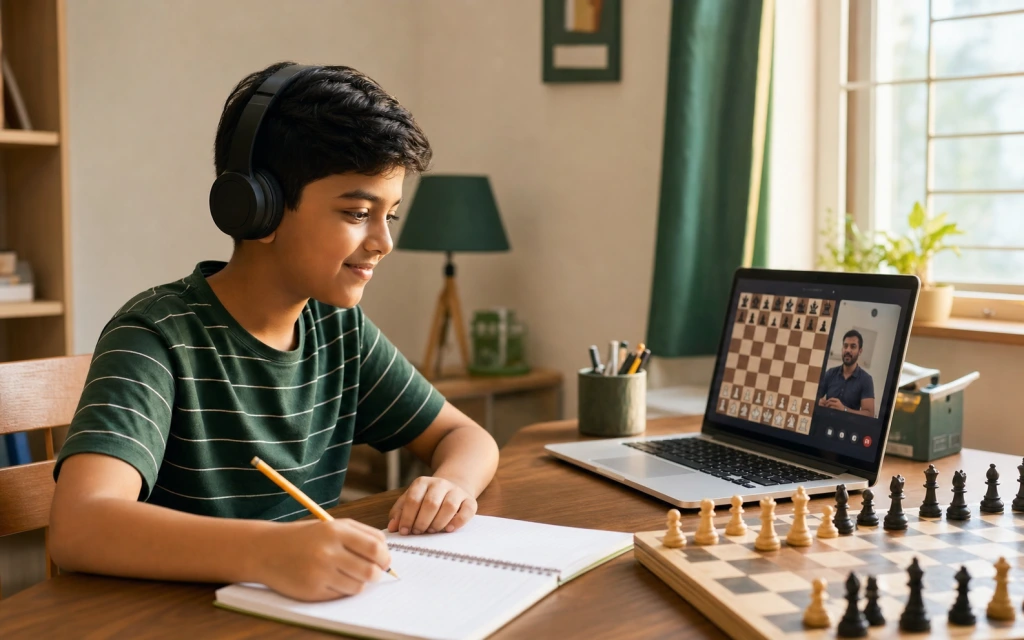
During sessions. I keep a Lichess study open for every student. When we review a game, I import it into that study and we annotate it together, move by move, while I ask the child to explain their thinking before I show the engine’s view. The order matters: their reasoning first, the machine second. That study becomes a permanent, interactive record the student can reopen any time, which is far better than a lesson that evaporates when the call ends.
For homework. Between sessions I assign specific Lichess activities: a set number of puzzles at a chosen difficulty, rapid games rather than blitz, or a position to study in a shared board. Because Lichess tracks puzzle ratings and results, I can tell whether the work actually happened and how carefully. If I see a student’s puzzle rating slip sharply between sessions, that usually means they were rushing to clear puzzles rather than solving them, and we fix that habit directly in the next lesson. A free platform cannot notice that; a coach who sees the same child every week can.
For game review. Students send me their game links before we meet. I review them in advance, mark the two or three moments worth teaching, and arrive ready to go straight to the critical positions instead of spending fifteen minutes hunting for them. That preparation is what makes a 45-minute session feel like ninety.
For tournament simulation. Before an important event, we use Lichess to recreate tournament conditions: rapid games under clock pressure, the opening lines the child will actually play, and timed puzzles in the final days to sharpen tactical vision. It is not a substitute for over-the-board practice, but it rehearses the thinking.
For team and community. Lichess teams let me build a private group for my students, so they can play team events and solve together. Competing alongside peers who are also being coached adds a motivation that solitary platform use never quite matches.
The pattern is consistent: the platform supplies volume and tooling; I supply judgement, structure, and the weekly nudge that keeps a child honest. Neither replaces the other. You can see how our sessions are organised on the courses page, and meet the actual coaches on the coaches page.
Comparison table#
| Feature | Lichess | ChessWize coaching |
|---|---|---|
| Cost | Free (donation-funded) | From ₹2,500 for 8 classes (₹313/session); group ₹375, 1:1 ₹1,000/session |
| Puzzles | Unlimited, rated | Curated to the child’s weaknesses |
| Game analysis | Free Stockfish engine | Coach-guided, thinking-process first |
| Study boards | Collaborative studies | Used live during sessions |
| Opening explorer | Master + Lichess database, free | Custom repertoire built for the child |
| Learning path | Unstructured, blank dashboard | Personalised, sequenced curriculum |
| Child safety | Opt-in Kid Mode | Same coach, supervised 1:1 or small group (max 6) |
| Error diagnosis | Shows what, not why | Root-cause diagnosis |
| Accountability | Self-directed | Scheduled + homework + weekly parent report |
| Tournament prep | None | Full AICF/FIDE preparation cycle |
When Lichess alone is enough#
Fairness matters, so here is where a free platform is the right call and paying for coaching would be waste.
For casual players. If your child plays for fun and the cognitive benefits, without competitive ambitions, Lichess gives them everything and costs nothing. Its puzzle trainer and analysis beat most paid alternatives outright.
For self-motivated teenagers. Older children with real self-discipline can make strong progress on Lichess alone. The opening explorer, analysis, and rated games form a complete self-study environment for a motivated 14-year-old.
For supplementary practice. Every coached student should still use Lichess (or Chess.com) daily. Coaching provides direction; the platform provides the sheer volume of games and puzzles that direction needs to act on. If you are weighing the two big platforms, our Chess.com vs Lichess for kids piece compares them head to head.
When coaching earns its cost#
For children under 12. Young kids need structure, accountability, and instruction that adapts in real time. Lichess supplies tools; a coach supplies the plan for using them. Without that, most under-12s spend their Lichess time on blitz rather than on their actual weaknesses.
For plateau-breaking. A child stuck at the same level for months needs diagnosis, not more of the same practice. A platform cannot tell you why improvement stalled; a coach who knows the child’s patterns usually can.
For competitive players. If your child plays AICF tournaments, wants a FIDE rating, or is aiming at state and national events, coaching provides the preparation and strategic guidance no platform offers. You can compare our approach against other academies and tools on the comparison page, or read the sibling reviews of ChessWize vs Chess.com and ChessWize vs ChessKid.
A few expert tips for using Lichess well#
- Turn on Kid Mode before your child’s first login, and keep the password. It is the single most important safety step, and it takes two minutes.
- Set rapid as the default, not blitz. Faster games feel exciting but teach snap decisions. Rapid gives a child time to actually calculate, which is where improvement lives.
- Do five careful puzzles, not fifty rushed ones. Ask your child to say the idea out loud before moving. Understood patterns stick; cleared patterns do not.
- Save every serious game into one study. Reviewing your own losses is the cheapest coaching there is, and a running study makes patterns visible over a month.
- Play, then review, before playing again. A single reviewed game teaches more than three unexamined ones. This is the habit I try hardest to build in every student.
The setup I recommend to most parents#
For most families the strongest arrangement combines both:
- Coaching sessions for live instruction, game analysis, a personalised curriculum, and tournament preparation.
- Daily Lichess practice of roughly 20 to 30 minutes: puzzles, rapid games, and reviewing shared study boards.
- Lichess homework completing the specific activities the coach assigns between sessions.
This uses Lichess for what it is best at, unlimited free practice and excellent tools, while a coach handles what a platform structurally cannot: knowing your child and telling them the truth about their chess. If you want to talk it through, we offer a free 30-minute demo with no obligation and a refund on any unused sessions, bookable from the contact page. For families outside big metros, our live online chess classes reach cities like Coimbatore where local titled coaching is scarce.
Back to the parent hub: Chess coaching comparisons.
Frequently Asked Questions#
Is Lichess good for kids?#
Yes, as a practice tool. The puzzles, Stockfish analysis, and study features are outstanding and free. Its limits for children are safety, since Kid Mode is opt-in, and the lack of structure or a human to explain why a mistake happened. Use it inside a plan, not as the only resource.
Is Lichess completely free?#
Yes. Every core feature is available without payment. Lichess is a non-profit funded by donations, with no premium tiers, no locked features, and no advertisements. The only paid option is hiring an independent coach through the Lichess coach marketplace, which is separate from the platform itself.
Can I use Lichess for chess coaching?#
Absolutely. Lichess study boards are strong coaching tools, and many professional coaches, including ours at ChessWize, use them during live sessions for game analysis and lesson preparation. The platform supplies the tools; the coach supplies the diagnosis and the plan.
How do I keep my child safe on Lichess?#
Enable Kid Mode in account settings. It limits messaging to the child’s Lichess class, hides forums, blogs, streams, and videos, and cannot be switched off without the account password, so keep that password yourself. Without Kid Mode, the account is a standard open platform with chat and community features.
Should I pay for coaching if Lichess is free?#
It depends on your child’s age and goals. A self-disciplined teenager can improve a lot on Lichess alone. A younger child, or one preparing for AICF tournaments, usually needs the structure, accountability, and personalised feedback that no free platform provides. Many families combine both.
See also: ChessKid vs live coaching · ChessWize vs Chess.com
Tarun Gupta
Founder of ChessWize. 10+ years in chess education with international academy experience. Designs the structured curriculum that every ChessWize coach teaches. Best for parents who want a clear progression path, not just lessons.
View FIDE ProfileReferences & Sources
- [01] Lichess is a free, open-source chess server run as a non-profit, funded by donations with no ads or paid tiers — https://en.wikipedia.org/wiki/Lichess, accessed 2026-07-16
- [02] Lichess Kid Mode is parent-controlled, limits messaging to a child's class, hides forums, blogs, streams and videos, and cannot be turned off without the account password — https://lichess.org/page/kid-mode, verified 2026-07-16
- [03] Lichess provides free Stockfish computer analysis and collaborative study boards to every user — https://lichess.org/, accessed 2026-07-16
- [04] Stockfish is a leading open-source chess engine used for post-game analysis — https://en.wikipedia.org/wiki/Stockfish_(chess), accessed 2026-07-16
- [05] Chess.com is a general-audience platform whose opening explorer sits behind a paid membership — https://www.chess.com/, accessed 2026-07-16