AICF Tournaments for Beginners (2026): Membership, Fees & Your First Event
Step-by-step AICF guide for parents: state registration, membership costs, rating tiers, the tournament calendar, and how to prep for a first event.

Day-to-day coach at ChessWize. 7+ years training students aged 5–15 across India, the USA, the UK, Singapore, Australia, and the Middle East. Known for structured, interactive sessions that turn nervous beginners into tournament-ready players.
On this page
For parents
Key takeaways
- 1Start at school/club level before district events — the competition jump is real.
- 2AICF membership (fees vary by year/state process; often a few hundred rupees annually) is required for rated events — register through official AICF/PRS channels.
- 3District → State → National is the usual hierarchy; skipping steps often produces demoralising first experiences.
- 4One to two tournaments per month, with recovery practice weeks between, is a sustainable cadence for most school-age kids.
- 5Classical time controls need different stamina than rapid; begin with faster controls only if the circular allows, then build toward classical.
AICF tournaments are India’s official competitive chess ladder: membership, rated events, and a district–state–national path under the All India Chess Federation, which is affiliated with FIDE. Beginners should start local, get an AICF ID before rated events, and treat early results as practice in a Swiss hall — not as a career verdict.
ChessWize, the site you are reading, is a live online coaching programme. We prepare many students for these events but we are not the federation and we do not run a physical tournament centre. Fees, membership rules, and circulars always come from AICF, your state association, and the organiser.
What is the AICF?#
The All India Chess Federation (AICF) is the national governing body for chess in India. It is affiliated with FIDE, the world federation. AICF and state associations together shape how official tournaments are sanctioned, how national ratings are maintained, and how players progress toward national and international representation.
For a parent, AICF matters because:
- Ratings. Official national ratings use the Elo framework familiar from FIDE lists. Unrated school fun days do not move that number.
- Rated tournament structure. District, state, and national events sit inside federation-recognised structures (with local variation).
- International pathway. Selection conversations for events such as Asian Youth and World Cadets run through national structures — covered in national schools, Asian Youth, and World Cadets.
- Titles and norms. National titles and FIDE norm paperwork eventually touch federation processes; that is a later problem than your first open.
Headquarters and leadership details change over years; for current officers and notices, use official AICF channels rather than any coaching blog (including this one).
AICF tournament tiers for juniors#
Indian competitive chess is easier to navigate if you treat it as a ladder. Each step has a different opponent pool, travel load, and emotional cost.
Tier 1: School and club events#
What they are. Tournaments run by schools, clubs, or local academies. Some are AICF-rated; many are not.
Who should play. Complete beginners and early-stage players. These are the right place for a first chess tournament: friendlier halls, age-appropriate fields, lower stakes.
Typical shape. Five to seven rounds Swiss, rapid or classical, tens to a couple of hundred players.
Rating impact. Unrated = no national rating change. Rated school events can seed an initial rating or nudge an existing one, but fields are often narrow, so treat them as learning labs first.
Tier 2: District and inter-district#
What they are. Events under district associations with state oversight. These are generally the first “this is the real system” halls for many families.
Who should play. Children who have finished a few school/club events and can sit a multi-round day without melting down.
Why they matter. Strong finishes often feed state championship qualification. Pairings get tougher; clocks matter more; parents discover that lunch logistics are half the sport.
Tier 3: State championships#
What they are. Annual age-category championships organised by state associations under AICF’s wider system. Categories commonly run from under-7 through under-17 and open sections, depending on the state circular.
Who should play. Players with district experience and a coach or parent who has read the circular’s time control, venue, and qualification notes.
Typical shape. Longer Swiss events, often classical or long rapid, with deeper fields in states such as Tamil Nadu, Maharashtra, and Gujarat where junior chess volume is high.
Selection consequences. Top finishers may qualify toward national championships. Certificates can matter for school portfolios; check what your school actually accepts.
Tier 4: National championships and above#
What they are. National age-group events and other AICF-level championships that draw the strongest juniors from many states. Coverage often appears on outlets such as ChessBase India.
Who should play. Players who have earned qualification or meet published entry criteria (rating, state nomination, or open conditions — depends on the specific event).
Logistics. Travel, multi-day hotels, and meals dominate the budget. Families should plan costs carefully; national trips can run into tens of thousands of rupees depending on city and duration — get quotes for this year’s host city rather than trusting any single blog number forever.
International representation (Asian Youth, World Cadets) sits above this ladder and is selective. Details change by circular; see the national pathway article.
AICF membership and registration (parent checklist)#
Membership#
To play AICF-rated events, your child typically needs:
- AICF registration / ID through official federation systems (players and coaches commonly use the PRS-style portals linked from AICF). Annual fees are modest relative to coaching — often on the order of a few hundred rupees, but use the live portal amount for the year you register.
- State association requirements where applicable. Some states layer their own registration or renewals.
Keep digital and paper copies of: AICF ID, date of birth proof, passport-size photos if the circular asks, and a parent phone that will stay on during the event.
Event registration#
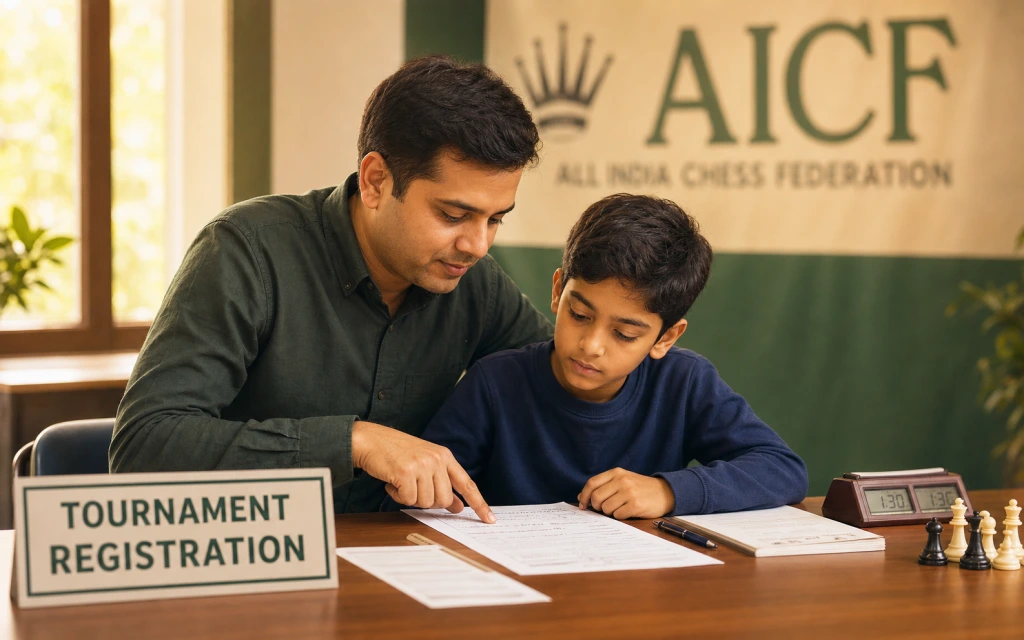
A normal flow:
- Find the circular (state association site, ChessBase India listings, coach groups, school chess teacher).
- Confirm: dates, city, time control, sections, rating status (AICF / FIDE / unrated), entry fee, last date, and refund rules if any.
- Register online or offline as specified; pay the fee; save the confirmation.
- Note reporting time for round one — late arrivals lose games in silent ways.
Popular state and national events fill quickly. Register soon after a circular drops if the field is capped.
Understanding AICF ratings (without mythology)#
AICF ratings use Elo mathematics: you gain points for results above expectation and lose them for results below, relative to opponents’ ratings. FIDE’s international list is a sibling system, not a copy-paste of the national list.
Getting a first rating. Play rated games in a rated event. After the organiser submits results and the federation processes them, an initial rating appears. Processing is administrative; parents often wait on the order of several weeks after an event before the list updates. That wait is not a promise about playing strength.
Rough orientation bands for Indian juniors (descriptive, not official titles):
| Band (approx.) | What you often see over the board |
|---|---|
| ~800–1000 | Knows rules; basic tactics; openings still messy |
| ~1000–1200 | More consistent tactics; some opening habits |
| ~1200–1400 | Can compete seriously at district; building stamina |
| ~1400–1600 | State-level conversations become realistic |
| 1600+ | Strong junior; national fields start to make sense for some |
These bands are coaching heuristics, not AICF law. Two children at 1100 can look completely different if one calculates and the other memorises four moves of the Italian Game.
AICF vs FIDE. Separate lists. A player may hold both. FIDE-rated opportunities are thinner at pure school level and more common as you climb. Numbers often differ between lists; do not panic-compare them without context. Full primer: FIDE rating and Elo for kids.
Improving the number. Rating moves when results against the field move. Practice quality, event selection, and recovery matter more than playing every weekend. See improve your child’s chess rating for training structure without fake timelines.
Time controls: rapid is not classical#
Parents underestimate this. A child who thrives at 15+10 online can freeze at 60+30 over the board.
- Blitz (very short): fun, poor diagnostic for early competitive growth if it becomes the only diet.
- Rapid: common in school and many local opens; teaches pairings without full classical fatigue.
- Classical: standard for serious state and national paths; needs bathroom plans, snack rules, and practice at longer thinking.
Read every circular’s control twice. Our dedicated guide is chess time controls and formats for kids.
Planning a beginner tournament calendar#
First year of events (typical pattern, not a rule):
- First three months: about one event per month while school settles.
- Later non-exam months: one to two events when energy allows.
- Aim for a handful of rated experiences across the year rather than a medal chase every Sunday.
After the first year:
- Keep one to two rated events per month in lighter academic periods if recovery homework is real.
- Include at least a serious attempt at district/state when ready.
- Protect board-exam and major school assessment windows.
Seasonal rhythm many Indian families feel:
- Early calendar months: active before heavy exam blocks in some boards.
- Summer holidays: denser events and camps — also denser burnout risk.
- School reopening: moderate.
- Later year: many district/state peaks — read your state’s actual calendar.
ChessWize coaching (online only) can sit beside this calendar: we run ages 5–15, group sessions from ₹375, two-on-one ₹550, 1:1 ₹1,000, starter pack ₹2,500 for 8 classes, batches max six, free 30-minute demo, refund on unused classes under plan terms. Details: courses, coaches on coaches, comparisons on compare. City context pages such as Delhi NCR online classes and Chennai explain the same online model for local families — still no ChessWize hall.
Deep dive: how I prepare a first-time rated player (coach method)#
When a family says “first AICF-rated open next month,” I do not start with a flashy new opening. I run a practical four-part prep that fits school kids who still have homework, cricket, and grandparents’ birthdays.
Part 1 — Paper before pieces. We print or save the circular and highlight five lines: section (U-9? open?), time control, reporting time, what to bring, and whether the event is rated. I make the child read the time control aloud. If they cannot say how much time they get for the game, they are not ready for the hall yet — they are ready for a conversation. Parents handle payment and AICF ID; the child handles knowing when round one starts. This split prevents the classic scene where the adult is arguing at the control desk while the child has no board sense of the day.
Part 2 — One opening file, not a library. For a first rated event I want two White setups the child has played in practice games and one Black response to 1.e4 and 1.d4 that reach playable middlegames without ten forcing lines of theory. We spend sessions on development, castling timing, and what to do when the opponent leaves the book on move five — which is most of junior chess. If the child loves the London System and already plays it online, we deepen that, not switch to a Najdorf crash course. New openings in the final week before a debut are how you manufacture time trouble.
Part 3 — Tactics with a Swiss flavour. Puzzle work stays on pins, forks, skewers, back-rank themes, and loose pieces. I mix in “find the safe move” positions, not only mate flashcards. We also play practice games near the event control (if it is 25+10, stop living on 3|2 blitz). Online platforms add volume; OTB clocks help when notation is required.
Part 4 — Hall habits and emotional script. We rehearse: arrive early, find pairings, set light-right, call the arbiter for disputes, keep greetings polite. After a loss: bathroom, water, one sentence, no engine autopsy until the day ends. Parents get their script: no coaching from the ropes, no rating lectures between rounds, food that survives round four.
Between rounds of the real event. If I am coaching remotely that weekend, I may review a finished game after the day — not during — unless the family has arranged a planned check-in that respects arbiter rules. Most improvement from a debut open comes on the Monday after: we pick the single worst recurring error (for example, moving the same piece three times in the opening) and build one week of homework around it. That is how tournaments feed training, instead of becoming expensive entertainment.
What I refuse to do. I will not promise a rating number after one Swiss, or claim coaching alone “produces” a state medal on a fixed calendar. I will promise a clear prep plan, honest game review, and a sustainable calendar. A last-place finish with scoresheets and appetite for round five still counts as education; a medal followed by a child refusing the next event after parental blow-ups is a failed weekend.
The same method works online or offline: circular literacy, narrow openings, relevant tactics, hall behaviour. The federation runs the event; the coach runs preparation.
Expert tips for parents in the tournament hall#
-
Pack like a second arbiter. Water, light snacks allowed by rules, spare pencil if notation is required, AICF ID copy, and a sweater — halls are often over-air-conditioned. A hungry child blunders more than a slightly under-prepared one.
-
Protect sleep over last-minute opening videos. The night before, no crash courses. A rested nervous system calculates better than a tired brain full of half-remembered traps.
-
Debrief with one lesson, not twenty. After the event, choose a single theme for the next fortnight of practice. Stacking ten fixes teaches despair.
-
Respect the arbiter and the pairings. Teach your child to raise a hand for help. Parent-side arguments rarely improve the result and model the wrong sport.
-
Keep online practice clean between events. Use Chess.com or Lichess for puzzles and longer games; cut pure bullet binges that undo classical patience. Coaching homework should match the next circular’s control when possible.
Common beginner mistakes#
Skipping district for state. The gap in tactics, speed of play, and emotional pressure is large. Play several lower-rung events first.
Ignoring the circular’s rating status. Families travel for “rated” events that are unrated, or miss FIDE opportunities by not reading footnotes.
Over-scheduling. Weekly tournaments without recovery produce flat games and school conflict. One to two per month is plenty for most beginners.
Only blitz online before classical OTB. Transfer fails. Schedule longer practice games.
Parent coaching from the gallery. Illegal in spirit and often in letter; more importantly, it blocks the child from learning independence.
Treating one bad Swiss as destiny. Rating lists move slowly; one event is a sample, not a sentence. The wider tournament pathway hub helps keep perspective.
State association variation (what changes when you move cities)#
Active ecosystems (for example Tamil Nadu, Maharashtra, Gujarat, Karnataka, Telangana, Andhra Pradesh, West Bengal) often mean denser calendars and deeper fields. Developing regions may require travel to neighbouring states for rated volume. AICF membership is national in spirit — you can play rated events outside your home state when the circular allows — but state championships and selection rules remain local.
If your district calendar is thin, ask coaches and state sites about nearby opens rather than waiting a year for a single home event. Online coaching can fill training gaps; it cannot invent a local Swiss for you.
How coaching and platforms fit the pathway#
- Live coach: event selection, prep plan, game review, emotional reset.
- Platforms (Chess.com, Lichess): puzzle volume and practice games between rounds of life.
- OTB events: the only full test of clocks, nerves, and rules.
ChessWize reviews tournament games online with the same coach model (no coach rotation in normal programme use), weekly parent WhatsApp notes, and published programme prices above. We do not claim federation authority. For online-vs-offline class logistics, read online vs offline chess classes. For platform practice vs coaching, see ChessWize vs Chess.com for kids.
Frequently Asked Questions#
What is the difference between AICF and FIDE rating?#
AICF rating is India’s national list; FIDE rating is the international list. Both use Elo maths but different game pools. A child can hold both. Many early district events affect only AICF, while stronger state and national events may also be FIDE-rated — always read the circular.
Do I need AICF membership for every tournament?#
For AICF-rated events, yes. Unrated school or club events may not require it. The circular states membership rules, entry fee, and whether the event is rated. Keep your child’s AICF ID and date of birth documents ready before peak registration windows.
How many tournaments does it take to get a first AICF rating?#
Often a single multi-round rated event is enough once the required rated games are completed, but exact processing depends on the event report and federation timelines. After results are submitted, the rating can take several weeks to appear on the list — treat that as administrative time, not a skill promise.
Which tournament should my child play first?#
Choose a nearby school, club, or beginner-friendly open with a clear circular, reasonable entry fee, and an age category that matches your child. Avoid jumping straight into a strong state championship. Our first-tournament guide walks parents through packing, pairings, and etiquette.
How many tournaments per month is healthy?#
For most school-age beginners, one event per month early on, then one to two during lighter academic periods, works better than every weekend. Recovery weeks let you fix one weakness found in the games instead of stacking fatigue on top of homework.
Can online coaching help with AICF tournaments?#
Yes, as preparation and game review between events — not as a substitute for over-the-board experience. ChessWize is live online only (ages 5–15, groups max six, free 30-minute demo) and often reviews tournament PGNs, openings, and time-control practice with the same coach each week.
Back to the parent hub: Chess tournament and rating pathway in India.
See also: First chess tournament guide · FIDE rating and Elo · National and international events · Online chess coaching for kids in India
Hrdyansh Pandey
Day-to-day coach at ChessWize. 7+ years training students aged 5–15 across India, the USA, the UK, Singapore, Australia, and the Middle East. Known for structured, interactive sessions that turn nervous beginners into tournament-ready players.
View FIDE ProfileReferences & Sources
- [01] The All India Chess Federation (AICF) is the national governing body for chess in India and is affiliated with FIDE — en.wikipedia.org/wiki/All_India_Chess_Federation
- [02] FIDE is the international chess federation that oversees world championships, titles, and the global rating list — en.wikipedia.org/wiki/FIDE
- [03] The Elo rating system is a mathematical method used by FIDE and national federations to rate chess players — en.wikipedia.org/wiki/Elo_rating_system
- [04] AICF player registration and related services are accessed through the federation’s online systems (commonly referenced by players via prs.aicf.in) — aicf.in / prs.aicf.in public portals
- [05] ChessBase India regularly publishes Indian tournament circulars, reports, and national event coverage for players and parents — chessbase.in
- [06] The Swiss-system tournament format is widely used in multi-round chess events to pair players with similar scores — en.wikipedia.org/wiki/Swiss-system_tournament