On this page
The complete guide to AICF registration, district-to-national chess tournaments, FIDE Elo ratings, and age categories for kids competing in India.

Day-to-day coach at ChessWize. 7+ years training students aged 5–15 across India, the USA, the UK, Singapore, Australia, and the Middle East. Known for structured, interactive sessions that turn nervous beginners into tournament-ready players.
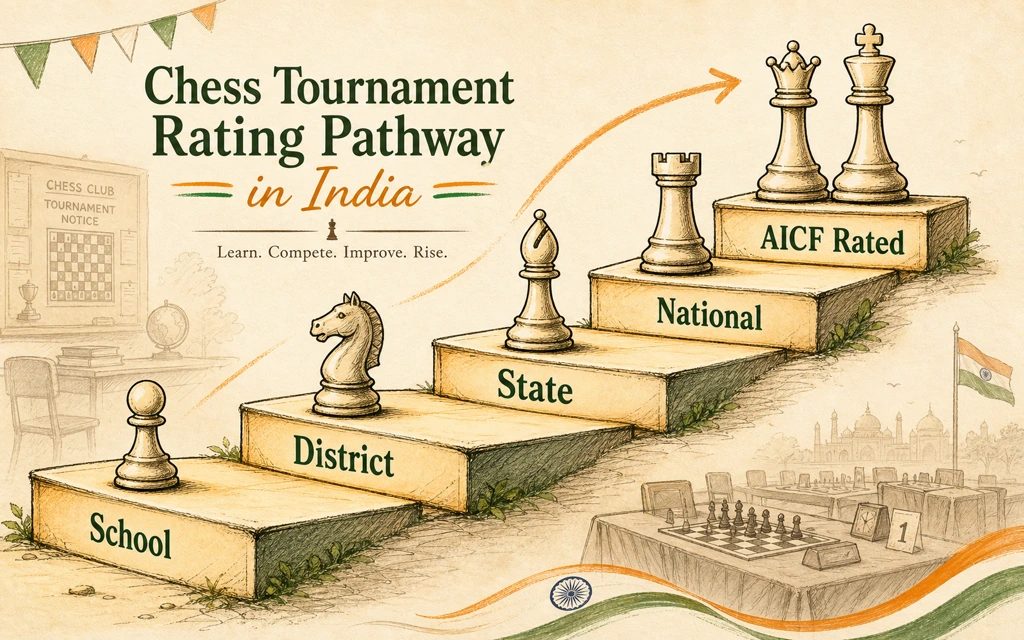
Chess Tournament and Rating Pathway in India#
By Coach Hrdyansh Pandey · Last updated 4 May 2026 · Fact-checked by Coach Tarun Gupta
Your child has been training for months. They can spot forks, execute basic endgames, and play a decent Italian Game. Now they want to compete. The next question from every Indian parent is the same: where do we start, and how does this whole rating thing work?
India has one of the most structured junior chess ecosystems in the world, governed by the All India Chess Federation (AICF) at the national level and FIDE internationally. But navigating it for the first time feels overwhelming — between AICF registration, State Chess Associations, age categories, time controls, and the mechanics of earning an Elo rating, parents rarely get a clear picture from any single source.
This guide fixes that. It walks through the complete pathway from “never competed” to “has a published FIDE rating,” with every step explained in practical terms.
Step 1: AICF Registration — Your Entry Ticket#
Before your child can enter any official chess tournament in India — district, state, or national — they need an active AICF registration. This is non-negotiable.
How to register:
- Visit prs.aicf.in — the AICF Player Registration System.
- Click “Register New” and fill in your child’s details: full name, date of birth, state, contact information.
- Upload a passport-sized photograph and a government-issued age proof (birth certificate or Aadhaar card).
- Pay the annual registration fee — currently approximately ₹300 per year.
- Save the AICF ID number. You will need it for every tournament entry going forward.
The registration is valid for one financial year (April–March) and must be renewed annually. I recommend registering at least two weeks before your child’s first planned tournament — processing delays are rare but do happen, and arriving at a tournament venue without a valid AICF ID means turning around and going home.
Step 2: Understanding Age Categories#
Indian chess tournaments follow FIDE’s international age category system. The categories are based on the player’s age as of 1 January of the tournament year:
| Category | Age on 1 Jan | Typical events |
|---|---|---|
| U-7 | Under 7 years | District, State, National Sub-Junior |
| U-9 | Under 9 years | District, State, National Sub-Junior |
| U-11 | Under 11 years | District, State, National, Asian Youth |
| U-13 | Under 13 years | District, State, National, World Cadets |
| U-15 | Under 15 years | District, State, National, World Youth |
A child born on 15 March 2017 would be 9 years old on 1 January 2026, placing them in the U-11 category (under 11, meaning age 10 and below). This is the key detail parents miss — the cutoff is 1 January of the tournament year, not the tournament date itself.
Most tournaments also offer an “Open” category with no age restrictions. For a child’s first competitive experience, we strongly recommend age-category events — the competition level is calibrated for peers, and the psychological environment is friendlier.
Step 3: The Tournament Pyramid — District to International#
Indian chess competitions follow a clear hierarchy. Here is how it works from the ground up:
District-Level Tournaments#
Your child’s first competitive chess experience. District tournaments are organised by your local District Chess Association, which operates under the State Chess Association.
- Format: Almost universally Swiss tournament system — a pairing method where players with similar scores are matched in each round. A seven-round Swiss event means every player plays seven games regardless of results (unlike knockout formats where a single loss eliminates you). This is significant for beginners: your child gets guaranteed game time even after a first-round loss, and they accumulate experience with every round rather than watching from the sidelines.
- Duration: One or two days, typically on weekends. Single-day rapid events are the most common format for district competitions.
- Entry: Register through the District or State Chess Association. Entry fees range from ₹200 to ₹500. Some events accept walk-in entries on the day, but most require advance registration through WhatsApp groups or email.
- What to expect: 40–100 players, mixed skill levels, tournament hall in a school or community centre. Your child will use a digital clock for the first time, write moves on a paper scoresheet in algebraic notation, and follow the touch-move rule (once you touch a piece, you must move it) which applies strictly in competitive play.
State-Level Championships#
Top finishers from district events qualify for state championships. Each State Chess Association conducts these annually in every age category.
- Format: Swiss tournament, typically 7–9 rounds over 2–3 days.
- Competition: Significantly stronger than district level. Most participants have been training for at least six months.
- Selection: Top performers qualify for national championships. The number of qualifying slots varies by state — larger chess states like Tamil Nadu, Maharashtra, and Karnataka send more players.
National Championships#
The crown events of Indian junior chess. Multiple national-level events exist throughout the year:
- National Schools Championship: Open to students of recognised schools, played under AICF rules.
- National Sub-Junior Championship: For U-7, U-9, and U-11 categories.
- National Under-series: For U-13, U-15, and U-17 categories.
- National Championship (Open/Women’s): For adult categories, but exceptionally strong juniors sometimes participate.
These events are covered by ChessBase India and attract attention from the chess community nationwide. Results at nationals are the primary pathway to international selection.
International Events#
For the strongest junior players, AICF nominates teams for:
- Asian Youth Championship: The regional qualifying event for World Cadets/Youth.
- World Cadets Championship: For players under 8, 10, and 12.
- World Youth Championship: For players under 14, 16, and 18.
- Chess Olympiad (junior divisions): India has been increasingly successful, and exposure to international play begins at the youth level.
We cover the national-to-international pipeline in detail in our national, Asian Youth, and World Cadets guide.
Step 4: Time Controls — Classical, Rapid, and Blitz#
Every competitive chess game has a time control — a clock ticking for each player. Understanding the three standard FIDE formats is essential before your child’s first tournament:
Classical chess — The standard format for serious competition. Each player gets 90 minutes for the entire game plus a 30-second increment added after every move. A single classical game can last 4–5 hours. This is the format used in national championships and most FIDE-rated events in India.
Rapid chess — Faster-paced. Each player gets 15 minutes plus a 10-second increment per move. Games typically last 30–45 minutes. Rapid is the most common format at district-level events because organisers can fit more rounds into a single day.
Blitz chess — The fastest standard format. Each player gets 3 minutes plus a 2-second increment. Blitz requires strong pattern recognition and is not recommended for a child’s first tournament — the pressure of a ticking clock before they are comfortable with scorekeeping and etiquette is counterproductive.
Each format has its own FIDE rating track. Your child can have separate classical, rapid, and blitz ratings — they are published independently on ratings.fide.com. For most Indian junior players, the classical rating is the primary competitive metric.
For a deeper look at how these formats affect preparation, see our guide to chess time controls and formats for kids.
Step 5: How the Elo Rating System Works#
The Elo rating system, developed by physicist Arpad Elo and adopted by FIDE in 1970, assigns every competitive chess player a numerical rating that reflects their playing strength. Here is what parents need to know:
How you earn your first rating:
- Your child plays in FIDE-rated classical tournaments (identified by a “FIDE-rated” designation in the tournament brochure).
- They must complete at least 5 games against opponents who already have a FIDE rating. These games can be spread across multiple tournaments over a period of up to 26 months.
- Their performance across those games must yield a performance rating of at least 1400. Performance rating is calculated based on results against rated opponents — beating a 1500-rated player contributes more than beating a 1200-rated player.
- Once these criteria are met, the FIDE ID is generated automatically by the tournament arbiters, and the rating appears on the next monthly FIDE rating list at ratings.fide.com.
You do not need to apply for a FIDE ID. This is the most common misconception. The tournament’s chief arbiter submits the results to FIDE, and the ID is created as part of that process. If someone tells you to “apply for a FIDE ID first,” they are misinformed.
What the numbers mean:
| Rating range | Approximate level |
|---|---|
| 1000–1200 | Beginner competitor. Knows rules and basic tactics. |
| 1200–1400 | Intermediate. Spots tactical patterns, plays openings with purpose. |
| 1400–1600 | Club player. Solid tactical vision, emerging strategic understanding. |
| 1600–1800 | Strong club player. Can compete seriously at state level. |
| 1800–2000 | Expert. State championship contender. |
| 2000–2200 | Candidate Master territory. National-level competitor. |
| 2200+ | Titled player territory (CM, FM, IM, GM). |
For a detailed explanation of rating mechanics and how K-factor affects junior ratings, see our FIDE rating and Elo for kids guide.
Preparing for the First Tournament: Practical Advice#
Based on coaching dozens of kids through their first tournaments, here is what actually matters:
Before the event:
- Practise with a physical clock at home. Digital chess clocks cost ₹800–₹2,000 on Amazon India. Your child needs to be comfortable hitting the clock after every move without losing concentration.
- Practise scorekeeping. Use algebraic notation to record every move during practice games at home. At the tournament, this is mandatory in classical and rapid formats.
- Read the tournament brochure completely. It lists reporting time, venue address, number of rounds, time control, and entry fee details. Arrive 30 minutes early on Day 1.
During the event:
- Pack snacks, water, and a light jacket (tournament halls are often air-conditioned).
- Parents typically cannot sit near the boards during play. Find the spectator area and resist the urge to watch every move — your anxiety will transfer to your child.
- After each game, the coach (if present) or parent should review the scoresheet with the child. What went well? What was the critical mistake? This post-game analysis is where the real learning happens.
After the event:
- Enter the games into Lichess or Chess.com for computer analysis. The engine will identify moments where your child had a winning position but chose the wrong move.
- Discuss what the child enjoyed and what felt stressful. The emotional experience shapes whether they want to compete again.
For a complete first-tournament checklist, see our first chess tournament for kids in India guide, and for a gentle introduction to the competitive landscape, our AICF tournaments for beginners overview.
Frequently Asked Questions#
Do I need a FIDE ID before entering my child’s first tournament?#
No. Your child needs an AICF registration (via prs.aicf.in), not a FIDE ID. The FIDE ID is generated automatically after the first FIDE-rated event. For non-FIDE-rated district events, only the AICF ID is required.
How often does the FIDE rating list update?#
Monthly. After your child’s first rated event, their rating typically appears within 4–6 weeks on ratings.fide.com.
Can my child play in open tournaments instead of age-group events?#
Yes — most open Swiss tournament events accept all ages. However, for first tournaments, age-group events provide a more appropriate competitive level and reduce the intimidation factor of facing adult opponents.
What if my child loses every game at their first tournament?#
That is completely normal and not a failure. The first tournament is about experience — learning to use a clock under pressure, writing moves neatly on a scoresheet, and handling the emotional swings of competitive play in a hall full of strangers. Most children who compete regularly improve dramatically after their first three or four events, precisely because those early losses teach lessons no practice session can replicate.
How do I find upcoming tournaments near me?#
Check your State Chess Association website, the AICF events calendar, and ChessBase India for announcements. Local WhatsApp groups maintained by district chess associations are often the fastest source of information.
Return to the main hub: Online chess coaching for kids in India.
Hrdyansh Pandey
Day-to-day coach at ChessWize. 7+ years training students aged 5–15 across India, the USA, the UK, Singapore, Australia, and the Middle East. Known for structured, interactive sessions that turn nervous beginners into tournament-ready players.
View FIDE ProfileReferences & Sources
- [01] AICF registration fee approximately ₹300 annually via prs.aicf.in — aicf.in
- [02] First FIDE rating requires minimum 5 games against rated opponents with 1400+ performance — FIDE handbook
- [03] FIDE rating list updates monthly — ratings.fide.com
- [04] Swiss-system tournament pairing used in 95%+ of Indian chess events — AICF tournament regulations