
Your Child's First Chess Tournament in India
What parents need for a first kids chess tournament in India: AICF steps, Swiss format, age categories, pack list, nerves, and a coach's prep method.

Day-to-day coach at ChessWize. 7+ years training students aged 5–15 across India, the USA, the UK, Singapore, Australia, and the Middle East. Known for structured, interactive sessions that turn nervous beginners into tournament-ready players.
On this page
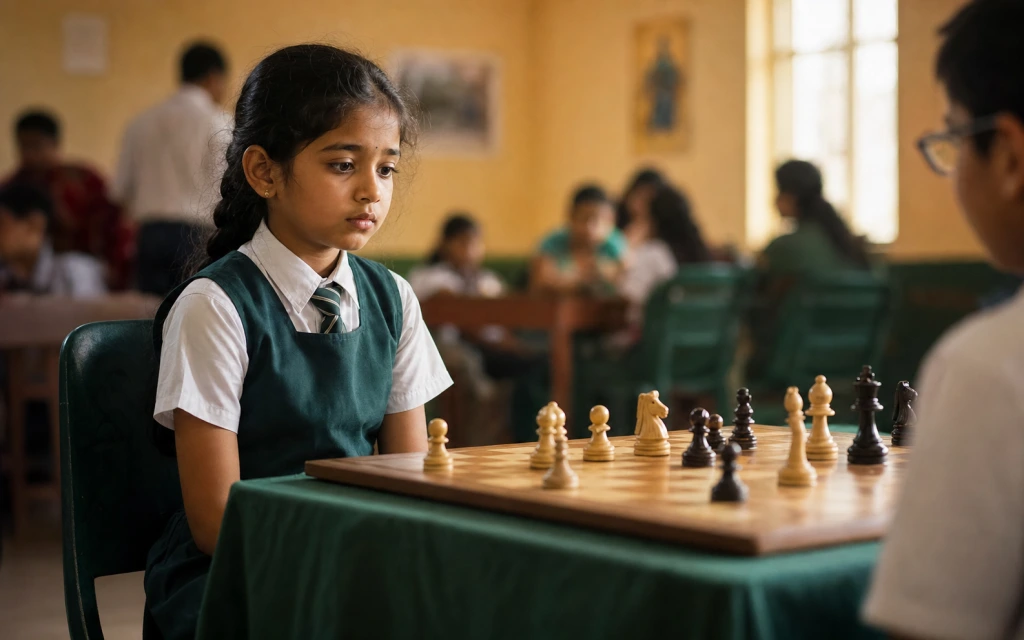
A child’s first chess tournament in India is usually a local or district Swiss event in an age category (U-7, U-9, or U-11), not a national championship. You register from the event circular, bring ID and a pen, leave the hall when the round starts, and treat the weekend as practice under real clocks—not a career verdict.
I coach children aged 5–15 for tournament preparation as well as weekly class work. Parents from cities such as Mumbai, Bengaluru, and Delhi NCR ask the same practical questions: where do events appear, what does Swiss pairing mean, what goes in the bag, and how do we handle a first-round loss without spoiling the rest of the day. This guide answers those in order.
ChessWize is online-only coaching—we do not run a physical centre—so the tournament hall you enter will be organised by a school, club, district association, or state body. Coaching and competition are separate products; good coaching still makes the first event less chaotic.
Why do a first tournament at all?#
Direct answer: A first event turns home practice into public play with clocks, pairings, and silence rules. The child learns tournament etiquette and recovers from wins and losses in the same afternoon—skills that pure homework never teaches.
Parents sometimes wait for a “perfect” rating or a polished opening repertoire. That delay is rarely useful. The useful readiness checklist is simpler:
- Knows all legal moves, including castling, en passant, and promotion (chess rules for kids).
- Can set the board correctly every time (board setup and notation).
- Can play a full game without collapsing after one mistake.
- Can sit still for the length of a rapid game with short breaks.
- Accepts that parents wait outside the hall.
If those are mostly true, a gentle local event is appropriate. If the child still needs constant rule reminders, stay with practice games and classes a little longer. For how coaching fits beside events, see online chess coaching for kids in India and the courses overview.
Where do Indian parents find kids’ tournaments?#
Direct answer: Use your state chess association notices, the ChessBase India calendar and reports, school circulars, local clubs, and your coach’s recommendations. Prefer nearby events with an age category and a rapid or classical control—not open blitz on day one.
The All India Chess Federation (AICF) is India’s national chess body and a member federation of FIDE. Most serious junior events follow AICF or state-association procedures. That does not mean every school event is rated—always read the circular.
Practical sources I point parents to:
- State chess association websites — entry forms, membership rules, and district calendars.
- ChessBase India — widely used calendar and post-event reporting; good for spotting local open juniors.
- School chess clubs and CBSE / inter-school circuits — softer entry points, sometimes unrated.
- Your coach — coaches who prepare students for events usually know which local Swiss is kinder for first-timers.
For the first tournament, prefer:
| Prefer | Avoid for a first event |
|---|---|
| Local or district event | Distant state or national championship |
| Age section (U-7 / U-9 / U-11) | Open section full of older teens and adults |
| Rapid or slow classical | Bullet or pure blitz as the main format |
| Driving distance, one venue | Multi-city travel on top of nerves |
| Clear circular (rounds, fees, contact) | Vague WhatsApp forwards with no organiser name |
If you want the full pathway after the first event—district, state, national—read AICF tournaments for beginners and the tournament and rating pathway hub.
What age category should we enter?#
Direct answer: Enter the official age category printed on the circular (for example U-9 if your child is under that cutoff). Do not “play up” into Open for a first event. Cutoff dates differ by event; many AICF-linked events use a 1 January-style year cutoff, but the circular always wins.
Standard junior bands you will see:
- U-7, U-9, U-11 — most common first-event bands.
- U-13, U-15, U-17 — older juniors and stronger fields.
- Open — mixed ages and adults; fine later, poor first experience for most young children.
Age is calculated from the event’s rules, not from “how old they feel.” Bring a birth certificate or school ID if the organiser asks. Wrong-category registration creates administrative stress your child does not need.
How does the Swiss format work for kids?#
Direct answer: In a Swiss-system tournament, nobody is eliminated. After each round, players with similar scores are paired. A child who loses round 1 still plays every remaining round and can still finish the weekend with a solid score.
That single fact calms more families than any pep talk.
How a typical junior Swiss runs:
- Round 1 pairings come from rating, random seed, or a published list.
- After results, the software (or arbiter list) pairs similar scores.
- Colour balance (White/Black) is considered where possible.
- Scoring is usually 1 for a win, ½ for a draw, 0 for a loss.
- After the last round, highest score ranks first; ties use tiebreaks.
Why this helps first-timers: A loss early does not send the child home. The job becomes “play the next game cleanly,” not “survive an elimination bracket.”
Weekend shape: Many local events run 5–7 rounds over one or two days, often with 3–4 rounds on a long Saturday. Pairings appear on a board or screen 10–15 minutes before the round. Teach your child to find their name, board number, and colour without panicking.
Tiebreaks parents hear about: Buchholz (sum of opponents’ scores), Sonneborn-Berger, and direct encounter. Your child does not need to calculate them. You only need to know that equal points can still produce different ranks.
Byes: Some circulars allow a half-point bye requested in advance (school exam, travel). Do not invent a bye on the day without speaking to the arbiter. Full withdrawals after start affect pairings for others—tell the organiser promptly if you must leave.
For how time modes differ, use chess time controls and formats for kids. Rapid is usually the kinder first format; classical is longer and more tiring.
AICF membership, IDs, and rated vs unrated events#
Direct answer: Unrated school events need little beyond the entry form. Rated events usually need AICF and sometimes state association membership, completed before the first round. Exact fees and portals change; follow the circular and your state association’s current instructions.
Parents mix three different numbers:
- Tournament entry fee — paid to that event.
- AICF membership — annual national registration when required for rated play (often discussed in the low hundreds of rupees per year; confirm the live figure on the official process).
- State association membership — required in many states for rated junior events.
Bring printed or digital proof on the day. Photograph confirmation emails. If the circular lists an AICF ID field and your child has none yet, complete registration early—do not wait until Saturday morning at the venue.
Rated play connects later to published lists and, for some players, to FIDE rating and Elo. FIDE player pages live on ratings.fide.com. A first local Swiss is still mostly about experience, not a number.
What to pack for tournament day#
Direct answer: Pack organiser requirements first (ID, membership proof, entry slip), then a pen for notation, water, light snacks, a quiet waiting activity, and a light jacket. Leave phones silent; children should not handle devices in the hall.
Essentials
- Photo ID / birth proof if requested
- AICF / state membership proof when the event is rated
- Pens that write reliably (notation)
- Water bottle
- Light snacks (fruit, nuts, sandwich)—not a heavy restaurant meal every break
- The circular or pairing WhatsApp QR if the organiser uses one
Strongly useful
- Small physical set for calm warm-up away from the hall
- Notebook for a one-line post-game note (“hung a queen on move 12”)
- Jacket—halls are often cold under AC
- Parent phone charger and a book for the waiting area
Leave out
- Electronic devices for the child during rounds
- Loud toys
- Coaching notes with engine lines you plan to whisper between rounds
Notation is required in many classical and some longer rapid events. Even when not required, I like children to write moves in a first rated event if they can manage it. It creates a record for the post-event review with their coach. If notation is new, practise it at home from our notation guide before the weekend, and print a blank scoresheet.
Tournament day: minute-by-minute expectations#
Direct answer: Arrive early, settle logistics, find the board, leave the hall, stay out of the game, and help the child reset between rounds without post-mortems or phone engines.
Before round 1
- Aim for 30–45 minutes early (I prefer closer to 45 for first events).
- Confirm registration desk, fee receipt, and any ID check.
- Find pairings: table number, opponent name, colour.
- Walk to the table together. Check light square on the right nearest each player’s right hand—basic FIDE Laws of Chess board orientation.
- Short instruction only: play your normal game, press the clock, call the arbiter if something is unclear, enjoy the day.
- Parent exits the hall.
During the round
- Parents wait in the designated area. Entering to “just fix something” is not allowed once play starts.
- Do not send signals through the glass.
- Do not live-analyse on your phone for the child.
Between rounds
- Food, water, toilet, short walk.
- If they lost: acknowledge feelings, no deep analysis (“That was hard. We’ll look with coach later.”).
- If they won: brief praise, then reset—over-celebration before round 5 is still a parent problem I see weekly.
- No opening “downloads” from an engine.
After the last round
- Collect any certificates if the organiser distributes them on site.
- Thank the child for completing the event—finishing all rounds is itself a success metric for a first tournament.
- Schedule a calm game review with the coach within a day or two, not a heated talk in the car park.
How I prepare a student for their first Swiss weekend#
Direct answer: In the two weeks before a first event I stop adding heavy theory, rehearse the full tournament routine at home, fix three non-negotiable habits (board setup, clock, asking the arbiter), and agree a parent script for losses. The goal is a child who can finish the schedule with dignity, not a forced podium.
This is the method I walk parents through on WhatsApp after they book a date. I use the same sequence in live online sessions for ages 5–15 when a family aims at a first local Swiss—not a medal claim, and not a promised rating jump.
Week minus two: readiness check, not a crash course. We play one full game at the expected time control (shared digital board in class, or a physical set and phone timer at home). I watch four things only: rules accuracy, board orientation, whether they rush after a capture, and whether they collapse after hanging a piece. If rules still fail under mild pressure, I tell the parent the event should wait. If rules are fine but nerves are high, we still go—nerves are normal—but we plan recovery language. I do not introduce a brand-new opening; children cling to novelty under stress. We keep whatever they already know—often a simple king-pawn or queen-pawn start—and emphasise development and king safety. Tactics stay light: one pin or fork from tactics training, not a hundred random puzzles the night before.
Week minus one: the mock tournament hour. At the end of a lesson or at home we run a short ritual: child sets the board alone; we start a clock with the real control from the circular (for example 15+10); the child writes moves if notation will be required; mid-game I create one problem (“flag is low—what do you do?” or an illegal-move claim) so they practise calling for help; after the game they say one sentence about what went well and what felt hard. Parents rehearse their lines in the same session. Allowed after a loss: “I saw you kept playing. We’ll talk with coach later.” Banned: “Why did you play that?”, “I told you about the queen,” and any engine screenshot.
Two days out: logistics drill. We practise finding name, colour, and table on a pairing list. We pack the bag once as a dry run and set travel time with margin—whether that is a long Hyderabad cross-town drive or a short walk to a school hall. Membership printouts go in the bag early. Children sleep better when the bag is already done.
Around the event, not inside the hall. Arbiters run the room; I am not a parent substitute at the rope. If families message between rounds, I answer parents only for process—hydration, bye rules, withdrawal etiquette—never move ideas. After the event we open scoresheets in the next class, pick one recurring theme (king left in the centre, or weak f7), and one task for home practice. That turns the weekend into training data. I do not promise a score or claim a fixed pack of classes makes a child “tournament ready” on a calendar date. Readiness is a checklist. Families wanting lessons can take ChessWize’s free 30-minute demo, then choose group (₹375), two-on-one (₹550), or 1:1 (₹1,000)—entry fees stay separate.
Managing first-tournament nerves#
Direct answer: Expect poor sleep the night before and butterflies in round 1. Reduce novelty with a mock routine, arrive early, set a process goal (“finish all rounds”), and celebrate effort after the last game regardless of score.
Common signs: stomach discomfort, clinginess at the hall door, rushed first ten moves. Useful responses:
- Frame the day as “learning how tournaments work.”
- Practise clock + notation at home so the tools are familiar.
- Avoid comparing scores with classmates in the waiting area.
- Name famous players only carefully—Viswanathan Anand’s long career includes many losses; the point is that strong players keep playing, not that your child must become a professional.
If anxiety is extreme (panic, repeated refusal, physical distress), it is acceptable to withdraw kindly and try a smaller school event later. Forcing a melting child through five rounds teaches the wrong lesson.
Realistic costs parents should budget#
Direct answer: Local junior events are usually modest per weekend; memberships are annual; travel and food often exceed the entry fee. Coaching fees are separate and depend on format.
Per event (indicative local ranges parents commonly see—confirm each circular):
- Entry fee: often roughly ₹300–₹1,000 locally; higher for larger state events
- Food and local transport: often ₹200–₹500+ for a long day
- Travel/hotel: only if the venue is out of town
Annual side costs when playing rated events:
- AICF membership and state membership where required (check current official amounts)
- Optional set/clock at home for practice (venues usually provide equipment)
If a child plays a handful of local events in a year, many families land in a broad band of several thousand rupees for pure tournament expenses—before coaching. That is a planning figure, not a quote.
ChessWize coaching, if you use it, is priced separately on the courses page: group sessions from ₹375, two-on-one ₹550, 1:1 ₹1,000 per session, with a starter pack at ₹2,500 for 8 classes, a free 30-minute demo, and refunds on unused classes under plan terms. Compare formats on group vs private classes or the site compare page when you are weighing options—not as a requirement to enter a school Swiss.
After the tournament: review, rating lists, next steps#
Direct answer: Rest the same evening, review games with the coach within a couple of days, and only then decide the next event. If the tournament was rated, allow administrative time for the result to appear on the relevant list.
Game review
Scoresheets are gold. In the next lesson we walk through critical moments, especially tactics missed and openings that left the king unsafe. Focus on decisions, not character attacks. Link patterns back to weekly work on tactics and simple endgames later.
Rating appearance
For rated events, published updates follow organiser reporting and federation schedules. It is normal to wait on the order of several weeks (often discussed as roughly four to six weeks) before a first rating or rating change shows. That is an administrative timeline, not a skill promise. Details sit in FIDE rating and Elo for kids and the rating pathway hub.
Choosing the next event
If the child wants another tournament, pick a similar level soon enough that memories stay useful, without stacking three weekends in a row. Burnout is real in junior chess. One thoughtful event per stretch of training usually beats a stampede.
Expert tips from live tournament prep coaching#
These are habits I actually use with families on the tournament track—not slogans.
- Write the parent script before round 1. Agree the exact sentences you will use after a loss. When emotions spike, scripts beat improvisation.
- Train the arbiter ask. Role-play: “Excuse me, I need help with the clock.” Children who can ask for help stop illegal-move arguments from turning into tears.
- One tactical theme, not twenty. The week before, keep tactics narrow (for example forks on royal pieces). Scattered puzzle marathons raise anxiety without raising clarity.
- Protect sleep like it is part of the entry fee. A tired child blunders pieces they “know.” Travel the night before if the venue is far; do not discover the route at 7 a.m.
- Review on paper, not in the car. The car park post-mortem is where confidence goes to die. Book the review into the next coaching slot with a named coach from the coaches roster.
How coaching and first events fit together#
Tournament play does not replace coaching, and coaching is not a substitute for sitting at a real board under an arbiter. Families who do both usually use weekly live lessons for habits and occasional Swiss events for application. ChessWize sessions are live online with the same coach model, small groups capped at six or private formats, ages 5–15, English or Hindi as arranged, and weekly parent WhatsApp notes—see how online chess classes work and how to pick a chess coach. Public parent ratings for ChessWize stand at 5.0 on Google from 21 reviews as of our published trust copy; still judge any academy by a demo you watch yourself.
If you are still choosing between platforms and live coaches, sibling articles such as ChessKid vs live coaching and online vs offline chess classes separate products cleanly. None of them require inventing a ChessWize hall in your city—we remain online-only.
Frequently Asked Questions#
How do I register for a chess tournament in India?#
Find events through your state chess association site, the ChessBase India calendar, or your child’s coach. Register online when the circular opens, pay the entry fee (often roughly ₹300–₹1,000 for local junior events), and complete any AICF or state membership steps the circular requires before the first round.
What format do kids chess tournaments use?#
Most junior events in India use a Swiss-system of 5–7 rounds. Everyone plays every round; winners meet winners on score. Age sections such as U-7, U-9, and U-11 keep opposition roughly age-matched. Rapid time controls are common for first events; classical appears more at district and state level.
How old should a child be for a first tournament?#
Many children try a school or club event around age 6–7 once they know the full rules and can finish a complete game without constant adult help. AICF-rated open junior events are often more comfortable from about age 7–8. Readiness is about rules, notation basics, and emotional recovery after a loss—not age alone.
Do parents stay in the playing hall?#
No. In organised AICF-style events, parents wait outside the hall once the round starts. That is normal and enforced. Help your child find the table, check the light square is on the right, settle them, then leave. Coaching or engine tips between rounds is not allowed.
Will my child get a rating after the first event?#
Only if the event is officially rated and your child meets the federation’s conditions for a published rating. Results are processed after the tournament; a first published rating can appear on the relevant list within roughly four to six weeks, depending on how the organiser and federation schedule the report. Unrated school events give experience only.
What should we practise in the week before the first tournament?#
Keep it light: board setup and notation, clock handling, a few quiet full games at the planned time control, and one calm conversation about winning, losing, and asking the arbiter for help. Skip heavy new openings. Sleep and simple routines matter more than last-minute theory.
Back to the pathway hub: Chess tournament and rating pathway in India.
See also: AICF tournaments for beginners · FIDE rating and Elo for kids · Chess time controls for kids.
Return to: Online chess coaching for kids in India.
Hrdyansh Pandey
Day-to-day coach at ChessWize. 7+ years training students aged 5–15 across India, the USA, the UK, Singapore, Australia, and the Middle East. Known for structured, interactive sessions that turn nervous beginners into tournament-ready players.
View FIDE ProfileReferences & Sources
- [01] AICF is the national federation for chess in India and a FIDE member federation — https://en.wikipedia.org/wiki/All_India_Chess_Federation, 2026
- [02] Swiss-system tournaments pair players with similar scores each round without eliminating anyone — https://en.wikipedia.org/wiki/Swiss-system_tournament, 2026
- [03] FIDE publishes the Laws of Chess that govern board setup, clocks, illegal moves, and arbiter authority — https://handbook.fide.com/chapter/E012023, 2023
- [04] FIDE ratings and player profiles are publicly searchable for titled and rated players worldwide — https://ratings.fide.com/, 2026
- [05] ChessBase India publishes tournament calendars, reports, and registration pointers used widely by Indian parents — https://chessbase.in/, 2026
- [06] FIDE defines classical, rapid, and blitz categories used in most junior event circulars — https://en.wikipedia.org/wiki/Fast_chess, 2026