
Best Chess Openings for Kids: A Level-by-Level Guide
Which chess openings should your child learn first? Italian Game, London System, Sicilian, and more, by skill level, with principles over memorisation.

Day-to-day coach at ChessWize. 7+ years training students aged 5–15 across India, the USA, the UK, Singapore, Australia, and the Middle East. Known for structured, interactive sessions that turn nervous beginners into tournament-ready players.
On this page
Parents and students ask me this question constantly: “Which openings should my child learn?” My answer surprises most people: for beginners, the specific opening matters far less than the principles behind it.
I have seen children memorise 15 moves of the Sicilian Defense and then blunder a piece on move 16 because they never learned why those moves were played. I have also seen children who know only 3–4 moves of the Italian Game play excellent chess because they understand centre control, piece development, and king safety.
That said, openings do matter — and choosing age-appropriate openings makes learning faster and more enjoyable. Here is my level-by-level guide based on years of coaching experience.
Before Openings: The Three Principles#
Before your child memorises a single opening move, make sure they understand these three principles. Every good opening follows them, and every bad opening violates them:
-
Control the centre. Place pawns and pieces on squares that control e4, d4, e5, and d5. The centre of the board is where the action is — pieces on central squares influence the most squares and can move to either side of the board quickly. Practise this concept on Lichess with centre-control exercises.
-
Develop your pieces. Get Knights and Bishops off the back rank and into the game early. Each developed piece is a soldier in the fight — a piece sitting on its starting square is useless. The general rule: Knights before Bishops, develop toward the centre, and avoid moving the same piece twice in the opening unless necessary.
-
Get your King safe. Castle early. The King is vulnerable in the centre of the board, where files can open and attacks can come from multiple directions. Castling tucks the King into a corner behind a wall of pawns and activates a Rook — two benefits in one move.
If your child follows these three principles, they will play a reasonable opening regardless of what specific moves they choose. The principles are the foundation; the openings are the furniture.
Beginner Level (Unrated to 800 Elo)#
At this stage, your child should learn one opening as White and one response as Black. Keep it simple.
As White: The Italian Game#
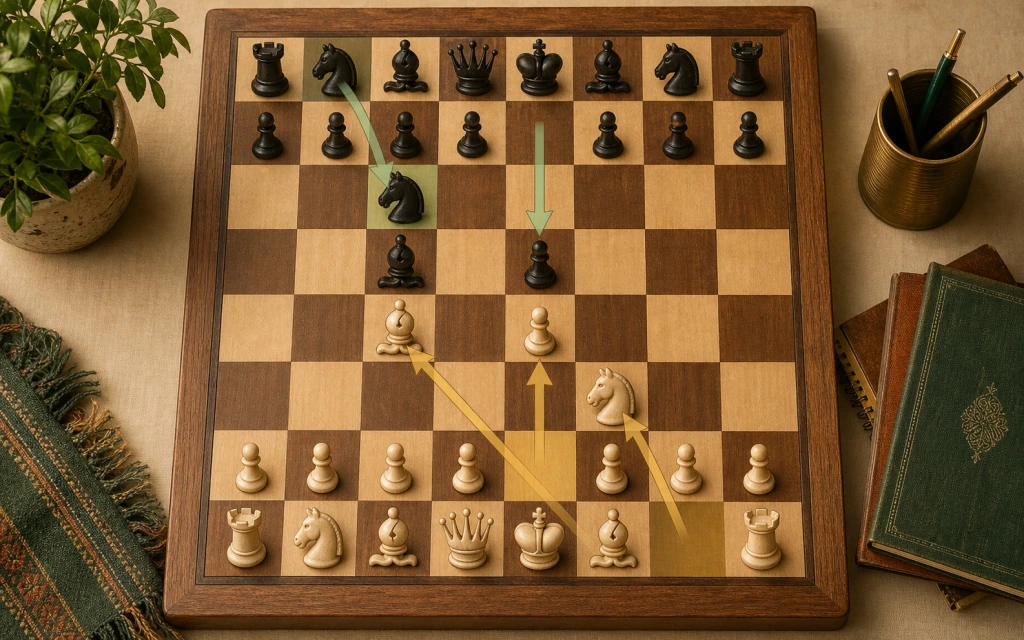
Moves: 1.e4 e5 2.Nf3 Nc6 3.Bc4
The Italian Game is the best first opening for children because every move illustrates a principle:
- 1.e4 — controls the centre with a pawn
- 2.Nf3 — develops a Knight and attacks the e5 pawn
- 3.Bc4 — develops the Bishop to an active diagonal, targeting the f7 square (the weakest point in Black’s position)
After these three moves, White has followed all three principles: centre control, development, and preparation for castling (Kingside castle is possible on the next move).
Why I recommend it: The Italian Game teaches kids to think about squares, not just pieces. They learn that Bc4 is not just “moving the Bishop” — it is aiming at a specific target (f7) and controlling important diagonal squares. This kind of purposeful thinking transfers to every position in chess.
Common traps to know: The Scholar’s Mate attempt (Bc4 + Qf3/Qh5 targeting f7) is popular among beginners. Your child should know both how to attempt it and — more importantly — how to defend against it.
As Black: The Symmetric Response (1.e4 e5)#
For beginners, simply playing 1…e5 in response to 1.e4 is sufficient. This leads to Open Game positions where both sides develop naturally, and tactical opportunities arise from piece interaction rather than positional complexity. After 1.e4 e5, Black follows the same principles: develop Knights (Nf6, Nc6), develop Bishops, and castle early.
If the opponent plays 1.d4, respond with 1…d5. At the beginner level, symmetrical responses are perfectly adequate because the games are decided by tactics and blunders, not opening theory.
Intermediate Level (800–1400 Elo)#
At this stage, your child should expand their opening knowledge to 2–3 options as each colour and begin understanding the strategic ideas behind each opening.
As White: Expanding the Repertoire#
The Ruy Lopez (1.e4 e5 2.Nf3 Nc6 3.Bb5): The “King of Openings” and the most played opening at every level. Instead of Bc4 (Italian), the Bishop goes to b5, putting pressure on the Knight that defends the e5 pawn. This opening teaches positional concepts — pawn structures, Bishop pair advantages, and long-term strategic planning. I introduce the Ruy Lopez when students reach approximately 1000 Elo.
The Queen’s Gambit (1.d4 d5 2.c4): An excellent second opening system. White offers a pawn (c4) to gain central control. The Queen’s Gambit teaches children that chess is not just about moving pieces forward — it is about space, pawn structure, and strategic initiative. Most Indian children recognise the name from the Netflix series, which helps with engagement.
As Black: Building Defences#
The French Defense (1.e4 e6): A solid, structured defence that teaches pawn chain concepts. After 1.e4 e6 2.d4 d5, Black creates a clear pawn structure with strengths and weaknesses. The French teaches children about the “bad Bishop” (the light-squared Bishop gets blocked by the e6 pawn) and gives them their first experience with positional decision-making — should they try to free the Bishop or accept a slightly passive position for the sake of solidity? I recommend the French for children who enjoy strategic, slower games and have the patience to build positions gradually.
The Caro-Kann (1.e4 c6): Similar to the French but avoids the locked-in light-squared Bishop problem. After 1.e4 c6 2.d4 d5, Black develops solidly with the Bishop free to develop to f5 or g4. The Caro-Kann is popular among Indian players — Viswanathan Anand played it regularly at the highest level, which makes it aspirational for young Indian students. The positions tend to be less sharp than the Sicilian, making it a good choice for children who prefer stability and clear plans over tactical chaos.
The Scandinavian (1.e4 d5): An immediate challenge to White’s centre. After 1.e4 d5 2.exd5 Qxd5, Black’s Queen develops early (normally a bad idea, but the Scandinavian makes it work because White must spend time attacking the Queen, giving Black development tempi). I recommend this for children who enjoy active, aggressive play and do not mind the unusual Queen development. The Scandinavian teaches children that chess rules have exceptions — sometimes violating a principle is the right decision if you understand why.
Common Opening Traps Every Child Should Know#
Before your child enters their first tournament, they should recognise these traps — both to attempt them and to avoid falling into them:
Scholar’s Mate (4-move checkmate). 1.e4 e5 2.Bc4 Nc6 3.Qf3 (or Qh5) Nd4?? 4.Qxf7#. This is the most common checkmate among absolute beginners. Your child should know how to defend against it (develop the Knight to f6, which blocks both Qf3 and Qh5 threats) and should not attempt it in serious games because it violates opening principles (early Queen development) and fails against any opponent who knows the defence.
Legal’s Mate. A beautiful trap in the Italian Game where White sacrifices the Queen to deliver checkmate with minor pieces. After 1.e4 e5 2.Nf3 d6 3.Bc4 Bg4 4.Nc3 g6 5.Nxe5 Bxd1?? 6.Bxf7+ Ke7 7.Nd5#. Teaching this trap helps children understand that capturing the Queen is not always the best move — a valuable lesson about board vision.
Fishing Pole Trap. In the Ruy Lopez, after 1.e4 e5 2.Nf3 Nc6 3.Bb5 Nf6 4.0-0 Ng4, Black threatens to sacrifice on h2 for a mating attack. This trap teaches children about the danger of ignoring opponent threats after castling.
Fried Liver Attack. After 1.e4 e5 2.Nf3 Nc6 3.Bc4 Nf6 4.Ng5, White attacks the f7 square with two pieces. If Black plays 4…d5 5.exd5 Nxd5?? 6.Nxf7 — the Knight sacrifice on f7 leads to a devastating attack. This is one of the most exciting tactical sequences in beginner chess, and understanding it deeply improves both attacking and defensive skills.
Advanced Level (1400+ Elo)#
At this stage, opening study becomes more systematic. Your child should understand multiple variations within their chosen openings, study typical middlegame plans that arise from each opening, and begin building a personal repertoire based on their playing style. The key difference at this level: your child should understand not just what to play, but what plans to follow in the resulting middlegame.
As White: Depth Over Breadth#
The Ruy Lopez and Queen’s Gambit remain excellent choices. Add:
The Italian Game — Giuoco Piano and Evans Gambit lines: Revisiting the Italian Game at a higher level reveals deep strategic and tactical ideas. The Evans Gambit (3.Bc4 Bc5 4.b4) is particularly exciting for aggressive players — White sacrifices a pawn for rapid development and a strong centre. Evans Gambit games are rich in tactical motifs and teach children about the practical value of initiative versus material.
London System (1.d4 d5 2.Bf4). While not as principled as the Queen’s Gambit, the London System is a practical choice for children who want a reliable, low-theory opening. White develops the dark-squared Bishop before playing e3, creating a solid formation that is easy to set up and difficult for opponents to disrupt. The London is particularly useful in rapid and blitz tournament games where preparation time is limited.
As Black: The Sicilian#
The Sicilian Defense (1.e4 c5): The most popular response to 1.e4 at all levels above 1400. The Sicilian creates asymmetrical positions with tactical complexity — exactly what strong players want. I typically introduce the Sicilian around 1200–1400 Elo because the positions require tactical maturity and a solid understanding of piece coordination.
The Sicilian has many variations (Najdorf, Dragon, Scheveningen, Alapin). For kids entering this level, I recommend the Classical Sicilian or the Accelerated Dragon as starting points because their plans are clearer than the theoretically dense Najdorf. The Dragon variation is particularly popular with children because the fianchettoed Bishop on g7 creates exciting attacking possibilities, and the name itself captures their imagination.
How Many Openings Should a Child Know?#
Beginners: 1 opening as White, 1 response as Black. That is it.
Intermediate: 2 openings as White (one with 1.e4, one with 1.d4), 2–3 defences as Black.
Advanced: 2–3 complete systems with multiple variations and middlegame plans.
The most common mistake I see in Indian chess education is parents pushing their children to learn too many openings too early. A child rated 700 does not need to know the Najdorf Sicilian. They need to know the Italian Game well enough to reach a comfortable middlegame — and then they need to work on tactics.
The Opening Study Rule#
Here is the rule I use with all my students: spend no more than 20% of your chess study time on openings. The remaining 80% should go to tactics (puzzles), endgames, and game analysis. Study your openings on Chess.com or ChessBase India resources, but do not let opening preparation become a substitute for improving your actual chess skills.
What this looks like in practice for a child who studies chess for 1 hour per day:
- 10–12 minutes on opening review (reviewing a few key positions, learning one new variation per week)
- 20–25 minutes on tactical puzzles (the most important daily activity for improvement)
- 10–15 minutes on endgame practice (fundamental checkmates, pawn endgames, basic techniques)
- 15–20 minutes on game analysis (reviewing their own recent games with a coach or engine)
An 800-rated player who knows 20 moves of the Sicilian Najdorf and cannot solve basic tactical puzzles is wasting their time. An 800-rated player who knows 4 moves of the Italian Game and solves 30 puzzles per day will improve much faster. The puzzles build the tactical vision that makes openings work — without tactical ability, even the best opening preparation collapses when the opponent plays something unexpected.
The exception to this rule is immediately before a tournament. In the 2–3 days before competition, your child should review their main opening lines and prepare responses to the most common opponent moves they expect to face. This is practical preparation, not deep study — and it should feel like revision, not learning new material.
Frequently Asked Questions#
Should kids memorise opening moves?#
Not initially. Children should learn the principles behind their openings, not memorised move sequences. Memorisation becomes appropriate at the intermediate level (800+ Elo) and should be limited to the main lines of 2–3 openings.
What is the easiest opening for beginners?#
The Italian Game (1.e4 e5 2.Nf3 Nc6 3.Bc4) as White. It follows all three opening principles naturally and leads to positions where tactical opportunities arise early — keeping young players engaged.
When should kids start learning openings?#
After they are comfortable with the chess rules and can play complete games without forgetting piece movements. Typically ages 7–8 for structured opening study.
Is the Sicilian Defense too hard for kids?#
The Sicilian is appropriate for intermediate players (1400+ FIDE) who have solid tactical foundations. For beginners, it creates complex positions that require skills they have not yet developed.
Back to parent hub: Chess learning path for kids.
See also: Chess tactics — pin, fork, skewer · Basic endgames for kids
Return to the main hub: Online chess coaching for kids in India.
Hrdyansh Pandey
Day-to-day coach at ChessWize. 7+ years training students aged 5–15 across India, the USA, the UK, Singapore, Australia, and the Middle East. Known for structured, interactive sessions that turn nervous beginners into tournament-ready players.
View FIDE ProfileReferences & Sources
- [01] The Italian Game is the most recommended beginner opening for children — chess.com
- [02] Opening principles matter more than memorised lines for players below 1500 Elo — lichess.org