Basic Chess Endgames for Kids: The Essential Guide
A complete guide for parents and coaches: K+Q, K+R, K+P endgames, opposition, Lucena and Philidor with drills kids can follow.

Founder of ChessWize. 10+ years in chess education with international academy experience. Designs the structured curriculum that every ChessWize coach teaches. Best for parents who want a clear progression path, not just lessons.
On this page
For parents
Key takeaways
- 1Teach checkmate technique in K+Q and K+R before opening theory for beginners.
- 2Opposition is the bridge between all king-and-pawn endings, not a separate topic.
- 3Lucena and Philidor give children usable tools for winning and drawing rook endings.
- 4Repetition under a short clock matters more than perfect theory for retention.
- 5Every child who can convert from K+Q and defend with opposition has stronger tournament resilience.
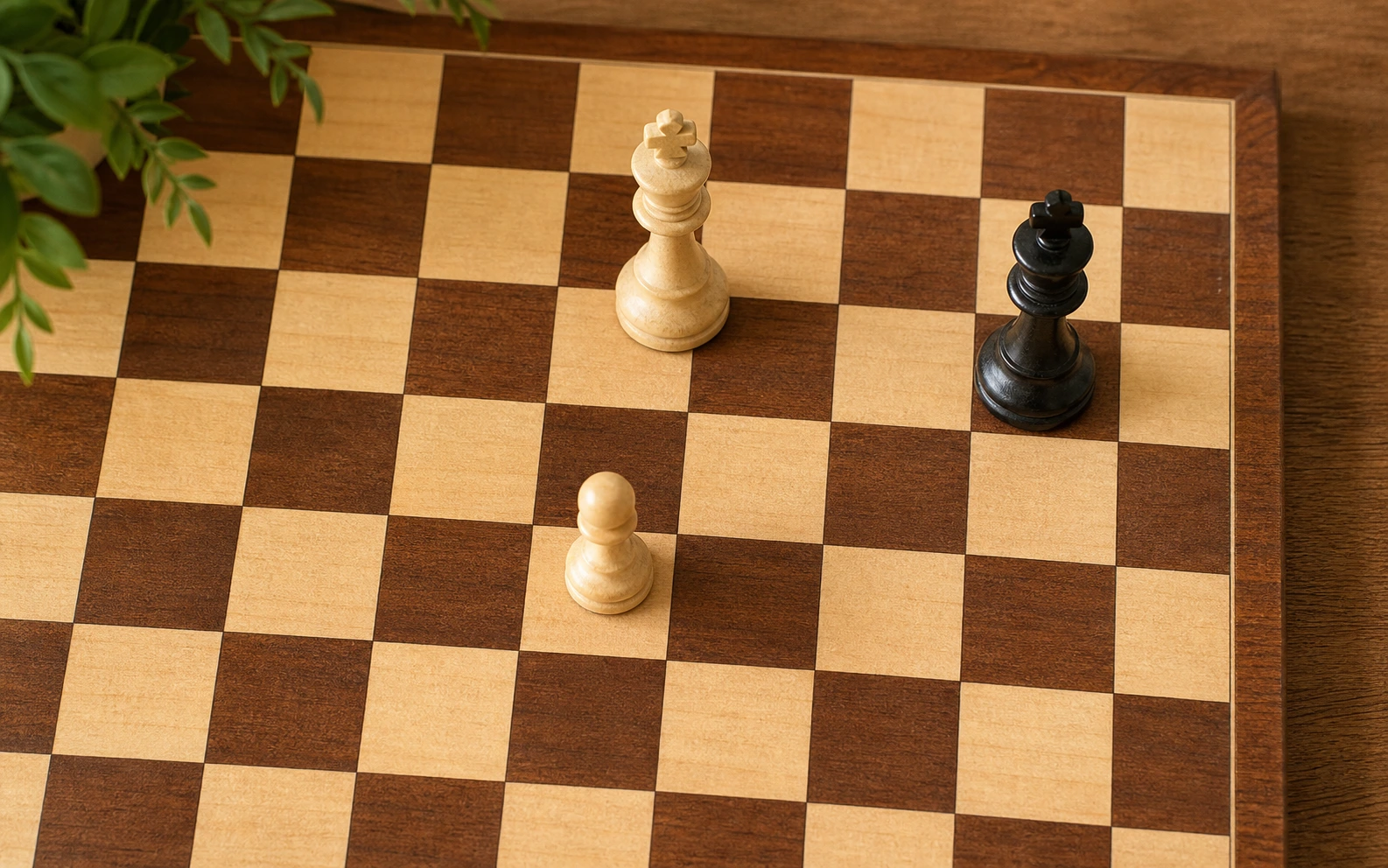
Quick answer: For practical chess coaching with children, endgame basics should be introduced early. Start with King and Queen vs King, then King and Rook vs King, then King and Pawn structure built around opposition. This order gives children conversion skill that applies to almost every game they play online or over the board.
I have taught hundreds of children who know opening lines but miss simple endgames and lose converted games. The reason is usually not weak intelligence. It is training order.
Why endgames matter before opening study#
Openings shape a game, but endgames decide converted outcomes. In practical children’s events, most games are decided by a few late moves where one child forgets a forced line. If a child can convert basic winning endings, they naturally score more.
I tell parents this in one line: “If a child cannot finish a simple endgame, tournament progress stalls no matter how bright the opening preparation.”
Core endgames every coach should insist on#
King and Queen vs King#
This is the highest-leverage first objective for kids.
- Put the queen on safe distance, cut escape squares.
- Bring king to support.
- Restrict to edge or corner.
- Deliver mate with correct final move.
The most common avoidable error is stalemate. I drill children to ask one safety question before every move when the enemy king is trapped: “Does my move remove all legal moves?” If yes and no check, the position is a draw.
I use only live board drills, short clock, and immediate reset if the child stalemates. A child learns this better by feeling the mistake than by reading diagrams.
King and Rook vs King#
This is harder than K+Q and usually needs the most repeated coaching.
The rook must coordinate with king; no single move from the rook alone works. Children need to learn:
- keep the rook far enough from the king,
- use king opposition,
- close rank by rank,
- mate only after the king cuts off escapes.
I test this with a child in noisy conditions and a two-minute limit, because real pressure appears when the clock is low. The child who can recover under pressure from one mistake is the one that improves in tournaments.
King and Pawn endings#
Opposition is the nerve center.
The opposition rule is useful across all king-and-pawn endings, not only rook-pawn cases. We teach it as “who does not have to move wins the key square contest.”
When the pawn is a rook pawn, there is extra drawing complexity near the corner. Children must know that not all promotion races are automatic.
Deep-dive H2: my 7-session method for converting basic endgames into live results#
I use this method with children aged 6 to 13 when they are ready for structured evaluation. It is not a generic theory section; it is a practical conversion system for real mistakes they repeatedly make in tournament-like games.
Session 1: pattern transfer from game to template#
I start with two actual games from the child and only two positions: one from K+Q and one from K+R. I do not begin with theory. The child must reproduce the line from memory on a fresh board orientation. This builds retrieval, not recognition.
Session 2: mistake library#
The child plays 10 K+Q positions and marks where each win was lost (or nearly drawn). I capture one mistake category only: wrong approach, weak king support, rushing mate. Every future position rehearses that specific weakness.
Session 3: speed under time#
I add short-clock repetitions: 90 seconds per move for five positions. The point is not to score all wins immediately; it is to keep technique stable under pressure and prevent “I know this but forget under time.”
Session 4: opposition as language#
For K+P, we convert it into language, not just rule. I ask:
- “Who has to move?”
- “What is the opposition square?”
- “Can the other king pass?”
When children speak this in simple words, they retain it far longer.
Session 5: bridge phase (Lucena)#
I show only one rook-pawn ending with pawn support and teach a fixed bridge move sequence. We repeat until the child can set it up without me naming the position.
Session 6: hold phase (Philidor)#
Now they learn the defensive skeleton. Most children resist defensive lines, but this is where they stop avoidable losses. I ask them to hold one full rook ending against passive pressure and not panic into side checks.
Session 7: two-sided test#
The final session tests both win and hold. Children defend once and win once from a mixed set. If a child can hold one down position and convert one won line in the same session, transfer quality is usually good enough for monthly repetition.
This seven-step sequence is my baseline. I run variants at different speeds depending on age, but the order stays the same.
A worked example: the rule of the square#
Here is a single position I teach in almost every beginner cohort, because it settles the most common panic — “can I stop that passed pawn or do I need to promote my own first?” It is called the rule of the square, and it lets a child answer that in one look instead of counting move by move.
Picture a white pawn on h5 with no white king nearby, and it is Black to move. Draw an imaginary square using the pawn’s file and rank as one side: from h5, the square runs h5–h8–e8–e5. The rule is simple: if the defending king can step into that square on its move, it catches the pawn; if it cannot, the pawn queens. When the side with the pawn is to move, the pawn advances first and the square shrinks by one, so the king must already be inside.
I make children physically trace the square with a finger for the first week, then remove the finger, then remove the naming. By the end they glance and say “in the square, safe” or “out, must promote mine.” It converts a scary race into a yes/no question. I pair it with the tactics work so the child sees that endgame calculation and tactical calculation are the same muscle used at two speeds.
Once the square is automatic, opposition slots in on top of it: the square tells you whether you can catch the pawn, and opposition tells you whether the stronger side can escort it home. That layering is why I never teach opposition cold — it only makes sense once the child already trusts the square.
Common endgame mistakes I see every week, and the exact fix#
Across live cohorts, the same handful of errors repeat regardless of city or age. Naming them makes them fixable:
- Rushing the K+Q mate into stalemate. Fix: the one-line safety check before every move when the enemy king is near the edge — “does this leave the king with zero legal moves and no check?”
- Cutting the enemy king with the rook but never bringing the king up. Fix: rule that the rook cuts and the king does the pushing; a rook alone mates nothing.
- Promoting into a stalemate with a lone pawn. Fix: teach underpromotion to a rook when a queen would stalemate — it feels counter-intuitive to a child until they lose a won game to it once.
- Panicking with side-checks instead of holding the Philidor draw. Fix: keep the rook on the third rank until the pawn crosses, then swing behind for checks. This is the single defensive skill that saves the most half-points.
- Treating every rook-pawn like a normal pawn. Fix: show the corner draw once so the child stops assuming an extra pawn always wins.
I keep a running note of which mistake each child owns, because fixing the one recurring error usually adds more points than any amount of new theory. That is the whole philosophy behind our small batches of six and same-coach continuity — the coach has to remember your child’s specific weakness week to week for this to work.
Building a stable endgame week at home#
A useful weekly schedule for parents:
- Mon–Wed: 10 minute K+Q sequence (short clock).
- Fri: one K+R conversion drill.
- Weekend: two K+P opposition mini-matches with child narration.
That rhythm is enough if done consistently for 4–6 weeks.
Comparison context and where this sits against tools#
This is where many families overpay for premium platforms while missing fundamentals. Lichess provides excellent free board and analysis practice for repetition. Chess.com has practical puzzles and game review pathways. Neither replaces guided coaching for first-time children, because neither explains where your child repeatedly loses under pressure.
I also keep eye on market alternatives for format fit, as of 16 July 2026:
- Kingdom of Chess shows a small-group cap model with recordings and active tournament-like components.
- CircleChess shows two live classes per week on intermediate plans, with parent meeting structure in verified public data.
- ChessGaja lists group sessions and 1:1 rates with LMS-like support.
Use those models only for fit and structure comparison; endgame learning quality remains in the repetition design.
For our live coaching details, review:
Expert tips from coaching room#
- Separate tactic study and endgame study. I keep at least two child-friendly blocks per week for endgames.
- Start from child mistakes, not textbook order. The same 3 mistakes repeat across games; fix those first.
- Use both offensive and defensive roles. A child who only converts winning endings will fail as a defender; teach both sides every session.
- Keep drills short and repeated. Endings fade fast after one long interval.
- Always practice with a clock by session 3. The first true test is execution under time pressure.
Frequently Asked Questions#
Should kids learn endgames or openings first?#
Endgames first. They transfer to every branch of play and correct recurring tactical habits that openings alone cannot teach.
How often should children practise endgames?#
Short, repeated practice is better than long rare sessions. Daily five-minute drill blocks out-perform heavy weekly marathons.
What are the three foundations for child endgame progress?#
Correct mate procedures, king cooperation, and opposition awareness.
How do I avoid stalemate mistakes in K+Q?#
Treat every decision as a legal-move check. If the enemy king has no legal move and is not in check, it is a draw. I make children say this line before every move in corner patterns.
At what level should we add Lucena and Philidor?#
After confidence in K+Q and K+R conversion and basic pawn opposition. These are useful once the child has already repeated foundational structures.
A practical endgame retention map#
For families building long-term retention, the way we sequence endgame work matters as much as which endgame is taught. The most common mistake is jumping from rules to novelty too quickly. I use this four-step rhythm for groups and one-on-one cohorts when repetition needs stability.
Week 1: only K+Q and K+R patterning, short sessions, no long game analysis.
Week 2: introduce opposition language in one sentence and apply it in three K+P positions.
Week 3: add mixed sessions where a child wins one game, blunders another, then defends a drawn rook endgame.
Week 4: remove explanation and test recall with no board reset.
By week four, most children move from “I know the idea” to “I can do it under pressure.” The speed increase comes from predictable cadence.
I still connect this with external practice pages so families have enough repetition volume: chess practice for kids at home, chess tactics for kids: pin fork skewer, and the sibling strategy piece best chess openings for kids.
For format and reporting checks, I keep practical references close: courses, coaches, and compare, and city availability pages like Chennai, Hyderabad, and Kolkata.
Sources#
- Wikipedia: Chess endgame overview — https://en.wikipedia.org/wiki/Chess_endgame (verified 16 Jul 2026)
- Wikipedia: Opposition — https://en.wikipedia.org/wiki/Opposition_(chess) (verified 16 Jul 2026)
- Wikipedia: Lucena position — https://en.wikipedia.org/wiki/Lucena_position (verified 16 Jul 2026)
- Wikipedia: Philidor position — https://en.wikipedia.org/wiki/Philidor_position (verified 16 Jul 2026)
- FIDE official page — https://www.fide.com/ (verified 16 Jul 2026)
- Lichess about and practice resources — https://lichess.org/about (verified 16 Jul 2026)
Back to parent hub: Chess learning path for kids.
Return to the main hub: Online chess coaching for kids in India.
Tarun Gupta
Founder of ChessWize. 10+ years in chess education with international academy experience. Designs the structured curriculum that every ChessWize coach teaches. Best for parents who want a clear progression path, not just lessons.
View FIDE ProfileReferences & Sources
- [01] The endgame is a fundamental pillar of chess skill with defined core techniques for King and Pawn, King and Rook, and King and Queen play. — https://en.wikipedia.org/wiki/Chess_endgame, 16 Jul 2026
- [02] The opposition concept is a defined strategic rule in king-and-pawn endings used across many practical games. — https://en.wikipedia.org/wiki/Opposition_(chess), 16 Jul 2026
- [03] The Lucena and Philidor positions are recognised rook-endgame structures in practical play and coaching material. — https://en.wikipedia.org/wiki/Lucena_position, 16 Jul 2026
- [04] Lichess and Chess.com both publish broad endgame and tactical practice functions that families can use for repetition drills. — https://lichess.org/about, 16 Jul 2026; https://www.chess.com/terms/chess-endings, 16 Jul 2026
- [05] FIDE and AICF use standard federated notation and rules that make endgame moves and notation consistent across rated events. — https://www.fide.com/, 16 Jul 2026; https://aicf.in/, 16 Jul 2026
- [06] The Philidor position is a recognised drawing method for the defending side in rook-and-pawn endgames. — https://en.wikipedia.org/wiki/Philidor_position, 16 Jul 2026