Chess Coaching vs Chess Apps for Kids
Chess apps vs live coaching for kids: when Lichess, ChessKid or Chess.com suffices, when a FIDE-rated coach adds value, and how to combine both.

Founder of ChessWize. 10+ years in chess education with international academy experience. Designs the structured curriculum that every ChessWize coach teaches. Best for parents who want a clear progression path, not just lessons.
On this page
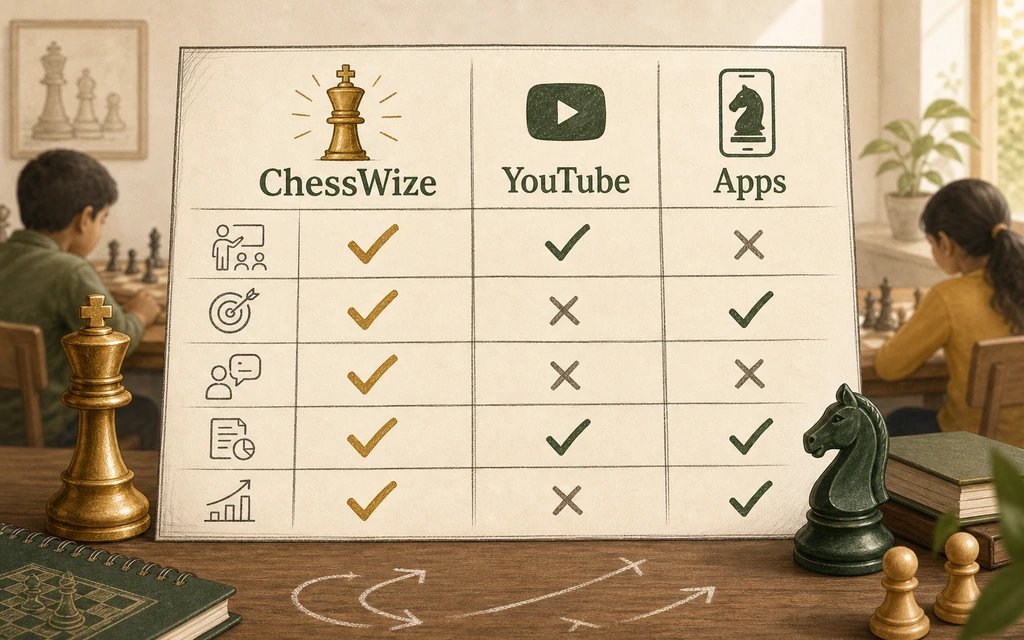
Most children who improve steadily use both: a chess app for daily puzzles and games, and live coaching for personalised correction. Apps excel at access and repetition; coaching excels at accountability and diagnosis. Neither replaces the other for a competitive child — but a purely recreational learner may never need a coach at all.
Parents ask me this question more than any other: “Can my child just use Chess.com or Lichess instead of paying for coaching?” It is a fair question. Chess apps have become extraordinary — free puzzles, lessons, game analysis, and opponents available around the clock. This guide compares the two approaches head-to-head, covers the three major platforms Indian families use, and helps you decide where to invest time and money.
Disclosure: ChessWize, the academy behind this guide, sells live coaching. We teach ages 5–15 online only — no physical centre — with group sessions from ₹375 per class, two-on-one from ₹550, 1:1 from ₹1,000, a starter pack of ₹2,500 for eight classes, batches capped at six, weekly WhatsApp parent reports, a complimentary 30-minute demo, refund on unused sessions, and a 5.0 Google rating from 21 reviews. Use this comparison on us as rigorously as on any app subscription.
The core difference: accountability vs accessibility#
Chess apps excel at accessibility. Your child can solve puzzles early in the morning, play a rated game at lunch, or watch a lesson before bed. There is no scheduling, no travel, and minimal cost. The three dominant platforms — Chess.com, Lichess, and ChessKid — collectively serve over 150 million registered users (Chess.com about page, 2026) and offer more chess content than any human coach could deliver in a lifetime.
Online coaching excels at accountability and personalisation. A human coach watches your child play, identifies specific weaknesses, corrects errors in real time, and adjusts the lesson based on the child’s response. No algorithm does this as well as an experienced coach — because chess improvement is not just about knowing the right move; it is about understanding why a move is right and when to apply the pattern in a different position.
The distinction matters most for children who are serious about improvement. A child using apps alone can stagnate for months without realising why — they keep making the same structural mistakes that puzzles do not address. A coached child has someone who notices the pattern and intervenes. Our is online chess coaching worth it guide walks through when that intervention justifies the cost.
Platform comparison: Chess.com vs Lichess vs ChessKid#
Here is an honest feature-by-feature comparison of the three platforms most Indian families use:
| Feature | Chess.com | Lichess | ChessKid |
|---|---|---|---|
| Cost | Free basic; premium ≈$4–13/month (annual billing) | Completely free | Free basic; Gold ≈$10/month |
| Target age | All ages (13+ recommended unsupervised) | All ages (Kid Mode available) | Under 13 (kid-specific) |
| Puzzles | Excellent. Limited free daily; unlimited premium. | Excellent. Unlimited, completely free. | Good. Age-appropriate, gamified. |
| Lessons | Comprehensive video + interactive curriculum. Premium only. | Community-created. Variable quality but free. | Structured for kids. Premium only. |
| Game analysis | Strong engine analysis. Premium for full depth. | Full Stockfish analysis, completely free. | Basic analysis. Simplified for kids. |
| Safety | Standard chat. Parental controls available. | Kid Mode restricts messaging; open chat by default | Chat restricted to preset phrases. Full parental controls. |
| Ads | Free tier shows ads. Premium removes them. | Zero ads. No premium tier exists. | Free tier shows limited ads. |
| Indian user base | Very large Indian community. | Large Indian community. | Moderate. Growing in India. |
Chess.com premium figures are approximate — its membership page is JavaScript-rendered; corroborated via third-party pricing guides, July 2026. ChessKid Gold at ≈$10/month corroborated via ChessKid Help Center, July 2026.
When to use Chess.com#
Chess.com is the most polished platform with the strongest structured lesson content. If your child is over 10, self-motivated, and your family is willing to pay for premium, Chess.com provides an excellent practice environment between coaching sessions. The bots with different playing styles are particularly useful for kids who want to practise against varied opposition. See our detailed ChessWize vs Chess.com for kids comparison for how it pairs with live classes.
When to use Lichess#
Lichess is the strongest value proposition in chess — possibly in all of education. Everything is free, funded by donations, with no ads and no account tiers (lichess.org/about). The analysis tools use the same engine (Stockfish) that professionals rely on. The puzzle system is excellent. The main drawback for younger kids is that child safety requires action: parents must enable Kid Mode, which restricts messaging and blocks forums, blogs, and videos. Without Kid Mode, the interface is designed for adult users with open chat. For kids over 12 with supervision, Lichess is hard to beat on value. Our ChessWize vs Lichess for kids guide covers setup steps.
When to use ChessKid#
ChessKid is purpose-built for children under 13. The safety features alone make it the right choice for younger kids — chat is restricted to preset phrases (“Good game!”, “Nice move!”), per ChessKid’s safety page, there are no external links, and parents get a dashboard to monitor activity. The lessons use simpler language and more visual explanations. If your child is under 10 and will use the platform independently, ChessKid is the safest option. Read our ChessWize vs ChessKid and Chess.com vs Lichess for kids guides if you are deciding among app options.
Coaching vs apps: where each wins#
| What your child needs | Apps | Coaching |
|---|---|---|
| Daily puzzle practice | Strong fit | Not designed for this |
| Playing opponents anytime | 24/7 availability | Scheduled sessions only |
| Correcting persistent mistakes | Engine shows the top move, not why it matters to your child | Coach identifies patterns in the child’s thinking |
| Building an opening repertoire | Generic recommendations | Personalised to the child’s style and level |
| Tournament preparation | No clock training or scorekeeping practice | Mock tournaments, game reviews, psychology prep |
| Motivation and accountability | Self-directed; easy to skip | Regular sessions create structure |
| FIDE credential development | Apps don’t prepare for OTB tournament mechanics | Coaches guide AICF registration, tournament entry |
For tournament-track families, apps and coaching are not competitors — they are different layers of the same stack. The app handles volume; the coach handles direction. Our chess learning path for kids shows how those layers fit together across age bands.
The hybrid model I use with every serious student#
After ten years designing curricula — first inside international academies, then at ChessWize — I stopped treating “coaching OR apps” as a meaningful choice. The question is ratio and sequencing. Here is the hybrid model I assign to nearly every student who is past the “do they even like chess?” stage, with a worked example so you can see how the pieces connect.
The weekly skeleton: two live coaching sessions (45–60 minutes each), fifteen to twenty minutes of daily app practice, and one or two longer games on the weekend that the coach reviews at the next session. That cadence costs less than daily coaching while keeping a human in the loop on the mistakes that actually matter.
Worked example — “Arjun,” a nine-year-old beginner in Pune (composite, not a single client): Arjun joins a ChessWize group batch — max six kids, same coach every week, ₹375 per session — after a complimentary 30-minute level check. In session one, his coach notices he develops queens early and leaves kingside pawns untouched. The coach assigns homework: ten Lichess puzzles tagged “mate in one” and one slow game with Kid Mode enabled.
Between sessions, Arjun does not wander the app randomly. He opens Lichess training, solves the assigned theme, and plays one 10+0 game. His mother receives a weekly WhatsApp note: which puzzles were missed, which opening mistake recurred, what to practise before Tuesday.
In session two, the coach pulls up Arjun’s Lichess game — exported or screen-shared — and pauses at move 14, where Arjun hung a knight while focused on a queen attack. This is the moment apps alone fail: Stockfish shows “+3.2” and suggests a retreat, but it does not know Arjun saw the knight and chose the queen anyway because he likes aggressive moves. The coach names the habit (“you calculate the attack first and check captures second”) and sets a mini-rule for the next week: before every capture, say “is anything hanging after this?” aloud.
Weekend homework: play one game on ChessKid if under ten, or Lichess with Kid Mode if older, and write down one move you regret. Session three opens with that confession — not a lecture. By week four, the queen comes out on move six instead of move three. No app measured that shift; the coach did, by watching the same child across three sessions.
Where AI tools fit: AIMchess (Premium ≈$7.99/month, per its pricing page, July 2026) can aggregate patterns across dozens of imported games faster than I can — useful for teenagers who already play daily. It still cannot ask “why did you play that in three seconds?” AIMchess supplements coaching for self-motivated older players; it does not replace live sessions for children who need accountability. Our ChessWize vs AIMchess for kids comparison goes deeper.
What parents get wrong: treating app time as a substitute for coach time rather than fuel for it. Two hours of random puzzle grinding without a theme reinforces existing habits — including bad ones. Fifteen minutes on an assigned theme after a coach sets it reinforces the lesson. The coach’s job is to choose the theme; the app’s job is to repeat it until the pattern sticks.
This is the same structure described on our courses page and in the how online chess classes work explainer — live session → assigned practice → game review → next session.
Pricing in India: coaching vs apps#
Here is what Indian families typically pay in July 2026:
| Option | Monthly cost (INR) | What you get |
|---|---|---|
| Lichess | ₹0 | Everything — puzzles, Stockfish analysis, games, studies |
| Chess.com Basic | ₹0 | Limited puzzles, basic analysis, ad-supported |
| Chess.com Gold/Platinum (approx.) | ₹350–₹1,100/month | Unlimited puzzles, lessons, full analysis |
| ChessKid Gold (≈$10/month) | ~₹850/month | Full kid-safe lessons and puzzles |
| AIMchess Premium (≈$7.99/month) | ~₹680/month | AI game analysis and study plans |
| ChessWize group (2×/week) | ₹375/session (≈₹3,000/month at 2×/week) | Live sessions, max 6 kids, same coach, weekly WhatsApp report |
| ChessWize 1:1 (2×/week) | ~₹8,000/month | Private sessions at ₹1,000 each |
| Other Indian academies (group) | ₹3,000–₹8,000/month | Varies by roster and group size — see class fees comparison |
The math is straightforward: apps alone cost almost nothing. Coaching is a meaningful investment. The question is whether the investment produces proportional returns — and for children who are serious about competitive chess, structured coaching plus free app practice usually delivers more per rupee than a premium app subscription alone. App-trained players often plateau because they practise what they already know and avoid what feels difficult. Coached players with assigned app homework work on blind spots because someone names them.
For Indian families budgeting, a practical starting path: use free Lichess or ChessKid for the first few months to confirm interest. If the child engages and wants to improve, add twice-weekly coaching and keep the app for daily reinforcement. ChessWize’s starter pack — ₹2,500 for eight classes — is one low-commitment entry point; CircleChess and Kingdom of Chess also offer free demos if you want to compare academies. Our free vs paid chess coaching guide covers the decision in more detail.
Online safety considerations for Indian parents#
When your child uses chess platforms, they interact with strangers online. The safety profile varies dramatically:
ChessKid is the safest default for independent use under 13. Chat is restricted to preset phrases. No private messaging. Full parental dashboard. The trade-off is a smaller opponent pool and fewer advanced features.
Chess.com offers parental controls and account restrictions, but default settings allow open chat. Parents need to configure privacy settings actively. The platform is designed for adults, and community forums can contain content inappropriate for young children.
Lichess requires parents to enable Kid Mode — it is not on by default. With Kid Mode, direct messages are limited and community features are blocked; without it, chat is open and moderation is community-driven. For children under 12, I recommend Kid Mode or supervised play only.
As a coach, I advise all parents of children under 12 to start with ChessKid for independent practice and use Lichess only with Kid Mode or supervision. Safety is not a feature to compromise on. Our is online chess coaching safe for kids guide covers video-session safety separately from app safety.
When your child does NOT need coaching#
I want to be honest about this, even though I sell coaching. Your child probably does not need paid coaching if:
- They are playing chess purely for fun with no competitive goals — apps are more than sufficient for recreational enjoyment.
- They are under six and just exploring whether they like chess at all — free apps and short videos are a better starting point than paid sessions. Our best age to start chess guide covers readiness signs.
- Your family’s budget is tight and coaching means sacrificing other important activities — Lichess provides world-class training tools for free.
- They are self-motivated, analytically inclined, and follow a structured plan independently — some older children genuinely thrive with self-directed app-based learning plus occasional club play.
None of this means coaching is bad value — it means coaching is not the first spend for every child. Start free, observe engagement, then add a human when patterns stall or tournament goals appear.
Expert tips for combining apps and coaching#
From ten years of curriculum design and hundreds of students, these are the combinations that actually work in live online coaching:
- Let the coach choose the app theme, not the child. “Do twenty minutes of puzzles” fails. “Do fifteen knight-fork puzzles on Lichess training, then stop” succeeds. Specificity beats volume every time.
- Review one game per week, not every game. Parents often ask coaches to analyse every blitz game. One slow game with written notes teaches more than ten rapid games skimmed by an engine.
- Match the app to the age, not the ambition. A seven-year-old on unrestricted Chess.com chat is a safety problem even if they are “talented.” ChessKid or Lichess Kid Mode first; expand access as maturity catches up.
- Use the weekly parent report as your dashboard. If you coach with ChessWize, the WhatsApp note tells you what app homework was set — hold your child to that, not to a generic “play chess today.”
- Re-evaluate the ratio every six months. Beginners need more coach time relative to app time. A 1400-rated twelve-year-old may need more self-study and tournament play relative to lessons. The hybrid ratio is not fixed for childhood.
Browse our coaches page to see who would run those sessions, the compare hub for academy-vs-app pages, and online chess classes for kids in India for the wider coaching landscape.
Frequently Asked Questions#
Can chess apps replace coaching entirely?#
For recreational players, yes. For competitive players aiming at FIDE-rated over-the-board tournaments, no. Apps show what went wrong in a position; a coach explains why your child keeps making the same mistake across different positions — the feedback loop apps cannot replicate.
Which free platform is right for a complete beginner?#
ChessKid for children under 10 — safest environment with age-appropriate lessons and no open chat. Lichess for children over 10 with parental supervision or Kid Mode enabled — unlimited free puzzles and Stockfish analysis with no paywall.
How do I know when my child needs coaching instead of apps alone?#
When practice volume is high but improvement stalls. If your child plays daily but repeats the same blunder patterns — hanging pieces in time trouble, ignoring king safety — they need a human who watches their thinking process, not another puzzle queue.
How much does coaching cost compared to chess apps in India?#
Apps range from ₹0 (Lichess) to roughly ₹350–₹1,100/month for Chess.com or ChessKid premium. Live coaching from Indian academies typically runs ₹3,000–₹8,000/month for twice-weekly group classes, with 1-on-1 rates higher. ChessWize publishes group sessions from ₹375 per class on our courses page.
Is AIMchess a substitute for live coaching?#
No. AIMchess analyses imported games and generates study plans — useful for self-motivated older players — but it cannot diagnose why a ten-year-old rushed a capture or lost focus mid-game. We compare it in our ChessWize vs AIMchess for kids guide.
What is the smartest combination for most families?#
Two live coaching sessions per week plus fifteen to twenty minutes of daily puzzle practice on Lichess or ChessKid between sessions. The coach sets the theme; the app reinforces it. Weekend games on the app become material for the next session’s review.
Return to the main hub: Online chess coaching for kids in India.
See also: ChessKid vs live coaching · CircleChess review for parents
Tarun Gupta
Founder of ChessWize. 10+ years in chess education with international academy experience. Designs the structured curriculum that every ChessWize coach teaches. Best for parents who want a clear progression path, not just lessons.
View FIDE ProfileReferences & Sources
- [01] Chess.com reports 150M+ registered users — chess.com/about, accessed 2026-07-16
- [02] Lichess is fully free, donation-funded, with no premium tier — lichess.org/about, accessed 2026-07-16
- [03] ChessKid restricts chat to preset phrases for child safety — chesskid.com/safety, accessed 2026-07-16
- [04] ChessKid Gold membership costs about $10/month per child — support.chesskid.com, corroborated 2026-07-16
- [05] AIMchess Premium costs $7.99/month or $57.99/year for AI game analysis — aimchess.com/pricing, accessed 2026-07-16
- [06] FIDE issues player ratings through sanctioned over-the-board play — fide.com/handbook, accessed 2026-07-16