
How to Pick a Chess Coach for Your Child
A step-by-step guide for Indian parents — define goals, verify FIDE credentials, evaluate trial sessions, and know when to switch coaches.
On this page
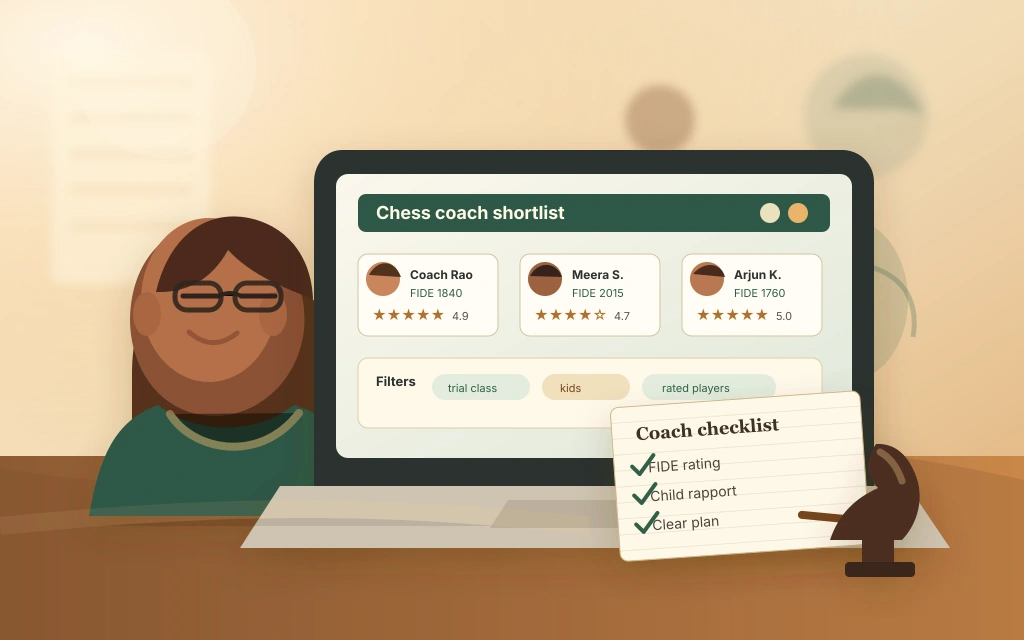
To pick the right chess coach, define your child’s goal first, verify the coach’s FIDE credentials at ratings.fide.com, watch a trial session for teaching skill rather than a sales pitch, and give the relationship eight to twelve sessions before judging. Teaching ability matters more than raw playing strength for beginners; credentials matter more as your child advances.
Picking the wrong chess coach wastes months of your child’s development and thousands of rupees. Picking the right one accelerates growth in ways that surprise parents, not just in chess, but in concentration, problem-solving, and competitive resilience. This guide walks you through a structured process that removes guesswork and helps you make a confident decision.
I am a chess coach myself, so I know exactly what parents should look for and what some coaches try to hide. ChessWize, the academy behind this guide, is one option you can evaluate with the same process, so use this checklist on us as rigorously as on anyone else. If you would rather start from the wider decision of what kind of class suits your child, our choosing chess classes for kids guide is the place to begin.
Step 1: Define Your Child’s Goals#
Before you look at a single coach profile, get clear on what you want. Different goals require different coaches:
Recreational exploration. Your child is curious about chess, wants to learn the rules and play for fun. They may have watched a friend play at school, seen chess in a movie, or encountered it through a family member. You need a patient, engaging coach who makes chess enjoyable, where playing strength matters less than teaching personality. The coach should be able to explain concepts using stories, visuals, and interactive exercises rather than abstract theory. Budget: low to moderate.
Cognitive development. You want chess to develop focus, problem-solving, and strategic thinking. The coach should understand pedagogy and connect chess to broader cognitive skills. Structured puzzles and analytical exercises matter more than competitive preparation. If this is your aim, our honest look at whether chess improves focus in kids sets realistic expectations.
Competitive play. Your child wants to compete in FIDE-rated tournaments, earn an Elo rating, and potentially pursue titles. You need a coach with strong playing credentials (advanced tier), competitive experience, and knowledge of the AICF tournament ecosystem. Our AICF rating for kids guide explains the rating side of that journey.
Elite development. Your child is already rated and aiming for national or international competition. You need a titled coach (FM, IM, or GM) with a track record of developing competitive players and the strategic depth to prepare opening repertoires against specific opposition.
Write down your child’s goal before proceeding to Step 2. If you are unsure, start with “recreational exploration” — you can always upgrade later.
Step 2: Verify Credentials#
This is the step most parents skip, and it is the most important one.
- Ask the coach or academy for the coach’s FIDE ID number.
- Go to ratings.fide.com and search for the ID or name.
- Verify: name, federation (IND for India), current Elo rating, title (if any), and last activity date.
- Cross-reference with what the academy or coach claims on their website.
If the credentials match, excellent. If they do not, ask for an explanation. If they refuse to share a FIDE ID at all, move on. For a detailed guide on what to look for and what to avoid, including the Arena title trap where an online-only title is passed off as a real FIDE one, see our complete FIDE-rated chess coach guide. You can also see how we display verifiable credentials on our own coaches page, where each coach’s FIDE profile is linked.
Credential benchmarks by student level:
- Beginner students: coach rated 1600+ Elo
- Intermediate students (800–1400 Elo): coach rated advanced tier
- Advanced students (1400+ Elo): coach rated 2100+ Elo or titled
Step 3: Book a Trial Session#
Every reputable coach offers a trial session (typically 30–45 minutes, the standard noted in Chess.com’s coaching guidance). Here is what to observe:
In the first 5 minutes:
- Does the coach assess your child’s level through questions or a quick puzzle test? Or do they jump straight into a generic lesson?
- Does the coach introduce themselves and explain how the session will work?
During the lesson (next 20–25 minutes):
- Does the coach adjust their explanations when your child does not understand? Watch for re-phrasing, alternative examples, and patience.
- Is the session interactive? Your child should be solving puzzles and making decisions, not passively watching the coach demonstrate.
- Does your child look engaged or bored? A good coach reads the room and adjusts energy.
In the last 5 minutes:
- Does the coach provide specific feedback about your child’s current level?
- Does the coach outline a plan for what the first month of training would look like?
- Does the coach answer your questions about their methodology, schedule, and pricing?
If the coach treats the trial as a sales pitch rather than a genuine lesson, that tells you something important about their priorities. Most academies, including ours, offer this trial free — you can book a complimentary 30-minute demo through our contact page and run this exact checklist.
What a good trial actually looks like from the coach’s chair#
Parents sometimes ask me what I am doing during a trial, so let me turn the table around and show you the session from my side. It will help you read one far more accurately.
The moment a child joins, I am not thinking about impressing the parent. I am running a quiet diagnosis. In the first two or three minutes I ask a couple of low-stakes questions — “Show me how the knight moves,” or I put up a simple position and ask what they would play — purely to locate the child’s real level. A coach who skips this and launches into a scripted lesson is teaching to an imaginary average child, not yours. That is the first thing you should watch for: is the coach calibrating, or performing?
Next, I deliberately give the child a problem slightly above what they just showed me they can do. This is the most revealing part of the trial, and most parents miss it. If I pitch it right, the child struggles for a moment, I offer one small hint, and they solve it themselves. Their face changes — that flicker of “I did it” is the entire product a good coach sells. What I am testing is not the child; I am testing whether I can find the right rung of the ladder for them and whether they respond to being stretched. A trial where the child sails through everything effortlessly is a bad trial: it means the coach played it safe and you learned nothing about how they handle difficulty.
Then I watch how the child fails, because every child fails during a proper trial. Do they shut down, or do they lean in? My job in that moment is to make failing feel safe — “Good try, that is exactly the move most people play, let us see why the computer might not.” How a coach handles a wrong answer in the first thirty minutes tells you everything about how they will handle three months of wrong answers. If the coach corrects with warmth and a reason, that is the coach you want. If they correct with a flat “no, wrong,” keep looking.
Finally, in the last five minutes, I tell the parent something specific and slightly uncomfortable — a genuine gap I saw, not just praise. “He calculates well but grabs the first move he likes; that is what we would work on first.” A coach who only flatters you in the trial is selling, not diagnosing. The honest, specific read is the signal that this person will actually track your child’s development rather than collect a fee. That single habit — specific feedback over flattery — is the clearest predictor I know of a coach worth committing to, and it is the standard I hold my own team to through our weekly parent reports.
Step 4: Ask the Right Questions#
During or after the trial, ask:
- “What specific areas would you focus on with my child in the first month?”
- “How do you track and measure progress?”
- “How often will you communicate with me about my child’s development?”
- “What happens if we need to reschedule a session?”
- “Can you share examples of students at a similar level and their improvement trajectory?”
Honest coaches answer these questions concretely. Vague answers (“we focus on overall improvement”) or deflections (“every child is different, so I cannot say”) are yellow flags; they may indicate a lack of planning or structure. If you are comparing a solo tutor against an academy while you ask these, our chess academy vs private tutor guide lays out the trade-offs, and group vs private chess classes covers class size.
Step 5: Evaluate After 8–12 Sessions#
Do not judge a coach after one or two sessions. Give the relationship 8–12 sessions (approximately one month of twice-weekly training) to develop. After that period, evaluate:
Positive indicators:
- Your child looks forward to sessions and practises voluntarily between them.
- You can see specific skills improving (solving harder puzzles, understanding new openings, making fewer blunders).
- The coach proactively shares observations and adjustments.
- Your child can explain what they learned in recent sessions when asked.
Warning signs:
- Your child dreads sessions or complains consistently about the coach.
- No measurable improvement after one month of consistent attendance and practice.
- The coach never communicates with you unless prompted.
- Sessions feel repetitive — the same topics covered without progression.
If three or more warning signs are present after 8–12 sessions, it is time to consider switching.
Expert tips from ten years of hiring and being a coach#
Beyond the five steps, here are the shortcuts I share with parents most often:
- Judge the follow-up, not the first lesson. Any competent coach can deliver one good trial. The real test is session three and four — does the plan progress, or does it repeat? Book two or three sessions before committing money to a package.
- Watch your child’s between-session behaviour. The single best signal a coach is working is a child who opens a puzzle app or sets up a position without being told. Voluntary practice is worth more than any credential on a profile.
- Match the coach to the phase, not the ceiling. A patient beginner-specialist is often better for a first-timer than a titled player, while a 1400+ child genuinely needs a stronger coach. Do not overpay for rating your child cannot yet use, and do not underpay when they have outgrown a level.
- Insist on written progress notes. A coach who sends a short weekly update is investing in your child outside session time. If you have to chase every update, that pattern rarely improves. This is why we treat weekly reports as a baseline, not an extra.
- Trust your child’s face over the sales page. Credentials get a coach onto the shortlist; rapport keeps them on it. A child who dreads every session will not improve no matter how strong the coach is on paper.
When to Switch Coaches#
Switching coaches is not failure; it is a normal part of finding the right fit. Here are legitimate reasons to switch:
- Skill ceiling mismatch. Your child has outgrown the coach’s playing level. A coach rated 1800 is excellent for beginners but may not provide sufficient depth for a student who has reached 1400+ Elo.
- Personality mismatch. Some children thrive with strict, structured coaching. Others need encouragement and flexibility. If the teaching style consistently clashes with your child’s personality after 8–12 sessions, the coach’s credentials do not matter — the learning is not happening. A child who dreads every session is not going to improve, regardless of how qualified the coach is.
- Stagnation. Your child has attended consistently for three months with homework completion, and there is zero measurable improvement. The coach may need to change approach, and if they cannot articulate what they plan to do differently, a fresh perspective from a different coach often breaks the plateau. Stagnation is sometimes the student’s fault (inconsistent practice), sometimes the coach’s fault (wrong methodology), and sometimes simply a mismatch — but after three months, you need to make a change regardless of the cause.
- Communication breakdown. You have asked for progress updates multiple times and receive nothing substantive. A coach who does not communicate with parents is not invested in the student’s development outside of session time. Progress tracking and parent communication are baseline professional standards, not optional extras.
Handle the transition professionally: give the current coach at least two weeks’ notice, explain your reasoning honestly (this helps the coach improve), and ensure your child’s learning records (game analysis, progress notes, puzzle history) transfer to the new coach so they do not start from scratch. Ask the outgoing coach for a brief written summary of your child’s strengths, weaknesses, and the topics covered — this document saves the new coach significant ramp-up time and ensures continuity of development.
Where ChessWize fits (and where it may not)#
To be transparent: ChessWize is an online academy, so if you specifically want in-person, over-the-board coaching in your own city, we are not the right fit and you should look locally. Where we do fit is families who want a named, FIDE-rated coach, the same coach every session with no rotation, weekly WhatsApp reports, and a clear curriculum. Sessions start from ₹313, there is a complimentary 30-minute demo, and unused sessions are fully refundable. You can compare us honestly against alternatives on our compare page, review pricing realities in our how much do chess lessons cost guide, browse tracks on the courses page, or see how the online classes for kids actually run. If you want a benchmark for the online market, our roundup of the best online chess classes for kids in India sets one out.
Frequently Asked Questions#
How many trial sessions should I book before choosing?#
Two to three, ideally with different coaches or academies. Comparing trials side by side gives you a clear reference point for teaching quality, personality fit, and session structure. A single trial in isolation tells you little, because you have nothing to measure it against.
Is it worth paying more for a higher-rated coach?#
It depends on your child’s level. For beginners, the premium is usually not worth it, because teaching ability matters more than playing strength. For advanced students (1400+ Elo), a higher-rated coach provides depth and repertoire knowledge that cannot be faked or improvised.
Can I sit in on my child’s sessions?#
Most online sessions allow parents to observe. I recommend observing one session per month rather than every session, because your presence can change the dynamic. Watch to understand the methodology and check the tone, not to micromanage the coaching.
How do I verify a coach’s FIDE rating myself?#
Ask for the coach’s FIDE ID, then search it at ratings.fide.com. Check the name, the federation, the current rating, any title, and the last activity date. Cross-reference this against what the coach or academy claims. If a coach refuses to share a FIDE ID at all, treat that as a reason to look elsewhere.
How long before I know if a coach is the right fit?#
Give the relationship eight to twelve sessions, roughly a month of twice-weekly training, before judging. One or two lessons are not enough to see teaching quality or rapport. After that window, look at whether your child enjoys sessions, practises voluntarily, and shows specific, observable improvement.
Is it bad to switch chess coaches?#
No. Switching is a normal part of finding the right fit, not a failure. Legitimate reasons include a skill-ceiling mismatch, a personality clash, three months of stagnation despite consistent effort, or poor communication. Handle the change professionally, and ask the outgoing coach for a short summary of your child’s strengths and gaps.
Back to parent hub: Choosing chess classes for kids.
See also: Finding a FIDE-rated chess coach · Best online chess classes in India
Return to the main hub: Online chess coaching for kids in India.

Aryan Pal
ChessWize's content lead and coach for early learners. Specialises in making chess feel intuitive for first-time players. Designs the explainer videos, exercise sets, and parent-facing learning materials every student receives.
View FIDE ProfileReferences & Sources
- [01] FIDE coach and player profiles are publicly searchable at ratings.fide.com — fide.com, 2026
- [02] A trial or introductory session of roughly 30 to 45 minutes is the standard for coach evaluation — chess.com, 2026
- [03] FIDE is the international governing body that awards titles such as FM, IM and GM — en.wikipedia.org/wiki/FIDE, 2026
- [04] The Elo rating system measures relative playing strength from game results — en.wikipedia.org/wiki/Elo_rating_system, 2026