
How to Find a FIDE-Rated Chess Coach for Kids
A parent guide to verifying FIDE credentials, choosing coaching level, and avoiding unverifiable claims.

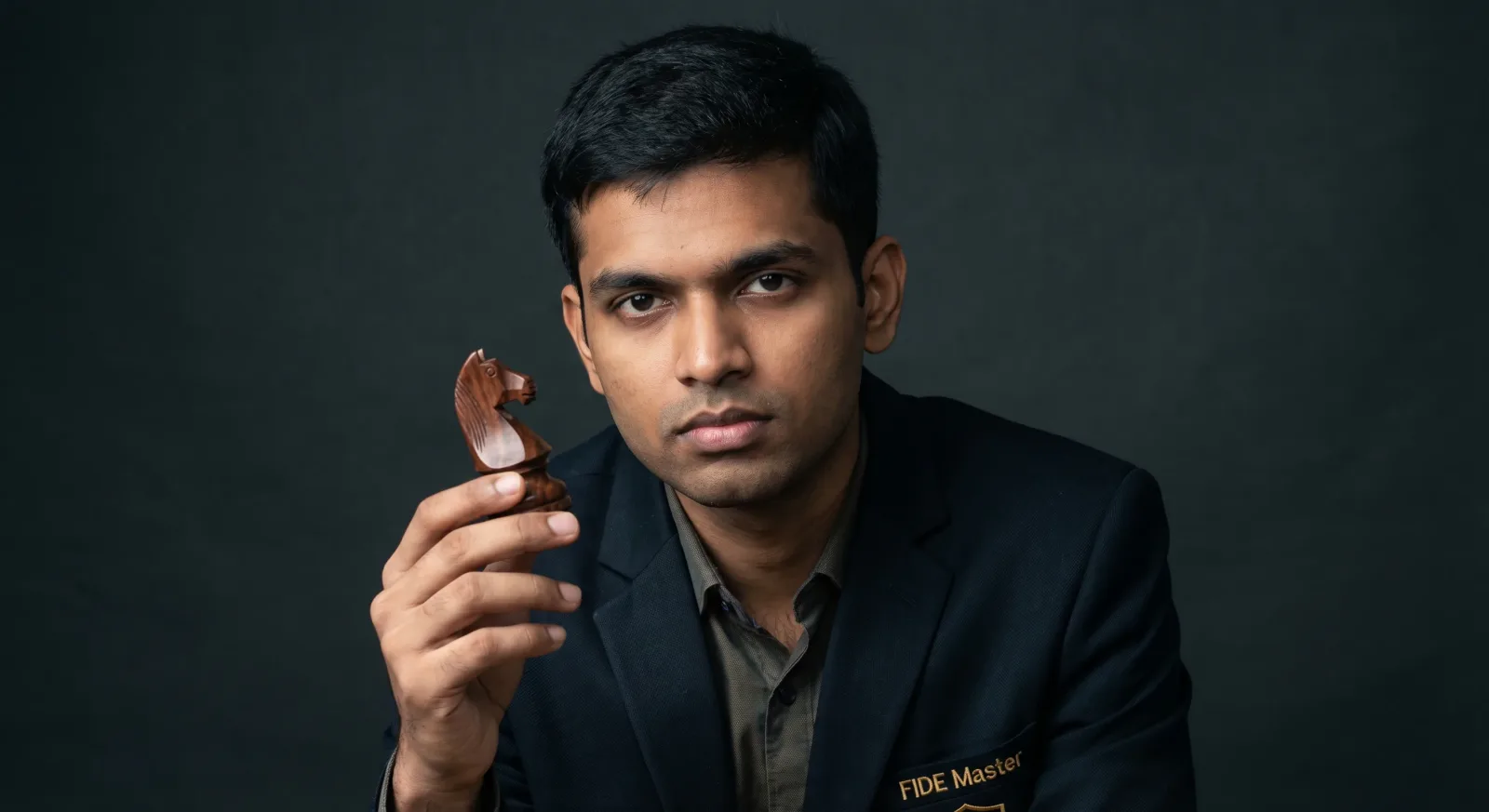
Day-to-day coach at ChessWize. 7+ years training students aged 5–15 across India, the USA, the UK, Singapore, Australia, and the Middle East. Known for structured, interactive sessions that turn nervous beginners into tournament-ready players.
On this page
For parents
Key takeaways
- 1A FIDE ID and rating can be independently verified; any coach without this level of verifiability deserves closer scrutiny.
- 2Arena titles are separate from standard over-the-board titles; treat the distinction honestly.
- 3For beginners, teaching clarity and routine design usually matter more than elite rating alone.
- 4A real coach choice process is: verify credentials, then match coaching depth to child level.
- 5ChessWize coaches work online-only, ages 5–15, with small batches and a complimentary demo flow.
Quick answer: Ask for a live FIDE ID first, then verify it on ratings.fide.com before talking to teaching style. For beginners, coaching fit and consistency normally matter more than rating alone. A title without child-friendly method often produces slow progress and poor retention.
I hear this exact line every week: “I only want a real FIDE-rated coach.” Good intention, but it is only half of the check. The other half is coaching method. A strong title helps, yet children in the first 8–12 months improve most when the coach can explain one mistake in a way a child can act on.
Disclosure: ChessWize is one live coaching option. We do not run any physical academy center; we run online coaching for children aged 5–15, with the same coach per cohort and a complimentary 30-minute demo before commitment.
Step one: verify credentials, not claims#
Ask for one number: FIDE ID.
Then open ratings.fide.com and check:
- profile name match,
- current rating,
- title displayed,
- whether the profile reflects current activity.
If a provider refuses to provide a verifiable ID, that is a direct signal to pause and ask more questions.
The second step is to check whether a title is claimed in the standard channel or online channel. Arena titles are not equivalent to over-the-board FIDE titles, so I treat them as separate credentials in family conversations.
What titles and ratings truly indicate#
In simple coaching language:
- GM and IM signal sustained over-the-board strength and higher benchmark standards.
- FM and CM indicate rating thresholds with less norm complexity.
- High current activity matters when tournament pathways and current opening lines change quickly.
Parents usually ask if titled coaches are mandatory for children. I use a practical rule in coaching consultations:
- beginner to early consistency stage: teaching method is top criterion,
- plateauing or competitive stage: title depth becomes a stronger criterion.
So I do not reject an untitled-but-patient coach for a beginner if they are active and clearly teachable, and I do not over-promise what a titled coach automatically gives.
Deep-dive H2: a 5-step method I use to evaluate a prospective kids’ coach#
This is the method I use before recommending or rejecting a coach for children. It avoids title bias and catches most mismatches early.
1) Credential and activity verification#
I verify name, ID, title, and recent activity within 18 months on the official profile first. A stale profile can still be real, but for tournament support and current pedagogy, recency matters.
2) Teaching compression test#
I ask the coach to explain one simple motif in 60 seconds: “What is opposition?” If the answer is clear, child-anchored, and repeated in practical terms, that is a good sign. If the explanation is abstract with no child translation, the fit is usually weak.
3) Error diagnosis model#
Ask for a worked example of one recurring beginner mistake — blunder, time pressure, or board panic. I watch for:
- whether the coach identifies cause, not only move,
- whether correction is repeated in follow-up tasks,
- whether homework is tied to the mistake pattern.
4) Delivery structure#
I check format variables before price: batch cap, same coach continuity, reporting rhythm, demo model, and handling of unused sessions. If these are unclear, I do not treat a higher title as sufficient proof.
5) Fit to current child#
A coach may be excellent for 12-year-olds and wrong for a 6-year-old. I compare communication tempo, session length tolerance, and assignment style to the child profile before approving any fit.
This five-step method is repeatable across all cities and all package modes.
How to evaluate coach claims without getting overwhelmed#
Use this exact sequence when speaking to academies:
- “Please share the FIDE ID and latest profile link.”
- “What is the batch size for ages 5–15 in this curriculum?”
- “Who is the core coach for my child’s cohort, and is the same coach available each week?”
- “How are mistakes tracked between classes?”
- “What is your policy if classes are missed due to exams?”
I keep this list because parents often hear attractive words and miss operational details.
Competitive comparisons, with fairness notes#
Families also ask how our setup compares with others seen in market search.
- Kingdom of Chess lists a small-group cap of max 5, live + recorded mix, and a free trial model.
- CircleChess publishes two live classes per week on verified intermediate plans and public parent-meeting structure.
- ChessGaja gives explicit group and 1:1 pricing bands with LMS support and a broader maximum group size.
- MindMentorz has package pricing visible in public snippets but limited verified detail in some sessions.
- ChessKid and Chess.com are strong self-guided ecosystems rather than always equivalent to live children’s coaching; ChessKid in particular is built around child-safety defaults (no open chat, auto-generated usernames).
- Lichess is completely free and even offers a parent-controlled Kid Mode that limits messaging and hides forums, blogs and streams — worth enabling if your child practises there between lessons, because on a self-guided platform safety is opt-in, not automatic.
The point is not to rank them aggressively. The point is to understand where each option is honest for your current stage.
For a structured, coach-led path, review:
- Courses
- Our coach profiles
- Compare options
- city pages for family fit: Mumbai, Delhi NCR, Bengaluru
- sibling pathway content: choosing chess classes, online vs offline, how to pick a chess coach for your child, AICF rating guide
Pricing context, without shopping for numbers#
You asked for transparent price context. I keep it simple:
- Group/mini-cohort sessions can start at ₹375.
- Two-on-one support is often listed around ₹550.
- 1:1 is typically ₹1,000 per session.
- Starter pack options include ₹2,500 for 8 classes in our published structure.
I avoid comparing only headline monthly totals. A good coach fit with flexible scheduling and clear reporting often beats a lower monthly number when continuation confidence is low. Families lose time when a cheaper model has weak continuity.
Our policy includes a refund on unused sessions, which is part of the decision for many parents who want practical risk control. We also send a weekly WhatsApp report so you can see what was covered without sitting in every class.
What FIDE ratings and titles actually mean, in numbers#
Parents ask me to translate the alphabet soup. Here is the plain version, drawn from FIDE’s own public title regulations rather than marketing copy:
- Candidate Master (CM): roughly a 2200 rating benchmark, the entry standard title.
- FIDE Master (FM): roughly a 2300 benchmark.
- International Master (IM): roughly a 2400 benchmark plus norm requirements earned at qualifying events.
- Grandmaster (GM): roughly a 2500 benchmark plus multiple norms.
A “rating” and a “title” are not the same thing. A rating moves up and down after every rated game; a title, once earned, is held for life. So a coach can be a titled FM whose live rating has drifted, or an untitled club player rated 1900 who is a superb teacher of six-year-olds. I hold both credentials of our own coaching team openly: our lead coach carries FIDE ID IN-25600184 with a 1850 rating, and the wider founding team plays in the 1780–1920 band. None of us claim GM strength, because that would be false, and a false credential is the fastest way to lose a parent’s trust.
For most families with a child in the 5–15 range, the honest truth is that a coach in the 1700–2000 band who teaches clearly will move a beginner forward faster than a distant 2400 who cannot slow down to a child’s pace. Playing strength stops being the deciding factor once a coach is clearly above the level they are teaching.
Matching coaching format and budget to your child’s stage#
Before you look at any title, decide which format fits the child, because format drives both learning speed and cost. There are three sensible options and I map them to child stage like this:
- Group / mini-cohort (from ₹375 per session). Best for first-time learners and social kids aged 5–10. A small batch (we cap ours at six) keeps peer energy without losing the coach’s attention. This is where most families should start.
- Two-on-one (around ₹550 per session). A middle path when a child needs more attention than a group but benefits from one sparring partner — often two siblings or two friends at a similar level.
- 1:1 (around ₹1,000 per session). Best for a plateauing or tournament-bound child who needs opening repertoire work and game-by-game correction. It is the most expensive per hour and, for a raw beginner, often more intensity than the child can absorb.
A practical way to test the water without over-committing is a starter pack: ₹2,500 for 8 classes (roughly ₹313 a session), taken after the free 30-minute demo. That gives you eight real data points on continuity and reporting before you decide on a longer commitment. Compare that structure against the tiered annual packages competitors publish — see our pricing and course options and the side-by-side compare view — and judge on continuation confidence, not just the headline monthly number.
Expert tips from my coaching office#
- Choose verifiable over impressive. I always prioritize proof: ID, profile, and recent activity.
- Separate title from method in your shortlist notes. One good item in each column helps avoid emotional choice.
- Start with a short format fit check. Ask the coach to test one real child mistake and map homework.
- Protect your child’s timetable. If your child misses classes for exams, confirm reschedule and reporting rules before enrolling.
- Keep three sessions of evidence before you scale commitment. I ask families to test communication and continuity through live interaction first.
Frequently Asked Questions#
Can a coach be good without a FIDE title?#
For early-stage learning, yes if coaching method is strong and communication is age-appropriate. For tournament-focused pathways, a coach with stronger playing credentials often helps more.
Do I need a titled coach for a beginner?#
Not automatically. Many beginners need routine, repetition, and psychological safety first. I choose method first and title depth after that.
Are online tools enough for coached improvement?#
No. Tools are excellent for repetition, but a live coach gives pattern diagnosis tied to the child’s exact errors and context.
What should I do if a coach refuses a FIDE ID?#
Pause and ask for alternatives. Credential transparency is the first trust check, especially when fees move into long-term programme commitments.
How do I handle coaching format choices?#
Use goal-based fit. Team confidence and consistency usually matter for beginners, while tournament-specific depth matters more once a baseline is stable.
Where can I verify platform-level data?#
Use official pages for FIDE and AICF for credentials, then use compare, courses, and coach list for service model checks.
One more practical step: child-fit before long-term commitment#
I keep a three-day onboarding check for families comparing multiple coaches. It catches most quality mismatch cases before a child develops trust dependence on one wrong format.
Day 1: request verifiable data (FIDE ID, schedule, coach continuity) and compare only what is public. A coach who cannot name their reporting cadence clearly usually lacks process maturity.
Day 2: run a 30-minute demo and capture one observed signal, not a full score review: did the coach simplify the child’s recurring issue and ask a practical follow-up question?
Day 3: match cost and method to your target age. For children under 8, routine and patience often outrank title depth. For older children with tournament intent, we add one correction metric per class and move progressively toward format specificity.
At the end of three days, most families already know whether the model is likely to hold through a full semester. This simple process is more useful than searching for “perfect” stats and guarantees.
Use these pages while you decide: courses, coaches, compare, online-vs-offline chess classes, and the city paths Delhi NCR, Mumbai, Bengaluru.
Sources#
- FIDE titles and trainer framework — https://www.fide.com/ (verified 16 Jul 2026)
- FIDE ratings database — https://ratings.fide.com/ (verified 16 Jul 2026)
- AICF official federation page — https://aicf.in/ (verified 16 Jul 2026)
- Chess.com ecosystem overview — https://www.chess.com/ (verified 16 Jul 2026)
- Lichess platform overview — https://lichess.org/about (verified 16 Jul 2026)
- Lichess Kid Mode (child-safety controls) — https://lichess.org/page/kid-mode (verified 16 Jul 2026)
Back to parent hub: Choosing chess classes for kids.
Return to the main hub: Online chess coaching for kids in India.
Hrdyansh Pandey
Day-to-day coach at ChessWize. 7+ years training students aged 5–15 across India, the USA, the UK, Singapore, Australia, and the Middle East. Known for structured, interactive sessions that turn nervous beginners into tournament-ready players.
View FIDE ProfileReferences & Sources
- [01] FIDE title requirements are publicly listed by FIDE and include both rating threshold and norm requirements for GM and IM. — https://www.fide.com/, 16 Jul 2026
- [02] Ratings and player profile checks are available through ratings.fide.com using FIDE IDs and names. — https://ratings.fide.com/, 16 Jul 2026
- [03] AICF is the recognized federated body for chess competition and ratings coordination in India. — https://aicf.in/, 16 Jul 2026
- [04] FIDE has a distinct trainer certification framework including FIDE Trainer and Instructor credentials. — https://www.fide.com/, 16 Jul 2026
- [05] Online chess ecosystems like Chess.com and Lichess use player development tools but are not substitutes for live structured coaching in every case. — https://www.chess.com/, 16 Jul 2026; https://lichess.org/about, 16 Jul 2026
- [06] Lichess publishes a parent-controlled Kid Mode that restricts messaging and community features for child accounts. — https://lichess.org/page/kid-mode, 16 Jul 2026