Chess vs Screen Time: The Debate Parents Need to Understand
Is online chess just more screen time? The active vs passive distinction, practical daily limits, and when to use a physical board instead of an app.

Founder of ChessWize. 10+ years in chess education with international academy experience. Designs the structured curriculum that every ChessWize coach teaches. Best for parents who want a clear progression path, not just lessons.
On this page
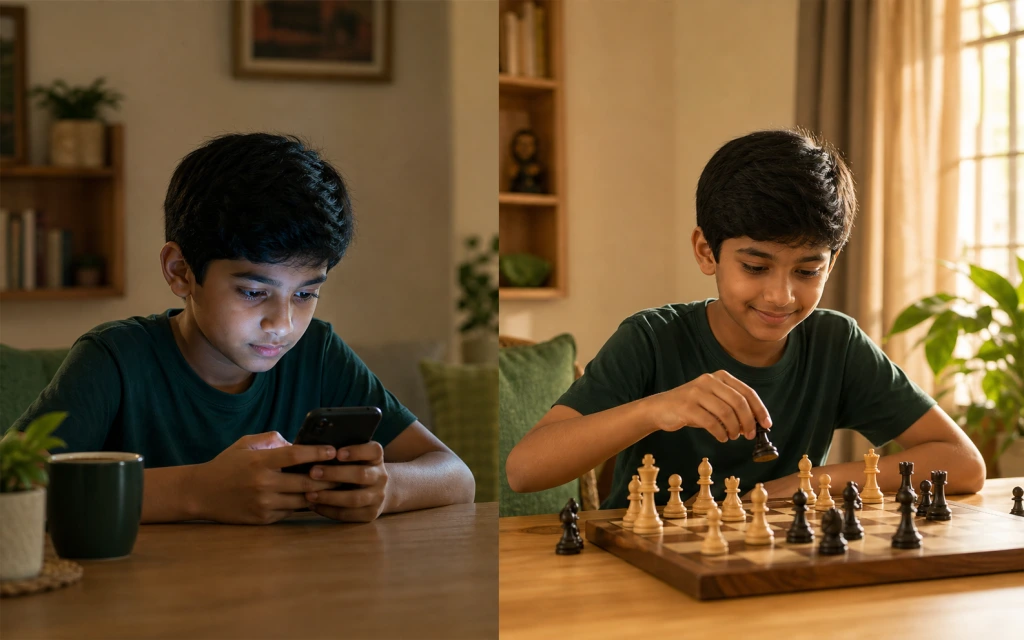
Online chess is screen time, but it is active screen time — the child is calculating, deciding, and responding to an opponent, not passively watching. That makes it closer to solving maths problems on a device than to scrolling videos, and health bodies like the WHO and AAP increasingly judge screen use by quality and context, not minutes alone. It still needs limits.
I founded and run an online chess academy. My students learn on screens, solve puzzles on apps, and play on platforms like Lichess and Chess.com. So when a parent asks me “isn’t this just more screen time?”, I have an obvious commercial interest in the answer being “no” — which is exactly why I want to be honest about it. ChessWize, the academy publishing this guide, teaches live online classes for kids aged 5–15, and I would rather you use us well than use us blindly.
The honest answer is nuanced: online chess is screen time, but not all screen time is equal. Understanding the difference between active and passive screen use changes how you should evaluate your child’s chess time on devices.
What is the difference between active and passive screen time?#
Paediatric health bodies increasingly distinguish two kinds of screen engagement, and the American Academy of Pediatrics frames its guidance around the quality and context of use rather than a single minute count.
Passive screen time — watching videos, scrolling feeds, consuming content without cognitive engagement. The brain is in reception mode, processing sights and sounds without solving problems or making decisions. This is the type most associated in research with attention difficulties, sleep disruption, and reduced physical activity.
Active screen time — creating, learning, or solving problems through a screen. Writing code, working a maths tutorial, a video call with a teacher, or playing a strategic game like chess. The brain does the same cognitive work it would do off-screen; the screen is only the delivery mechanism.
Online chess sits firmly in the “active” category. When your child plays a game or solves a puzzle on Chess.com or Lichess, they are making decisions, calculating variations, evaluating positions, and reacting to an opponent. The cognitive engagement is comparable to solving maths problems or reading a demanding book — activities no parent files under “screen time” in the negative sense. Our guide to whether chess improves focus in kids goes deeper into that cognitive load.
But active screen time is still screen time. Blue light, posture, and the displacement of physical activity apply no matter what the child is doing on the device. Being intellectually engaged does not switch off the physical effects of prolonged screen use, which is why the WHO’s guidance for young children still emphasises sitting less and moving more.
When does online chess become a problem?#
Even though it is active, online chess can develop unhealthy patterns, and I would be doing parents a disservice to pretend otherwise.
Blitz addiction. Some children (and plenty of adults) get hooked on rapid-fire blitz — one- or three-minute games — because the constant novelty and the small dopamine hit of each win or loss create a compulsive loop. They play twenty-plus games a day with no analysis, no learning, and no improvement. Functionally this is doom-scrolling: the brain is chasing stimulation, not growth. I actively discourage heavy blitz for children under 14, and our time controls guide explains why longer games build the skills that matter.
Avoidance of over-the-board play. Children who only ever play online miss half the game. Playing across a real board builds different skills — reading an opponent, managing a physical clock, writing notation, sitting in silence for a stretch. If your child refuses the physical board, the app has become a comfort zone rather than a training tool. Our comparison of online vs offline chess classes covers how to keep both in the mix.
Late-night play. Chess platforms run 24/7, and some children sneak games in bed after lights-out. Screen light, cognitive stimulation, and delayed sleep are a bad combination, and the platform will never enforce a bedtime — that is a parent’s job.
Rating obsession. Online ratings update after every single game, which can fixate a child on the number rather than the learning. I have seen students get anxious over a 20-point dip while ignoring that they played excellent chess. This is a screen-specific problem: over-the-board players only see rating changes after rated tournaments, not after every casual game.
Designing “active” online sessions: what I learned building a curriculum#
When COVID pushed all of us online, I watched a lot of children’s chess turn passive overnight — and it taught me the most important lesson of my coaching career, so let me be specific about it. A screen does not make an activity active or passive. The design of the session does. I have seen a child sit through a live online class that was, in every meaningful sense, more passive than an afternoon of solo puzzles: the coach lectured, the child watched, the child’s brain was in the same reception mode as watching cartoons. And I have seen a child solving puzzles alone be intensely, productively active. The device was identical. The engagement was opposite. Once I understood that, I stopped asking “how much screen time?” and started asking “how much thinking time?”
That question reshaped how we build every session at the academy. The enemy of active engagement is the child watching an adult think. So we designed sessions around the child doing the thinking out loud while the coach listens and probes. A coach shows a position and, instead of explaining the answer, asks: “what are you worried about here? what would you play, and why?” The child has to calculate, commit, and defend a choice — which is exactly the cognitive work chess is supposed to train. When the child is wrong, we do not correct and move on; we ask a question that lets them find the flaw themselves. This is slower, and it is harder to deliver, but it is the difference between a session that counts as valuable active time and one that is really just supervised watching. It is also, not coincidentally, why we keep groups small — a coach cannot run this kind of live questioning with a large class, because half the children go quiet and slip into passive mode.
The same principle governs what I ask parents to do at home, and it is the single most useful thing in this article. Do not measure your child’s chess by the clock on the wall; measure it by whether they are deciding or merely consuming. Twenty minutes of a child working through a position, pausing, calculating, and choosing a move is worth more than an hour of clicking through blitz games on instinct. When you glance at your child playing online, ask yourself: are they thinking, or are they twitching? A thinking child is quiet, occasionally frowning, sometimes muttering a line to themselves. A twitching child is playing fast, reacting, chasing the next game the instant one ends. The first is the active screen time worth protecting. The second is the passive loop dressed up as chess, and no amount of “but it’s educational” changes what it actually is. This distinction — thinking versus twitching — is the honest heart of the whole screen-time debate, and it is why we built structured, coach-led online classes rather than just handing children an app and hoping.
Practical guidelines for Indian parents#
Based on running an academy and talking with hundreds of families, here is what I recommend. These are practical starting points, not medical advice — for health questions, consult your paediatrician.
Daily limits. A maximum of around 45 minutes of self-directed online chess a day for children under 10, and 60–90 minutes for ages 10–14, counting coaching, puzzles, and casual games together. Structured live coaching can run beyond these because a teacher provides pacing, breaks, and structured engagement that self-directed app use does not.
Physical board time. At least one weekly chess activity should be on a physical board — a coaching session using a real board on a call, a game against a sibling or parent, or puzzles from a printed book. Moving physical pieces strengthens memory encoding and gives the eyes a rest.
No chess before bed. End all online chess at least 30 minutes before bedtime. The stimulation of an exciting game plus blue light makes it harder to fall asleep. If your child wants something chess-related at night, let them read a printed game collection.
Blitz limits. Cap blitz and bullet (games under five minutes) at a maximum of about five a day. Encourage ten-minute-plus games where the child has to think rather than react. The thinking is where the benefit lives.
Supervised access. For children under 10, keep chess on a shared family device rather than a personal phone. This naturally limits unsupervised and late-night play. For the youngest, ChessKid — built for under-13s with no open chat — is the safest environment.
When to choose a physical board over an app#
- First year of learning. Beginners gain from the tactile experience of moving pieces; the spatial understanding is stronger than point-and-click on a screen. Our chess benefits for kids guide explains why this early grounding matters.
- Pre-tournament preparation. Before an over-the-board event, practise on a physical board to simulate conditions. The screen-to-board transition disorients children who have only played online.
- Family chess time. Playing across a real board with a parent or sibling is a social, screen-free activity that builds relationships alongside skill — something no app replicates. Many families I work with hold a weekly “family chess hour” on Sunday mornings, and those shared sessions create positive associations that sustain a child through harder training phases.
- When attention is a concern. For children with attention difficulties, including ADHD, physical boards often produce better engagement because the tactile interaction holds focus and there are no notifications to compete with. See our chess for ADHD kids guide for session-modification strategies.
Expert tips: keeping online chess healthy#
- Measure thinking, not minutes. Ask whether your child is deciding or merely consuming. Twenty minutes of real calculation beats an hour of instinctive blitz. This single shift matters more than any clock rule.
- Cap blitz hard, protect long games. Limit sub-five-minute games to about five a day and steer your child toward ten-minute-plus games where they must actually think. Blitz is the format most likely to turn active chess into a passive loop.
- Keep a physical board in the weekly routine. One real-board session a week rests the eyes, strengthens memory, and prepares your child for over-the-board tournaments. It also makes chess a family activity, not a solo screen habit.
- Put a wall between chess and bedtime. Stop all online chess at least 30 minutes before sleep. Swap in a printed game or a chess book if your child wants a wind-down. Sleep protection is non-negotiable in my house and I recommend it in yours.
- Use a shared device and the right platform for young children. Keep under-10s on a family device and, for safety, on ChessKid rather than an open adult platform. Supervision plus the right environment prevents most of the problems above before they start.
If you are weighing whether structured coaching is worth the added screen time at all, our how online chess classes work guide shows exactly how a good session is designed to be active, our courses page lays out the tracks, and you can meet the FIDE-rated coaches who run them.
Frequently Asked Questions#
Does online chess count toward my child’s screen time limit?#
Yes. Online chess is active screen time, which is healthier than passive scrolling or video, but it still involves a screen with the same blue-light and posture implications. Include it in your child’s daily screen budget and make sure it does not crowd out physical activity, outdoor play, or sleep. The quality of the activity is better; the physical realities of screen use are the same.
Is chess better than passive screen time like YouTube?#
For cognitive engagement, yes. Online chess is active — the child is calculating, deciding, and responding to an opponent, the same thinking they would do off a screen. Passive video puts the brain in reception mode, which research links more strongly to attention and sleep concerns. Chess is closer to solving maths problems on a screen than to watching content, but it is still screen time and needs limits.
Is Lichess or Chess.com better for managing screen time?#
Both have similar screen-time implications. Lichess has a small edge for families worried about distraction and monetisation because it is completely free, open-source, and ad-free, so there are no upgrade prompts or ads competing for attention. For younger children, ChessKid — built for under-13s with no open chat — is the safest environment regardless of which platform the parent prefers.
Should I ban online chess entirely?#
No. Online chess gives your child access to opponents, puzzles, and coaching that a physical board alone cannot provide, and it is active rather than passive screen time. The goal is balanced use, not elimination. Set clear daily limits, supervise younger children on a shared device, cap blitz, keep chess away from bedtime, and make sure a physical board is part of the weekly routine.
How much online chess per day is reasonable for a child?#
As a practical rule, I suggest a maximum of about 45 minutes of self-directed online chess a day for children under 10, and 60–90 minutes for ages 10–14, including puzzles and casual games. Structured live coaching can run longer because a teacher provides pacing and breaks. These are starting points, not medical advice — adjust to your child and consult your paediatrician for health guidance.
When should my child use a physical board instead of an app?#
Use a physical board in the first year of learning, when preparing for an over-the-board tournament, for family chess time, and when attention is a concern. The tactile experience of moving pieces strengthens memory and removes on-screen distractions. Children with attention difficulties, including ADHD, often engage better on a real board because there are no notifications competing for focus.
Back to parent hub: Chess benefits for kids.
See also: Does chess improve focus? · Chess for ADHD kids · Online vs offline chess classes
Return to the main hub: Online chess coaching for kids in India.
Tarun Gupta
Founder of ChessWize. 10+ years in chess education with international academy experience. Designs the structured curriculum that every ChessWize coach teaches. Best for parents who want a clear progression path, not just lessons.
View FIDE ProfileReferences & Sources
- [01] The WHO recommends limiting sedentary screen time for young children and emphasises the type of activity — https://www.who.int/news/item/24-04-2019-to-grow-up-healthy-children-need-to-sit-less-and-play-more, 2019
- [02] The American Academy of Pediatrics distinguishes the quality and context of media use, not just total minutes — https://www.healthychildren.org/English/family-life/Media/Pages/default.aspx, 2026
- [03] Screen time research separates active, creative use from passive consumption — https://en.wikipedia.org/wiki/Screen_time, 2026
- [04] Lichess is a free, ad-free open-source chess platform — https://lichess.org/about, 2026
- [05] ChessKid, owned by Chess.com, is built for under-13s with no open chat and parent controls — https://www.chesskid.com/, 2026