
Does Chess Improve Focus in Kids?
What research says about chess and focus in kids: the evidence, the honest caveats, and practical observations from coaching hundreds of students.
On this page
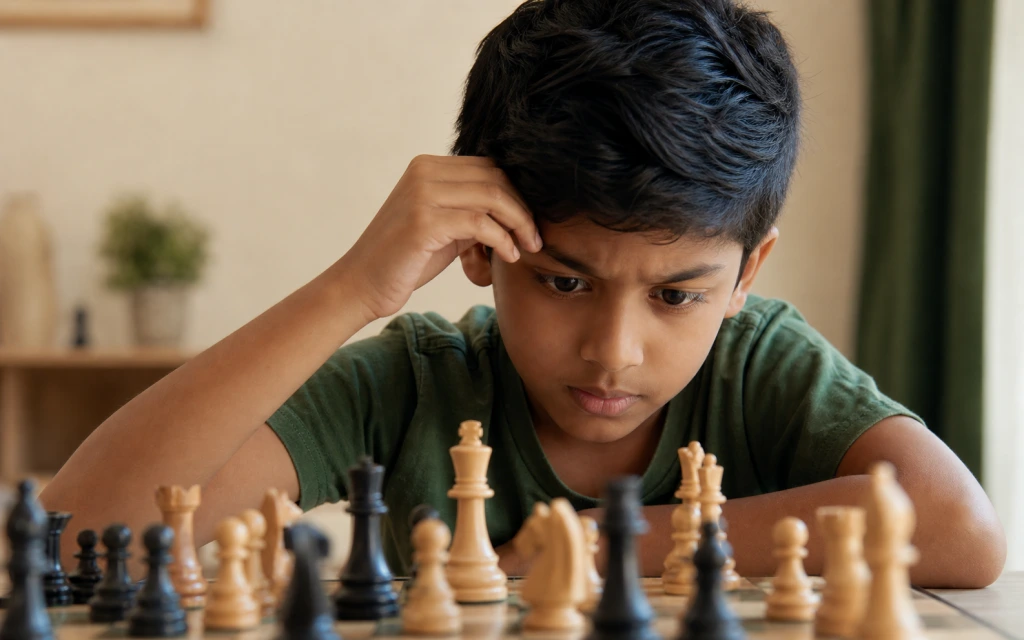
Chess can improve focus in children, but not automatically and not on its own. The evidence shows real gains in sustained attention when chess is taught in a structured way over several months, and weaker gains when children just play casually. In short: the way chess is practised matters far more than the fact that it is chess. Below I separate what the research supports from what marketing overstates, and I share what I have actually seen coaching children.
“Chess improves focus” is one of the most commonly repeated claims in chess education. You will find it on every academy’s website, in every parent testimonial, and in every article about chess for children. But is it actually true? And if it is, how does it work? ChessWize, the academy I coach with, makes this claim too, so I have a duty to be honest about its limits.
I have coached hundreds of children over the past several years. I have seen focus improve in some students and remain unchanged in others. The difference is not the chess itself; it is how the chess is taught and practised. Here is what the research says, where it falls short, and what I have observed as a working coach. If you are looking for a broader overview of cognitive benefits beyond focus, see our chess benefits for kids guide.
What the Academic Research Shows#
Multiple peer-reviewed studies have examined whether chess training improves cognitive function in children. Research summaries available on platforms like Chess.com and ChessBase India consistently cite findings that cluster around three core areas:
Attention control. Studies consistently report that children who receive structured chess instruction show improvements in sustained attention — the ability to stay focused on a single task for extended periods. This makes intuitive sense: a chess game requires continuous concentration for 30 minutes to several hours. The brain is being trained to resist distraction, and that training appears to transfer to other contexts.
Working memory. Chess requires holding multiple piece positions, possible moves, and future variations in mind simultaneously. Research has found measurable improvements in working memory among children who received regular chess instruction compared to passive control groups. This has practical implications for schoolwork — children with stronger working memory can follow multi-step instructions, hold mathematical operations in mind, and maintain context while reading longer passages.
Cognitive flexibility. The ability to shift between different strategies when a plan fails — a core chess skill — appears to improve with structured chess training. Children who can adjust their approach mid-game in chess show similar adaptive behaviour in academic problem-solving tasks.
These three components — attention control, working memory, and cognitive flexibility — are collectively known as “executive function,” and organisations like Understood.org describe them as the skills that most directly influence academic performance and behavioural self-regulation in children. Understanding this framework helps parents evaluate whether chess is producing the specific cognitive improvements they are hoping for. The overlap with maths is strong enough that we cover it separately in our chess and math skills for kids guide.
The Important Caveats#
Here is where I diverge from most chess academy marketing: the research has significant limitations that honest discussion requires acknowledging.
Active control group problem. Many studies compare chess-trained children against children who received no special intervention. Unsurprisingly, children who receive structured intellectual stimulation outperform children who receive nothing additional. The more meaningful test is when researchers use “active control groups” — where the control group learns another structured activity like music, coding, or a new language. In these comparisons, the measured benefits of chess are smaller, though still positive. This suggests that some of the focus improvement comes from any structured cognitive activity, not chess specifically. Chess is not magic; it is one effective option among several. The practical takeaway for parents: chess is an excellent tool for developing focus, but so is structured music practice, competitive debate, or learning to code. Choose the activity your child will actually stick with.
Self-selection bias. Children who choose chess and stick with it may already have higher baseline attention spans. The focus improvement attributed to chess may partially reflect pre-existing cognitive traits rather than chess-caused development. This does not mean chess has no effect — it means the effect size may be smaller than marketing materials suggest.
Duration and consistency matter. Studies showing meaningful cognitive improvement typically involve 20+ hours of structured chess instruction over several months. A child who attends one casual session per week for two months is unlikely to see the same benefits as a child who practises daily for six months. The dose matters.
Quality of instruction matters. Not all chess training is equal. Structured instruction that includes puzzle-solving, analysis exercises, and guided game review appears to produce larger cognitive benefits than unstructured play. Simply playing games on an app without analysis, reflection, or coached feedback produces entertainment and passing enjoyment, not meaningful cognitive training or lasting focus improvement. This is exactly why our online chess classes for kids are built around structured lessons rather than free play.
What a Focus-Building Session Actually Looks Like#
Parents often ask me how a chess session trains attention, so let me walk you through the structure I actually use, because the design is what does the work. A focus-building session is not “play a game and hope.” It is a sequence of deliberately paced tasks that each ask for a different kind of concentration, and the pacing is the point.
I open with five minutes of warm-up puzzles the child can mostly solve. This is deliberate. Starting with success settles a restless mind and signals to the child that this is a place where their effort pays off. Then I move into the day’s main idea — say, spotting a knight fork, one of the tactics we cover in chess tactics for kids. I do not lecture. I show one position and ask, “What is White threatening here?” Now the child has to hold the whole board in mind and search it. That searching, sustained for even ninety seconds, is attention training in its purest form.
The single most important moment in the whole session comes when the child blurts out the first move they see. Almost every child does this, especially in the early months. My response is always the same: “Good — now what would happen after that? And is there a better one?” I am asking them to inhibit the impulse to act and hold the position in working memory while they check an alternative. That pause, repeated dozens of times across a session and hundreds of times across months, is the mechanism. It is not mysterious. The child is practising the exact skill — stop, look, consider, then decide — that also helps them resist rushing through a maths problem or a comprehension passage.
Here is a real pattern I see, described honestly without naming any child. A seven year old joins who cannot sit for more than ten minutes and plays the first legal move every time. For the first three or four weeks it is genuinely hard work, and some parents wobble here. But by keeping sessions short, puzzle-led, and success-heavy, the child slowly builds stamina. Around the two-to-three-month mark — with two sessions a week plus short daily puzzles — I usually notice they start pausing on their own before moving. That self-generated pause is the moment focus has begun to transfer. Parents often report it independently: “She is checking her sums before handing in the paper now.” I cannot prove chess caused that from one household, but the pattern is consistent enough across families that I trust it.
I end every session with a two-minute review where the child tells me what we learned. Making them retrieve and articulate it cements the concentration habit and gives me an honest read on whether the session actually landed. That closing loop is where casual app play falls short: nobody asks the child to reflect, so the attention never consolidates. If you want to replicate this rhythm between lessons, our chess practice for kids at home guide breaks the routine down step by step.
What I Actually Observe in My Students#
The research aligns with what I see in practice, but with nuance:
Focus improvement is real, but gradual. I typically see noticeable attention improvements with consistent training over time (two sessions per week plus daily puzzles), though the pace varies from child to child. Parents often report that their child can sit still longer during homework, maintains concentration during school exams, and shows improved patience in non-chess activities. But this is a gradual process — not a switch that flips after a few lessons.
The mechanism is specific. Chess does not improve focus through some mysterious brain-changing process. It works through practice. During a coaching session, a child must concentrate for 45–60 minutes, follow multi-step reasoning, resist the urge to play the first move they see, and think through consequences. They do this repeatedly, session after session. Over time, the brain builds stamina for sustained concentration, just as muscles build endurance through repeated exercise.
Some children respond more than others. Children aged 7–12 tend to show the most noticeable focus improvements from chess. Younger children (5–6) benefit more from the social and rule-following aspects. Teenagers benefit from the strategic and competitive dimensions but may already have developed basic attention skills through other activities.
Board exam preparation connection. This is particularly relevant for Indian parents. Several parents have told me that their child’s improved concentration during chess training carried over to CBSE Board exam preparation — specifically, the ability to sit through a 3-hour exam without losing focus in the final section. I cannot prove causation from anecdotal evidence alone, but the correlation is consistent across many families I have worked with. The discipline of sitting at a chess board for 60–90 minutes, maintaining concentration even when tired, builds the same stamina needed for extended academic examinations. As reported on ChessBase India, several Indian schools have started integrating chess into their extracurricular programmes specifically because of these observed academic benefits.
If your child has attention difficulties specifically, chess can still help, but the approach needs adapting — I cover that carefully in our honest guide to chess for kids with ADHD.
Expert Tips: How to Get Real Focus Gains from Chess#
If focus improvement is one of your goals, these are the practices I have found produce the best results:
- Practise daily, briefly. 15–20 minutes of puzzle-solving on Lichess or Chess.com every day beats one long weekend session. Consistency, not duration, builds the attention habit.
- Insist on structured coaching, not just play. Sessions that include analysis, guided problem-solving, and post-game review develop deeper cognitive engagement than simply playing games. Our parent reports exist so you can see this structure at work each week.
- Keep the challenge just above comfort. Puzzles and opponents should be slightly harder than the child can easily handle. Easy tasks do not train focus; only tasks that require sustained effort do.
- Make chess a distraction-free zone. No phone nearby, no background video, no sibling interruptions. Enforcing a clean environment is itself a focus-training exercise, and it teaches the child what real concentration feels like.
- Use tournaments as focus milestones. A rated game lasting 60–90 minutes against a real opponent is the most intense concentration training chess offers. Occasional tournament play builds stamina that casual practice cannot match. Our guide to a child’s first steps online explains how we prepare students for that step.
How to Maximise Focus Benefits from Chess#
Beyond the tips above, the underlying principle is simple: focus is trained the same way endurance is — through repeated, slightly uncomfortable effort with recovery built in. Two structured sessions a week, short daily puzzles, a distraction-free setup, and honest review of mistakes will do more for a child’s attention than any amount of casual clicking. If you want a coach to build that routine around your child, you can browse tracks and pricing on our courses page, meet the team on our coaches page, or book a complimentary 30-minute demo through our contact page. Sessions start from ₹313, you keep the same coach every session, and unused sessions are fully refundable. Families across India, from Chennai to smaller towns, get the same online coaching.
Frequently Asked Questions#
At what age do focus benefits from chess appear?#
Research and my coaching experience suggest that measurable attention improvements are most noticeable in children aged 7–12. Below 7, the benefits are more behavioural (learning to follow rules, taking turns) than cognitive. Above 12, the benefits shift toward strategic thinking and competitive performance.
Is chess better for focus than other activities?#
When compared against passive control groups (no special activity), chess shows clear advantages. When compared against other structured cognitive activities (music lessons, coding, martial arts), the advantages are smaller. Chess is one excellent option for developing focus — not the only one. The best activity is the one your child enjoys enough to practise consistently.
How long does it take to see focus improvements?#
With consistent practice (4+ sessions per week including puzzles), most parents report noticeable changes over sustained training, though the pace differs child to child. For children with attention difficulties, improvements may take longer but are often more pronounced when they arrive.
Does casual app play improve focus?#
Much less than structured coaching does. Playing rapid games on an app with no analysis or reflection is entertaining, but it rarely builds lasting attention. The focus gains come from the pause-and-consider habit that a coach or a structured routine enforces, not from the number of games played.
Can chess replace treatment for attention difficulties?#
No. Chess is a complementary activity, not a medical intervention. For a child with diagnosed attention difficulties, any treatment plan should be guided by a qualified professional. Chess can support the practice of attention skills, as our chess for ADHD kids guide explains, but it is not a substitute for professional care.
Back to parent hub: Chess benefits for kids.
See also: Chess for ADHD kids · Chess and math skills
Return to the main hub: Online chess coaching for kids in India.

Aryan Pal
ChessWize's content lead and coach for early learners. Specialises in making chess feel intuitive for first-time players. Designs the explainer videos, exercise sets, and parent-facing learning materials every student receives.
View FIDE ProfileReferences & Sources
- [01] Frontiers in Psychology published studies showing chess improves executive function in children — frontiersin.org
- [02] Meta-analyses indicate effect sizes are smaller with rigorous active control groups — researchgate.net
- [03] Executive function includes attention control, working memory, and cognitive flexibility — pubmed.ncbi.nlm.nih.gov
- [04] Executive functions are the mental processes governing attention, working memory and self-control — en.wikipedia.org/wiki/Executive_functions
- [05] Understood.org explains how attention and executive-function skills develop in children — understood.org