
Chess Board Setup and Notation for Kids
How to set up a chess board correctly and read algebraic notation — step-by-step, with memory tricks, common mistakes, and tournament recording rules.
On this page
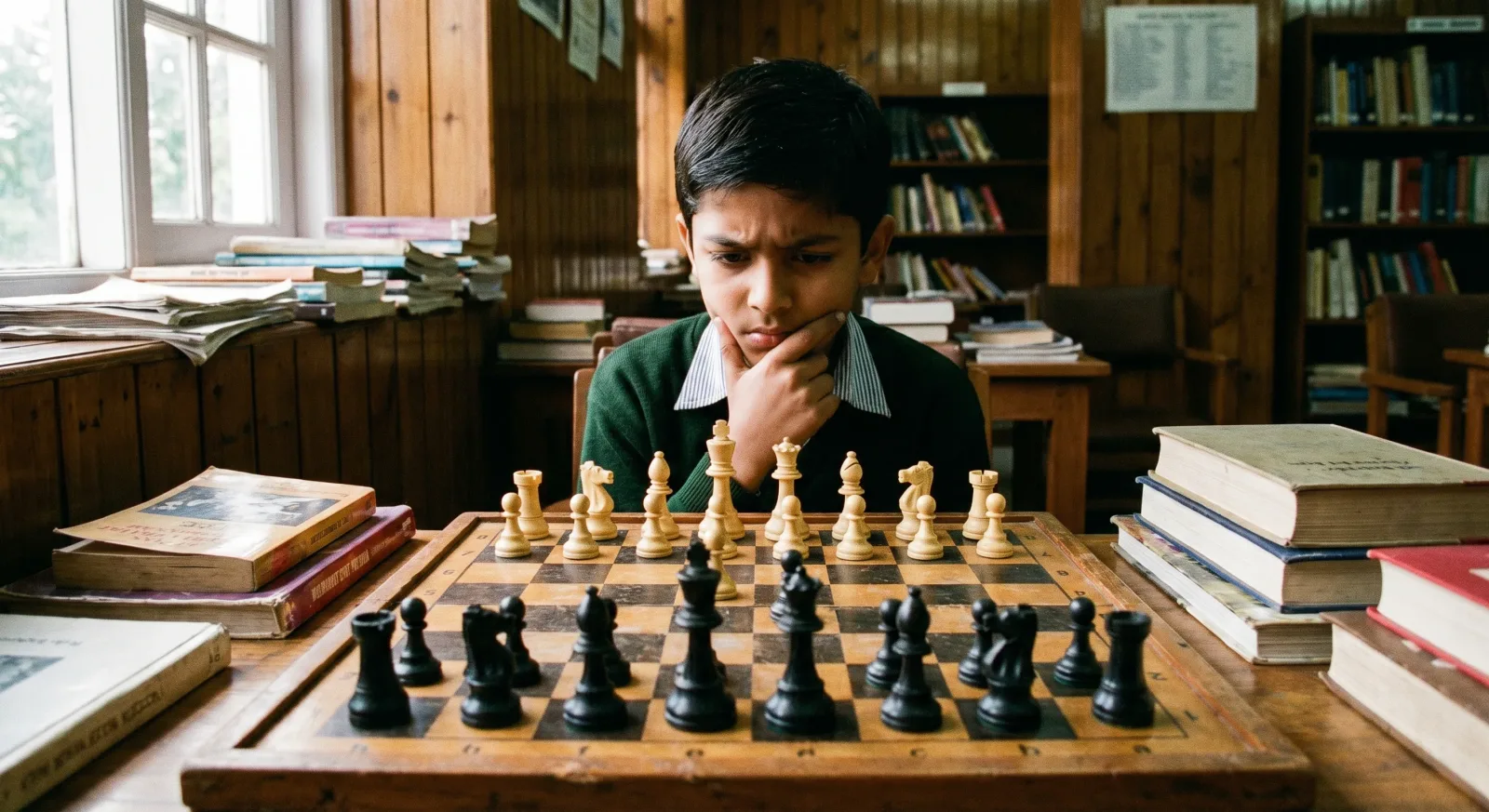
To set up a chess board correctly, place it so each player sees a light square in the near-right corner (“light on the right”), then put the queen on her own colour (white queen on d1, black queen on d8). To read algebraic notation, combine a piece letter with the destination square — Nf3 means knight to f3. Both skills take about twenty minutes to teach and last a lifetime.
The number of children who arrive at their first tournament with the board set up wrong still surprises me after years of teaching beginners. The king and queen are swapped. The board is rotated ninety degrees. The scoresheet stays blank because nobody showed them how to write a move. These are entirely avoidable, and fixing them permanently takes one short sitting. I teach the youngest beginners at ChessWize — children aged 5 to 10 in live online classes — and this is the exact lesson I give in the first week.
This guide covers two foundations every player needs: setting up the board correctly, and reading and writing algebraic notation, the universal language for recording chess moves.
How do you set up a chess board correctly?#
Setting up the board is three small steps. Get the orientation right, learn the grid, then place the pieces in order. Do it the same way every time and it becomes automatic within a week.
Step 1: Orient the board#
Place the board so there is a light-coloured square in the bottom-right corner from each player’s view. Both players should see a light square on their right. Memory trick: “light on the right.”
This is the single most common setup mistake. Rotate the board ninety degrees and every square name becomes wrong and the bishops start on the wrong colours. This orientation is not a convention we invented — it is written into the rules of chess.
Step 2: Understand files and ranks#
The board is a grid of two kinds of lines:
- Files — the vertical columns, lettered a through h from White’s left to right. I tell young students files are like houses on a street, each with its own letter address.
- Ranks — the horizontal rows, numbered 1 through 8 from the bottom (White’s side) up to the top (Black’s side). Ranks are like floors in a building: rank 1 is the ground floor, rank 8 the top.
Every square has a unique name: file letter + rank number. From White’s view the bottom-left square is a1, the top-right is h8, and e4 sits right in the centre — e-file, fourth rank.
Step 3: Place the pieces#
White’s pieces go on ranks 1 and 2, Black’s on ranks 7 and 8.
Rank 1 (White’s back row), left to right: Rook – Knight – Bishop – Queen – King – Bishop – Knight – Rook
Memory trick for the queen: the queen always starts on her own colour. The white queen goes on a light square (d1), the black queen on a dark square (d8). “Queen on her colour.”
Memory trick for the order: the back row is symmetric — rook and knight in the corners area, bishops beside the royals, and the king and queen in the middle. My youngest students remember it as “the taller pieces (king and queen) stand in the centre, guarded outward by bishops, knights, and rooks.”
Rank 2: all eight white pawns fill rank 2.
Ranks 7 and 8: mirror the setup for Black. Rank 8 repeats the same piece order and rank 7 is filled with black pawns.
Common setup mistakes#
- King and queen swapped. This happens when a child forgets “queen on her colour.” If the white queen sits on a dark square, something is wrong.
- Board rotated wrong. Check for a light square in the near-right corner. If it is not there, rotate ninety degrees.
- Knights and bishops swapped. Knights sit beside the rooks; bishops sit beside the king and queen.
Once the board is right, your child is ready to learn the moves in our chess rules for kids guide and to start building an opening from our best chess openings for kids piece.
How do you read and write algebraic notation?#
Algebraic notation is how players everywhere record their games. In rated tournaments — including AICF-rated events across India — players are required to write down every move on a scoresheet, so for a competitive child this is not optional.
How notation works#
Each move is written as piece letter + destination square.
- K = King, Q = Queen, R = Rook, B = Bishop, N = Knight (N, not K, because K is already the king)
- Pawns get no letter — just the destination square
Examples:
- e4 — pawn moves to e4
- Nf3 — knight moves to f3
- Bc4 — bishop moves to c4
- O-O — kingside castling
- O-O-O — queenside castling
- Qxd5 — queen captures on d5 (the “x” means capture)
- e8=Q — pawn promotes to a queen on e8
Special symbols#
- + — check
- # — checkmate
- x — capture
- ! — good move (an annotation, not an official symbol)
- ? — mistake (also an annotation)
A practice exercise#
Set up a board and play through this short, sensible opening by reading each move, finding the square, and moving the piece:
- e4 e5 2. Nf3 Nc6 3. Bc4 Nf6 4. d3 Be7 5. O-O O-O
If your child can play through these ten half-moves by reading the notation, they understand the system. To build fluency, replay one complete master game a week from a Lichess or Chess.com archive — start with short games of 20–25 moves and lengthen gradually. Print a blank A4 scoresheet for those practice games.
Teaching notation to a five-year-old: how I actually do it#
My own chess story started at ten, when a park match caught my eye on the way to a cricket game and my grandfather taught me the rules that evening. Years later, coaching beginners, I saw the same gap again and again: children who could push the pieces around happily but froze the moment someone handed them a scoresheet. Notation looks like homework to a small child, and if you teach it like homework, it becomes a chore they resist. So I stopped teaching it as writing and started teaching it as a treasure map, and the difference has been remarkable.
Here is the sequence I use, and you can copy it at home. First, before a single symbol, I make the grid a game. I call out a square — “find e4!” — and the child races to touch it. We do ten of these. No pieces, no rules, just the child learning that the board has addresses and that they can find any address in a second. Children love being fast at something, and within one session they own the coordinate system that adults sometimes find fiddly. This is the foundation, and skipping it is why so many kids struggle later: they are trying to write a language whose alphabet they never mastered.
Second, I connect a move to its written form in real time. The child makes a move on the board, and I write it while narrating: “knight to f3 — so we write N, then f3.” After a few moves I hand them the pen. The trick is that they are recording a game they are already playing and enjoying, so the writing is a souvenir of their own decisions rather than an abstract exercise. I have watched a five-year-old who refused to write his own name happily record twelve moves of his game, because to him it was proof of the clever things he had just done.
Third — and this is the step most people skip — I have the child read a game back. A week’s worth of scoresheets is useless if the notation only goes one way. So we take a short game they recorded, and they replay it move by move, setting up the pieces from their own writing. When a child sees their scribbles turn back into a real game on the board, the penny drops: notation is not a rule the arbiter imposes, it is a way to keep their games forever. From that moment they write neatly without being asked, because they understand why.
The whole progression takes most children two or three sessions, spread across a week so it sticks. I never introduce nerves or a clock during this phase — those come later, when the habit is already automatic, as we describe in our chess time controls guide. Rush a child into recording under tournament pressure before the habit is solid, and you will get blank scoresheets and tears. Build it calmly at home first, and the tournament becomes just another game they happen to be writing down. This patient, structured approach is the whole reason we built the ChessWize learning path — foundations first, in the right order, so nothing feels overwhelming.
Expert tips for board setup and notation#
- Say “light on the right” every single time. Make it a ritual before every game, even casual ones. A child who says it aloud for a month will never set the board sideways again, in class or at a tournament.
- Teach the coordinate game before the symbols. Ten seconds of “find e4!” races builds the grid fluency that makes notation easy. Most notation struggles are really coordinate struggles in disguise.
- Record a couple of home games a week. Nerves and a clock make first-tournament notation hard. Five to ten calmly recorded practice games at home build the muscle memory so it holds up under pressure.
- Always read games back, not just write them. Replaying a game from your own scoresheet turns notation from a rule into a tool. This one habit is what makes children write neatly of their own accord.
- Use a pen, write the move, then press the clock. In classical AICF events you record the move before pressing your clock, use pen (scoresheets are official documents), and cross out neatly rather than using correction fluid. Rehearse this rhythm at home so it is second nature on the day.
Tournament notation tips#
- Write the move before pressing the clock — a standard AICF rule for classical time controls.
- Use a pen, not a pencil; scoresheets may be handed to the arbiter.
- Fix a recording error by crossing it out neatly and writing the correct move beside it. No correction fluid.
- Keep the sheet readable — arbiters may review it during disputes or to verify a draw claim.
- In severe time trouble (typically under five minutes on the clock), recording is no longer mandatory in most AICF classical events; the child may stop writing and focus on the board. The FIDE Laws of Chess set out these scoresheet rules in full.
Once these foundations are solid, keep the momentum going with regular home practice from our chess practice for kids at home guide, and start recognising the patterns in our tactics for kids lesson. If you would like a coach to guide the whole sequence, our courses page lays out the beginner track, and you can meet the FIDE-rated coaches — including me — who teach it.
Frequently Asked Questions#
Do kids really need to learn chess notation?#
If they plan to play in rated tournaments, yes. AICF and FIDE rules require players to record every move in classical time-control events, so a child who cannot write notation cannot compete properly. Beyond the rulebook, notation lets you replay and analyse games afterwards, which is where most real improvement happens. For casual home play it is optional but still a genuinely useful habit.
What are ranks and files in chess?#
Files are the vertical columns, lettered a through h from White’s left to right. Ranks are the horizontal rows, numbered 1 through 8 from White’s side up to Black’s. Together they give every square a unique address — file letter plus rank number — exactly like street names and building numbers on a map. The centre square e4 sits on the e-file, fourth rank.
Which way does the chess board go, and where does the queen sit?#
Set the board so each player has a light-coloured square in their near-right corner — “light on the right”. Then the queen starts on her own colour: the white queen on the light square d1, the black queen on the dark square d8. If your white queen is sitting on a dark square, the board or the queen is wrong. These two checks fix almost every setup mistake I see.
At what age can a child learn board setup and notation?#
Most children can set the board correctly by age 5–6 with the memory tricks in this guide. Notation is a little more abstract; I find children are comfortable writing moves reliably around age 7–8, though bright five-year-olds manage it earlier. There is no rush — a child only needs fluent notation before their first classical rated tournament, not before they start learning to play.
What do the symbols like +, #, and x mean in chess notation?#
“x” marks a capture, so Nxe5 means a knight captures on e5. ”+” means check and ”#” means checkmate. “O-O” is kingside castling and “O-O-O” is queenside. A pawn reaching the last rank and becoming a queen is written like e8=Q. Coaches also add ”!” for a good move and ”?” for a mistake when annotating, though those are opinions, not official symbols.
How can my child practise notation at home before a tournament?#
Have them write down every move during casual games at home, and replay one short master game a week by reading the moves off a scoresheet. Both build fluency before nerves and a ticking clock make everything harder. Most children I coach become comfortable after about five to ten recorded practice games. Free game archives on Lichess and Chess.com give you endless material.
Back to parent hub: Chess learning path for kids.
See also: Chess rules for kids · Best openings for kids · Chess practice for kids at home
Return to the main hub: Online chess coaching for kids in India.

Aryan Pal
ChessWize's content lead and coach for early learners. Specialises in making chess feel intuitive for first-time players. Designs the explainer videos, exercise sets, and parent-facing learning materials every student receives.
View FIDE ProfileReferences & Sources
- [01] Algebraic notation is the standard, FIDE-recognised method for recording chess moves worldwide — https://en.wikipedia.org/wiki/Algebraic_notation_(chess), 2026
- [02] The FIDE Laws of Chess require players to record moves in classical time controls and define scoresheet rules — https://handbook.fide.com/chapter/E012023, 2023
- [03] The board is set with a light square in each player's near-right corner, per the rules of chess — https://en.wikipedia.org/wiki/Rules_of_chess, 2026
- [04] Chess.com's guide to reading and writing notation covers piece letters and special symbols — https://www.chess.com/article/view/chess-notation, 2026