
Is Online Chess Coaching Worth It for Kids?
Yes, for most kids 5-15 online chess coaching is worth it when the coach is named, FIDE-rated, and consistent. Here is how Indian parents can decide.
On this page
For parents
Key takeaways
- 1Online chess coaching is worth it when your child gets the same FIDE-rated coach every week, not a rotating pool of tutors.
- 2Look for structure: a clear plan, puzzle practice, real games, and weekly parent reports you can actually read.
- 3Start with a complimentary demo before paying for anything. Watch how the coach talks to your child, not just their rating.
- 4Online removes commute, travel, and city limits, so your child can train with a strong coach from anywhere in India.
- 5If a provider will not let you try first or refund unused sessions, treat that as a warning sign.
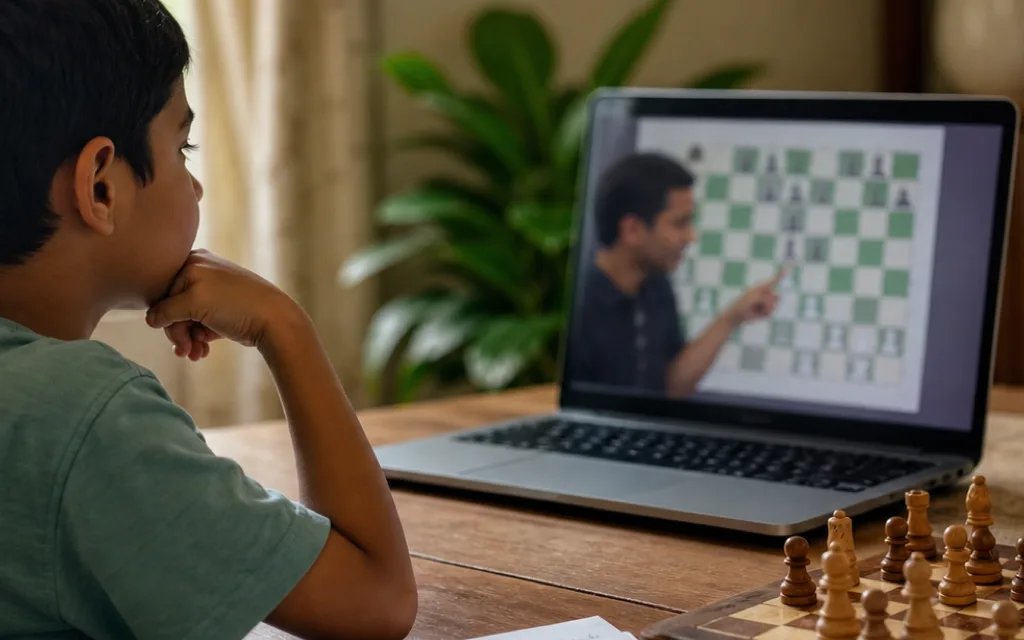
For most children aged 5 to 15, online chess coaching is worth it — as long as your child gets the same qualified coach every week, follows a real plan, and you can see progress in writing. The format is not the deciding factor. The coach, the structure, and the consistency are what make the money worthwhile. A screen with a strong, patient, FIDE-rated coach beats an in-person class with a rotating set of part-time tutors almost every time.
I coach kids online every day, mostly first-time learners aged 5 to 10, so I will not pretend the answer is always yes. Some setups waste your money, and I will tell you exactly which ones below. This guide walks through what “worth it” really means, what online coaching does well, where it falls short, and how to decide for your own child without guessing.
What does “worth it” actually mean for a parent?#
Worth it is not about whether chess is good for kids — it almost always is, and we cover that in chess benefits for kids. Worth it is about whether the specific coaching you are paying for delivers more value than the money, time, and screen hours it costs.
Three things decide that:
- Does your child improve? Better puzzle solving, fewer blunders, more confidence over the board.
- Does your child stay engaged? A child who dreads sessions will not improve no matter how good the coach looks on paper.
- Can you see what is happening? If you have no idea what your child learned this month, you cannot judge value.
If all three are true, the coaching is worth it. If any one of them is missing, no rating or marketing claim changes that. Keep those three tests in mind for the rest of this guide.
Is online really as effective as in-person coaching?#
For chess specifically, yes, and often more so. Chess is one of the few activities that translates almost perfectly to a screen. Tournaments, training, and analysis already happen on digital boards — the same Chess.com and Lichess interfaces a child will meet in real online competition. When your child trains online, there is no translation loss.
Online coaching also removes real friction:
- No commute. You are not driving across the city twice a week or arriving with a tired child before the lesson even starts.
- No geography limit. A family in a small town can train with a strong coach who would otherwise be unreachable. You are not stuck with whoever runs the nearest local class.
- Easy game review. The coach can replay your child’s online games move by move, pause, and show exactly where things went wrong — harder to do cleanly on a physical board.
In-person coaching has its own strengths, mainly the social energy of a room full of kids. For a fuller side-by-side, read online vs offline chess classes for kids. But for one-to-one skill building, a focused online session with the right coach is hard to beat. To see how structured lessons run, see how online chess classes work and our online chess classes for kids.
Deep dive: what a good online session actually looks like#
Parents rarely get to see inside a lesson before they pay, so here is my real forty-five minutes with a seven-year-old, minute by minute, because “structured coaching” is a vague phrase until you watch it.
Minutes 0–5, the warm-up. I never open with theory — nobody listens to theory at seven. I put a position on the shared board and ask, “what do you think Black should do here?” Their answer, right or wrong, is where the lesson starts. If they suggest a bad move, I do not say “no.” I ask, “okay, and then what does White play?” and let them discover the problem themselves. A rule a child finds on their own sticks; a rule they are told evaporates by next week. That is the whole basis of how I teach.
Minutes 5–20, one idea, drilled. Each session has exactly one target — say, the fork. I show one clear example, give a one-line rule (“knights love to attack two things at once”), then the child solves three or four puzzles that test only that idea. Not twenty puzzles on ten themes; three on one theme. Focus is what turns a pattern into instinct. This is the part free apps struggle with, because they cannot tell whether the child understood the fork or just guessed the highlighted square.
Minutes 20–35, a real game. We play a slow game where the child applies the day’s idea against me. I deliberately let positions arise where a fork is possible, and I watch whether they spot it live — which is completely different from solving a puzzle that announces “there is a tactic here.” When they miss it, I do not blurt the answer. I say, “look at my knight and your two rooks,” and wait.
Minutes 35–45, explain it back. This is my non-negotiable. Before we finish, the child must explain the day’s idea to me in their own words, as if teaching a younger sibling. My rule is simple: if a six-year-old cannot explain it back, I have not taught it yet, and I would rather re-teach today than pretend it landed. This last five minutes is also where the weekly parent report writes itself, because I already know precisely what the child can and cannot yet do.
Notice what a rotating pool of tutors cannot do here: a different teacher each week does not know that this child discovers rules better than they memorise them, does not remember that we drilled forks last Tuesday, and cannot hold them accountable for it today. That continuity is the entire product. It is why I would rather a family have one attentive coach at a modest rating than a carousel of titled strangers.
What separates coaching that is worth it from coaching that is not?#
The format is fine; execution is where money is won or lost. Genuinely good online coaching has four traits.
The same coach, every session. This is the single biggest factor. A child builds trust and rhythm with one teacher who knows their habits, their weak squares, and what motivates them. At ChessWize your child has the same FIDE-rated coach every week, not a different tutor from a shared pool. A rotating pool resets progress every session.
A named, verifiable coach. You should know exactly who is teaching your child. A real coach has a name, a track record, and a FIDE rating you can check yourself. Be cautious of anonymous group rooms.
A clear plan, not random lessons. Good coaching has structure: openings suited to the child’s level, tactical patterns, endgame basics, and real games to apply it all. Disconnected sessions are a yellow flag. Our how to pick a chess coach guide lists the questions to ask.
Reports you can actually read. You should not have to guess. ChessWize sends weekly WhatsApp parent reports showing what was covered and how your child is progressing, in plain language.
How do I judge it for my own child?#
Do not rely on marketing, or even on this article. Test it directly.
- Start with a complimentary demo. A serious provider lets you try before you pay. ChessWize offers a complimentary 30-minute demo you can book over WhatsApp. Use it to watch one full session.
- Watch the coach, not just the rating. Notice whether the coach assesses your child’s level, adjusts when your child does not understand, and keeps them engaged. A high rating means nothing if the coach cannot teach a 7-year-old.
- Check your child’s reaction. After the demo, ask whether they want to do it again. Genuine interest from the child is one of the most reliable signals you will get.
- Commit in small blocks. Do not sign a long upfront contract on day one. Start with a short block and reassess after eight to twelve sessions, roughly a month of twice-weekly training.
- Look for refund protection. ChessWize offers a 100% refund on unused sessions, so you are never trapped paying for lessons your child did not take.
You can compare structured plans and pricing on our courses page, see how much chess lessons cost, or meet the coaches directly.
Expert tips for getting real value#
- Sit in on the first two sessions. Not to supervise the chess, but to confirm the coach genuinely adapts to your child. Then step back so the child owns it.
- Ask the coach for one home task a week, and protect the slot for it. Coaching compounds only if the practice between sessions happens — see chess practice for kids at home.
- Judge progress over a month, not a session. Children plateau and jump; a single “bad” lesson is noise. Look at the trend in the parent reports.
- Praise the thinking, not the win. A child who lost but calculated well had a good session. Tie praise to results only and you teach them to fear strong opponents.
- Keep a free practice app alongside. Lichess or ChessKid between sessions is where the coach’s plan gets rehearsed. More on the trade-off in free vs paid chess coaching.
What about cost and screen time?#
Cost. Quality online coaching is usually more affordable than equivalent in-person training, because there is no travel and no venue cost. At ChessWize structured sessions start from around ₹313 per session (a ₹2,500 starter pack of 8 classes), which puts consistent, named, FIDE-rated coaching within reach for many families. The exact figure depends on the plan, and sessions band up to ₹1,000 each; see how much chess lessons cost for the full picture.
Screen time. Not all screen time is equal. A child solving tactical puzzles and thinking three moves ahead under a coach’s guidance is in a very different cognitive state from one passively scrolling videos. Active chess training is closer to doing maths problems than to watching cartoons. Balance still matters, so treat chess sessions as focused work time, not a replacement for outdoor play and rest.
When is online coaching not worth it?#
To be fair, there are cases where I would tell a parent to wait or choose differently.
- Your child genuinely dislikes chess. Forcing it rarely works, and the cognitive benefits depend on engagement. If your child tried a demo and clearly is not interested, do not pay for months of resistance.
- The provider will not let you try first. Any setup demanding a large upfront payment with no demo and no refund on unused sessions is asking you to take all the risk.
- There is no consistent coach. If you cannot get a named, repeating coach, the core advantage of personalised coaching disappears.
In all three cases, the issue is not online versus in-person. It is the specific offer in front of you. Safety questions are covered separately in is online chess coaching safe for kids?, including the value of Lichess Kid Mode for practice accounts.
The bottom line for parents#
For most kids 5 to 15, online chess coaching is worth it, and it often delivers more value than a local class — but only when three things line up: a named FIDE-rated coach your child sees every week, a real plan with visible progress, and genuine interest from your child. The format removes commute and geography; the coach and the structure do the rest.
The simplest way to find out is to watch one session yourself. Book a complimentary 30-minute demo over WhatsApp, sit in, and judge it against the three tests in this guide. When you are ready, you can book a complimentary demo through our contact page and see exactly how your child responds before paying a rupee.
Frequently asked questions#
Is online chess coaching as good as in-person classes?#
For most kids it is just as good and often better, because the screen mirrors the same boards, puzzle apps, and game review tools used in real competition. The coach matters far more than the format.
What age should my child start online chess coaching?#
Children from around 5 or 6 can start with short, playful sessions, and 7 to 15 year olds can handle full structured training. Younger kids simply need a patient coach and shorter sessions. See best age to start chess.
How do I know if the coaching is actually working?#
Look for your child solving harder puzzles, blundering less, explaining their moves, and looking forward to sessions. Weekly parent reports should show specific topics covered, not vague praise.
Is online chess coaching safe for young children?#
It is safe when sessions are one to one with a named, verified coach and a parent can observe any time. Avoid anonymous group rooms where you cannot tell who is teaching.
How much should I pay before deciding it is worth it?#
Start with a complimentary demo, then commit to a short block of sessions rather than a long upfront contract. A good provider lets you try first and refunds sessions you do not use.
Does the coach need a FIDE rating?#
A FIDE rating is not everything, but it is a checkable signal that the coach can actually play the game they teach. More important is whether that coach can hold a young child’s attention and explain a mistake in words the child understands.
Sources#
- Chess.com — https://www.chess.com/ (verified 16 Jul 2026)
- Lichess — https://lichess.org/ (verified 16 Jul 2026)
- Lichess Kid Mode — https://lichess.org/page/kid-mode (verified 16 Jul 2026)
- FIDE — https://www.fide.com/ (verified 16 Jul 2026)
- AICF — https://aicf.in/ (verified 16 Jul 2026)
See also: how to pick a chess coach · FIDE-rated chess coach for kids · online vs offline chess classes · group vs private chess classes

Aryan Pal
ChessWize's content lead and coach for early learners. Specialises in making chess feel intuitive for first-time players. Designs the explainer videos, exercise sets, and parent-facing learning materials every student receives.
View FIDE ProfileReferences & Sources
- [01] Competitive chess, training, and analysis already run on digital boards — chess.com, verified 2026-07-16
- [02] Lichess offers free games, puzzles, and engine analysis usable in live coaching — lichess.org, verified 2026-07-16
- [03] Lichess Kid Mode restricts chat and community features for young accounts — lichess.org/page/kid-mode, verified 2026-07-16
- [04] FIDE ratings govern official international play, so a coach's FIDE rating is publicly checkable — fide.com, verified 2026-07-16
- [05] AICF is the national federation whose events feed a child's rating file — aicf.in, verified 2026-07-16