
How Online Chess Classes Work for Kids
How online chess classes for kids run: live 1:1 or small-group video sessions, a shared board, demo booking, rescheduling and what you need at home.

Day-to-day coach at ChessWize. 7+ years training students aged 5–15 across India, the USA, the UK, Singapore, Australia, and the Middle East. Known for structured, interactive sessions that turn nervous beginners into tournament-ready players.
On this page
For parents
Key takeaways
- 1Online chess classes are live video lessons with a shared digital board, not pre-recorded videos.
- 2Your child keeps the same named coach every session, so the coach builds a real plan around your child.
- 3A complimentary 30-minute demo over WhatsApp shows you exactly how a real session runs before you pay.
- 4Weekly parent reports tell you what was covered and what to practise, so you are never guessing.
- 5All you need at home is a laptop or tablet, a stable internet connection, and a quiet corner.
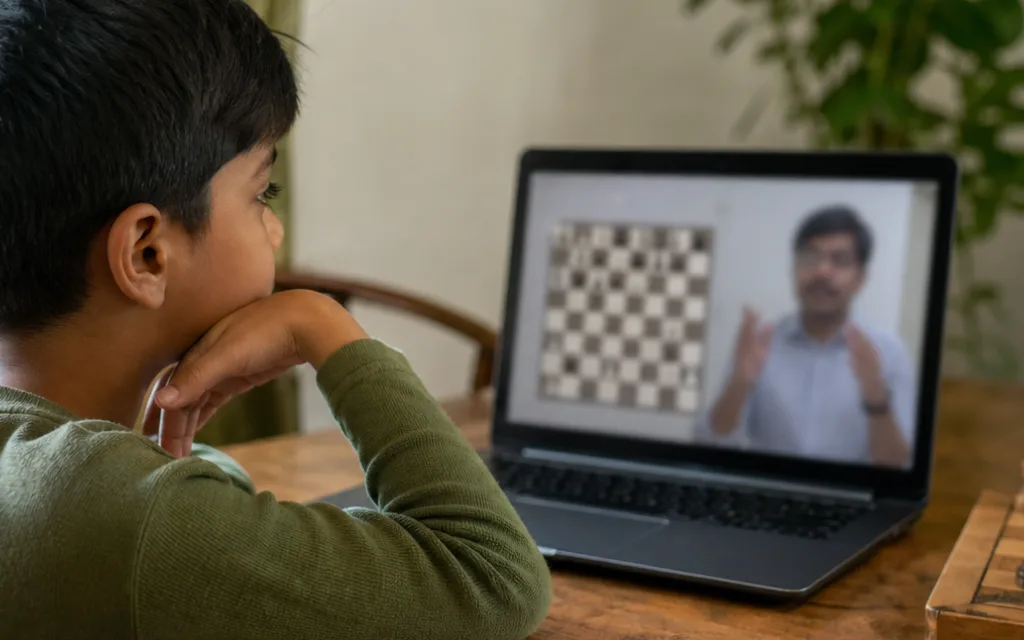
An online chess class for kids is a live, scheduled video lesson where your child and a real coach sit on a video call and play on a shared digital chessboard that both can see and move pieces on. It is not a pre-recorded video, and it is not your child clicking through an app alone. The coach teaches, asks questions, sets puzzles, and corrects mistakes in real time, exactly the way a good in-person coach would, except the board lives on the screen instead of the dining table.
I coach kids online every week, so let me walk you through exactly what happens, what your child needs at home, how a demo works, and what to do when life gets in the way of the schedule. By the end you should know precisely what you are paying for and what a normal week looks like.
What actually happens during a live online session#
A session is a real lesson with a real person. Your child joins a video call at a fixed time. On the same screen sits a digital chessboard that the coach controls. When the coach makes a move, your child sees it instantly. When your child moves, the coach sees it. The two talk the whole time.
A typical 45 to 60 minute session moves through a few stages. First, a short warm-up: a couple of puzzles to wake up the brain and let the coach gauge how your child is thinking that day. Then the main teaching block, where the coach introduces one idea — a tactic like the fork, an opening principle, or an endgame technique — and shows it on the board. After that comes practice: the coach sets positions and your child has to find the right move, with the coach guiding when needed. Many sessions end with a short game between coach and student so the new idea gets used under real conditions, followed by a quick recap of what to practise before next time.
The board is the centre of everything. Most ChessWize coaches use a shared board on Lichess study or Chess.com classroom, or a teaching board inside the video tool. Your child does not need to type or read long instructions: they point, click, or drag pieces while the coach explains by voice. That is why this format works even for a five or six year old who cannot yet write a full sentence.
Sessions are either one-to-one (your child and the coach only) or small group (up to six enrolled students with the same coach). Both are live and interactive. The format is chosen after a demo, based on your child’s level, temperament, and your budget.
What device and software do you need at home?#
Less than most parents expect. The honest list is short:
- A laptop or tablet with a camera and microphone. A desktop with a webcam works too. A phone screen is usually too small for comfortable board work over a full session.
- A stable internet connection. Standard home broadband or a reliable mobile hotspot is enough. Chess does not need heavy bandwidth the way streaming films does, but a steady connection matters so the call does not freeze mid-explanation.
- A quiet corner where your child can sit and concentrate for the length of the session. This matters more than any gadget. A kitchen table during dinner prep is not it.
You do not need to buy special chess software. The coach sends a link before class — to the video call and to the shared board. Your child clicks and joins.
A physical chess set at home is a nice extra, not a requirement. Some kids enjoy setting up positions on a real board to practise between classes, and I encourage it, but the lesson itself runs entirely on the screen.
For younger children, having a parent nearby for the first few weeks helps with mute buttons, camera angles, and accidental tab switches. Our terms of service note that a parent or guardian should be present at home during classes for children under 8.
How the complimentary demo works#
The most direct way to understand online chess classes is to watch one. That is why ChessWize offers a complimentary 30-minute demo, arranged over WhatsApp.
Here is the usual flow:
- You reach out on WhatsApp or through our contact page. Our team replies during office hours (10 AM – 8 PM IST, Mon–Sat).
- We ask a few basics — your child’s age, whether they know the rules, and what you are hoping for (casual learning, school team, tournaments).
- We schedule the demo at a time that suits your child’s energy — after school, not right before bedtime.
- On the day, you join a video call with a coach. The coach plays a short lesson on a live board with your child: a puzzle, a concept, maybe a few moves of a game. You watch how your child responds and how the coach explains.
- You decide whether to continue. There is no payment required for the demo.
The demo is a real coaching interaction, not a sales presentation. If the format does not suit your child, you have lost nothing except half an hour.
One-on-one vs small group: which format will you get?#
This is the question I get most from parents after the demo.
One-on-one gives undivided attention. Every puzzle is pitched at your child’s level. Every wrong move gets explained on the spot. It suits tournament-track children, shy kids who hesitate in a group, and anyone who needs a fully personalised plan.
Small group (six or fewer students) adds peer energy at a lower cost per session. The coach still teaches the group, but individual correction is shared across several children. It suits steady weekly improvement when your child enjoys playing classmates and you want structure without the price of private coaching every time.
Many families start in a small group and move to one-on-one when competitive goals sharpen. The coach stays the same where possible, so the relationship does not reset.
For a fuller comparison, see Group vs private chess classes.
How online classes keep the same coach and build a real plan#
A genuine concern with online learning is that it can feel like a conveyor belt: a different face every week, no one who actually knows your child. That is exactly what you should avoid.
At ChessWize, your child keeps the same named coach every session. That continuity is the whole point. A coach who teaches your child week after week remembers that your daughter rushes her moves when she is winning, or that your son freezes in the endgame, and builds the next lesson around fixing it. A rotating cast of stand-ins cannot do that, no matter how qualified each one is on paper.
If your regular coach is unavailable, we tell you in advance and propose a named substitute of equivalent credentials. You get a free trial session with a new coach before deciding to continue — as set out in our terms of service.
You can see who would actually teach your child on our coaches page, where every coach’s background is listed with FIDE IDs you can verify on ratings.fide.com.
How you stay informed as a parent#
Online does not mean invisible. A good programme is built so you always know what is happening, even though you are not the one being taught.
At ChessWize that runs on two simple things. First, weekly parent reports: a short, plain-language note on what your child covered, how they are progressing, and what to practise before the next session. Reports arrive on WhatsApp — the same channel you use to book and reschedule. Second, an open line during office hours so questions get answered without a formal email chain.
You are also welcome to sit in occasionally. I suggest watching one session a month rather than every session: enough to understand the methodology and see your child in action, not so much that your presence changes how they behave on the call.
Read more on our parent reports page.
Rescheduling, missed sessions, and pausing#
Real life does not follow a chess clock. Kids fall ill. Board exams land in February and March. Families travel for Diwali or summer holidays. A coaching programme that cannot bend will frustrate you within a month.
Here is how ChessWize handles it — plainly, from our published policies:
- Reschedule with notice: If you cancel a session with at least 4 hours notice, we schedule a make-up at no charge, subject to coach availability.
- Missed without notice: Sessions missed without notice count as delivered and are not refundable, because the coach reserved that slot for your child.
- Pause for exams or travel: Tell us in advance and remaining sessions are preserved. Nothing lapses while you are paused.
- Refunds on unused sessions: Unused sessions in an active package remain refundable per the timelines in our refund policy. If you are unsure how many sessions remain, ask on WhatsApp and we confirm the same day.
The practical habit: message on WhatsApp as soon as you know a session will not happen. Same-day illness is common; four hours is usually enough for us to offer another slot that week or the next.
How enrolment and payment work after the demo#
If the demo goes well, you choose a plan — typically a starter pack or a monthly rhythm — shown on our courses page. Sessions start at ₹313 per session on the starter pack (₹2,500 for 8 classes). You are not locked into a long contract upfront; unused sessions can be refunded per our policy.
Your coach and a fixed weekly slot are confirmed. The first paid session feels like the demo, except the coach already knows your child’s level and begins building a plan.
On cost, online coaching removes commute time and geography limits. Compared with travelling to an in-person class twice a week, the hour you save is often worth more than the fee difference. Compared with free apps where no one watches your child play, live coaching gives you a named coach, a real plan, and a clear picture of progress.
Safety and supervision — where this fits#
Logistics and safety overlap. Live coached sessions are closed video lessons with a known coach — not open online play where children can meet strangers. If that concern is on your mind, read Is online chess coaching safe for kids? and our child safety page.
Frequently Asked Questions#
Do online chess classes work for young children who cannot type well?#
Yes. The coach drives the shared board and explains everything by voice and video, so a five or six year old only needs to point, click, or drag pieces. Typing is never required to learn.
What equipment does my child need for an online chess class?#
A laptop or tablet with a working camera and microphone, a steady internet connection, and a quiet place to sit. A physical chess set is optional and useful for practice, but the lesson runs on the screen.
Is a one-on-one online class better than a group class?#
For most kids aged 5 to 15, one-on-one is better when you want every minute tailored to your child. Small groups of six or fewer suit steady weekly improvement at a lower cost. Both formats are live with a named coach.
How long is each session and how often should my child attend?#
Most sessions run 45 to 60 minutes. Two sessions a week is a sensible starting point for steady progress without overload. Your coach will recommend a rhythm based on your child’s age and goals.
Can I see how it works before paying?#
Yes. ChessWize offers a complimentary 30-minute demo arranged over WhatsApp. You watch a real coach teach your child on a live board, and only then decide whether to continue.
What happens if we need to reschedule or miss a class?#
Tell us at least 4 hours before the session and we arrange a make-up at no charge. Sessions missed without notice count as delivered because the coach’s slot was reserved. Families can also pause for exams or holidays.
If you want to ask about timings, your child’s level, or how to set up the first session, the fastest route is our contact page. Sit in on the demo, watch how your child takes to it, and let the lesson — not a sales pitch — make the decision for you.
Hrdyansh Pandey
Day-to-day coach at ChessWize. 7+ years training students aged 5–15 across India, the USA, the UK, Singapore, Australia, and the Middle East. Known for structured, interactive sessions that turn nervous beginners into tournament-ready players.
View FIDE Profile