
Chess Academy vs Private Tutor for Kids
Chess academy or private tutor for your child? A practical comparison of structure, cost, and flexibility, and which model works best at each stage.

Founder of ChessWize. 10+ years in chess education with international academy experience. Designs the structured curriculum that every ChessWize coach teaches. Best for parents who want a clear progression path, not just lessons.
On this page
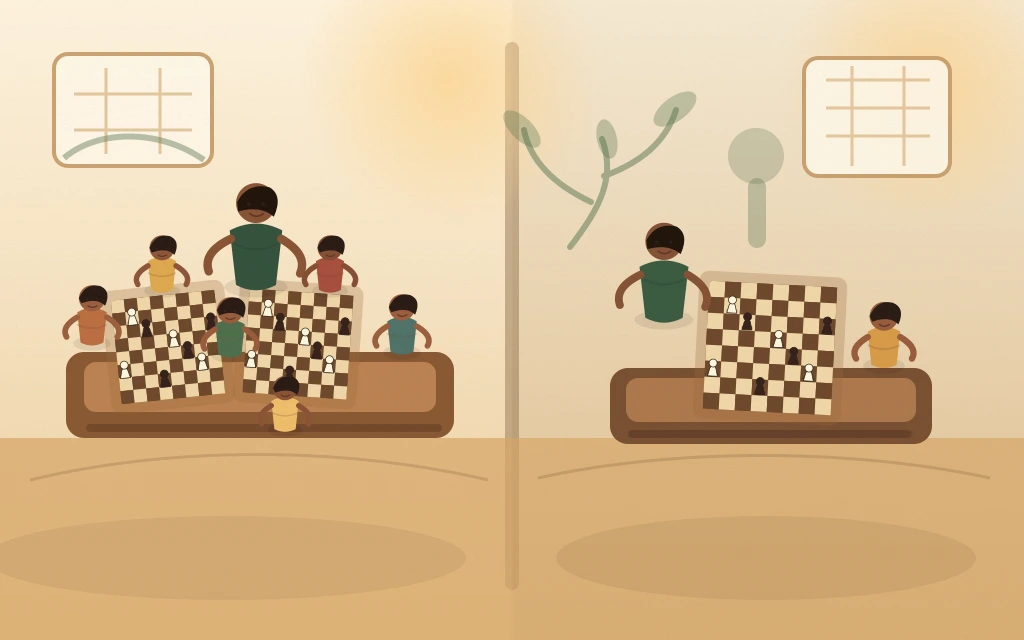
For most beginners, a chess academy wins on structure, cost and reliability; a private tutor wins for personalisation, flexibility and speed once a child is past the fundamentals. The honest answer is that the two models suit different stages, and many families end up using both. Below is a factor-by-factor comparison and a clear rule for which to pick right now.
Disclosure: ChessWize runs this website and operates on the academy model, so I have a bias — but some of my best students came to us after a good private tutor gave them a strong start. Both models work. I built ChessWize on the structured-curriculum approach, and I will be straight about where a private tutor beats it. If you want the wider decision first, start with choosing chess classes for kids and the group vs private breakdown.
The Academy Model: What You Get#
A chess academy is an organisation with multiple coaches, a structured curriculum, and operational systems. Whether it runs on platforms like Chess.com or its own classroom set-up alongside tools like Lichess study boards, the academy model typically provides:
Structured curriculum. The academy has a predefined path — stages from beginner to advanced with specific topics at each stage. Your child progresses through levels rather than learning random topics each session. The curriculum is usually designed by a titled player and delivered by several coaches. CircleChess, for example, runs two live classes a week with monthly parent-teacher meetings on its academy plans.
Peer interaction. In group sessions (4–6 students), your child learns alongside peers at a similar level. This creates healthy competition and social learning. Children often push each other harder than a coach can push them individually — the kid who solves a puzzle first makes the others want to speed up.
Coach backup. If your child’s primary coach is unavailable (illness, travel), a well-run academy assigns another qualified coach, so sessions are rarely cancelled. This continuity matters — children lose momentum quickly when lessons are interrupted, and regaining it costs time and money.
Quality assurance. In a good academy, coaches are supervised by a lead instructor who verifies FIDE credentials — which you can double-check yourself at ratings.fide.com. Lesson quality is monitored and feedback reviewed. With a lone private tutor there is no oversight; you rely entirely on the individual’s self-management and honesty. Our FIDE-rated coach guide explains what to verify.
Tournament coordination. Many academies run internal tournaments, register students for external AICF events, and coordinate group travel to state and national championships — valuable for parents new to the competitive ecosystem.
The Private Tutor Model: What You Get#
A private chess tutor is an individual working directly with your child 1-on-1. Independent tutors are easy to find on marketplaces such as Outschool or the Lichess coach directory, where each teacher sets their own rate. Here is what the model provides:
Maximum personalisation. Every minute is focused on your child. The tutor adjusts in real time to your child’s responses, questions and energy. No waiting for others to catch up, no material that is too easy or too hard — everything is calibrated to your child’s exact level.
Schedule flexibility. Private tutors usually offer more flexible scheduling than academies. Rescheduling a missed session is easier when you deal with one person rather than a booking system. For families with unpredictable schedules — shift work, travel, Board-exam season — this matters.
Faster initial progress. In my experience, children working 1-on-1 with a good tutor often progress noticeably faster in the first six months than group-class students at the same level. The feedback loop is tighter — every mistake corrected immediately, every concept explained until it clicks, no time on topics already mastered.
Personal relationship. The bond between a child and a private tutor is often stronger than with a group instructor, and that connection can be a powerful motivator for children who thrive on individual attention.
The Comparison Table#
| Factor | Academy | Private Tutor |
|---|---|---|
| Curriculum structure | ✅ Standardised, progressive | ⚠️ Depends on tutor’s planning |
| Personalisation | ⚠️ Limited in groups | ✅ Maximum |
| Peer motivation | ✅ Built-in | ❌ Absent |
| Coach backup | ✅ Always available | ❌ If tutor is unavailable, sessions stop |
| Quality oversight | ✅ Supervised by lead coach | ❌ Self-managed |
| Schedule flexibility | ⚠️ Fixed slots | ✅ Highly flexible |
| Cost (per session) | ₹200–₹750 (group) | ₹500–₹3,000+ (1-on-1) |
| Speed of progress | Good (group pace) | Faster (individual pace) |
| Tournament support | ✅ Coordinated | ⚠️ Varies by tutor |
For a real-world price anchor, see how these ranges play out in our chess class fees comparison guide.
Two real models, side by side#
To make the two approaches concrete, here is a genuine academy (ChessGaja) next to a teacher marketplace (Outschool), where independent tutors set their own terms — the closest public example of the private-tutor model. Both facts were checked on their own pages on 16 July 2026.
| Compared detail | ChessGaja | Outschool |
|---|---|---|
| What it is | Live coaching academy | Teacher marketplace |
| Pricing | Group classes ₹3,250/month + 18% GST (India, ≈₹3,835 payable) · 1-on-1 ₹1,700/hour + GST; international pricing in SGD/USD also published | No fixed price — each independent teacher sets their own rate. Typical group chess classes ≈$10–36/class; 1:1 tutoring ≈$24–58/session |
| Group size | max 12 students (group classes) |
Not published by this provider |
| Coaching model | Led by GM Priyadharshan Kannappan (USCF 2632, FIDE 2553); "coaches spanning from FIDE rating to GM level" | Independent, platform-vetted teachers set their own curriculum; credentials vary by listing |
| Free trial | Free level-assessment call ("no commitment"); paid starter package = 2 focused sessions + coach feedback | 14-day risk-free trial for new memberships (per Outschool support docs) |
The pattern is exactly what you would expect: the academy publishes one price, one coaching model and a defined group size; the marketplace has no single price or curriculum because every teacher is independent. Neither is “better” in the abstract — they answer different needs.
When to Choose an Academy#
Your child is a beginner. Beginners benefit from peer interaction and a predefined curriculum. They learn faster seeing other children make the same mistakes and corrections, and a group is more fun for young children who find 1-on-1 sessions intimidating.
Budget is a priority. Group classes cost 40–60% less per session than private tutoring with a comparably qualified coach. For families balancing chess with other extracurricular costs, academies deliver solid value.
You want operational reliability. If cancellations would be disruptive, an academy’s backup-coach system keeps sessions happening. Private-tutor cancellations are the number-one complaint I hear from parents who tried that model.
Tournament logistics matter. If your child is heading into competitive chess and you are new to the AICF ecosystem, an academy that handles registration, travel and group event prep saves real parent time. See best online chess classes for kids in India for who does this well.
When to Choose a Private Tutor#
Your child is intermediate or advanced. Once a child is past 1000+ Elo with solid foundations, the personalisation of 1-on-1 produces noticeably faster improvement. The tutor can spend whole sessions on specific weaknesses — depth a group cannot match.
Your child needs flexible scheduling. Families with irregular schedules, frequent travel, or several children in different activities benefit from a tutor’s willingness to shift session times week by week.
Your child is preparing for a specific event. Before a major tournament, intensive 1-on-1 prep with a tutor who knows your child’s game beats general group sessions. Many families use an academy for regular training and add a tutor for pre-tournament work.
Your child has specific learning needs. Some children learn better one-to-one due to attention difficulties, anxiety in groups, or a learning style that does not fit a particular academy’s approach.
How I decide which model a family needs#
When a parent books a demo and asks me straight out — “academy or private tutor?” — I do not give a generic answer, because the right call depends on three things I try to read in the first conversation. This is the actual decision process I use, and you can run it yourself.
First, I ask where the child is now. If they are a genuine beginner — still learning how the pieces move, still hanging queens — I almost always steer them toward a small group, even though a private slot earns us more. The reason is simple: a beginner does not yet have specific weaknesses that need surgical 1-on-1 attention. What they need is repetition, fundamentals, and the motivation of seeing peers their own age make and fix the same mistakes. Paying premium 1-on-1 rates to drill piece movement is, bluntly, a waste of a parent’s money, and I would rather tell them that on the demo than take it. I’ve had parents push back — “but 1-on-1 must be better” — and six months later their child is at exactly the level a group student reached for a third of the cost.
Second, I ask what the child is for right now — enjoyment, school enrichment, or competition. A child playing for fun and cognitive benefit thrives in a group and rarely needs a tutor at all. A child who has caught the competitive bug, is playing rated events, and keeps losing the same kind of position — that is when I recommend adding private sessions. At that point the tutor can prepare openings for known opponents and drill the exact endgame the child keeps butchering. The FIDE-rated coach guide explains how to pick that specialist.
Third, I ask about the family’s week. If a parent tells me their schedule is chaos — travel, two other kids’ activities, a demanding job — I am honest that a rigid academy slot may become a source of stress and missed sessions. For those families a flexible private tutor, or our own model where the same coach reschedules with them, works better than a fixed group they will keep dropping.
Then I give them the recommendation I would give my own nephew, even when it points away from our higher-margin option. That honesty is the whole reason ChessWize started — I said “yes” to one parent after a district win, and the thing that turned one student into many was never overselling. You can read how we structure both group and 1-on-1 tracks on the courses page, compare us directly on the compare page, or just book a free 30-minute demo and let a coach make this call with you.
The Optimal Path: Academy + Tutor#
The most effective model I have seen combines both across a child’s development:
Stage 1 (Beginner, unrated): Academy group classes. Fundamentals alongside peers — lower cost, social learning, structured progression.
Stage 2 (Intermediate, 800–1400 Elo): Academy small group (3–5 students) for regular training, plus occasional private sessions (monthly or biweekly) for targeted weakness correction.
Stage 3 (Advanced, 1400+ Elo): Private tutor as primary coach for personalised training, with academy group events and internal tournaments for peer competition and practice.
This staged approach matches investment to level — lower cost during the foundation phase when peer learning is most valuable, higher investment during the competitive phase when personalisation drives measurable Elo gains.
Coach tips: choosing and using either model#
- Verify credentials yourself. Whether academy or tutor, get the coach’s FIDE ID and check it at ratings.fide.com. A real coach will hand it over without hesitation.
- Always take a trial first. One session tells you more than any brochure. Watch whether the coach adapts when a concept does not land.
- Ask the group cap in writing. For an academy, “small group” means nothing without a number. Four to six is the sweet spot.
- Match the model to the stage, not the hype. 1-on-1 is not automatically better — it is better for specific, later-stage needs. Do not overpay for it while your child is still learning fundamentals.
- Reassess every few months. The right model changes as your child grows. Review after each stage rather than locking into one approach for years.
Frequently Asked Questions#
How do I find a reliable private chess tutor in India?#
Ask for the tutor’s FIDE ID and verify it free at ratings.fide.com, check references from other parents, and insist on a trial session before committing. Marketplaces like Outschool and the Lichess coach directory have listings, but personal recommendations from other chess parents are usually more reliable.
Can I switch from a tutor to an academy mid-year?#
Yes — most tutors have no lock-in and most academies accept new students at any time. The transition is smoother if the academy assesses your child’s level and places them in the appropriate group rather than starting from the beginning.
What is the ideal group size in an academy?#
Four to six students per instructor. Below four, you lose the peer-interaction benefit. Above six, individual attention drops and some children get overlooked during sessions.
Should I use both an academy and a private tutor?#
Often, yes — in sequence or combination. Many families use an academy for regular structured training and add occasional private sessions before a big tournament or to fix a specific weakness. It matches spend to need: cheaper group work early, targeted 1-on-1 when it drives real gains.
Is a chess academy or a private tutor cheaper?#
An academy, by a clear margin. Group classes typically run ₹200–₹750 per session in India, while comparable 1-on-1 tutoring runs ₹500–₹3,000+ per hour. That gap is exactly why the staged path — group early, private later — makes financial sense for most families.
Sources#
- ChessGaja — https://chessgaja.com/group-classes/ (verified 13 Aug 2026)
- Outschool chess classes — https://outschool.com/online-classes/chess (verified 16 Jul 2026)
- Lichess coach marketplace — https://lichess.org/coach (verified 16 Jul 2026)
- FIDE ratings lookup — https://ratings.fide.com/ (verified 16 Jul 2026)
- CircleChess / Caissa — https://circlechess.com/caissa-school-of-chess (verified 16 Jul 2026)
Back to parent hub: Choosing chess classes for kids. Not sure which fits your child? Compare ChessWize, browse online chess classes for kids, or book a free 30-minute demo.
See also: Chess class fees comparison · Best online chess classes
Return to the main hub: Online chess coaching for kids in India.
Tarun Gupta
Founder of ChessWize. 10+ years in chess education with international academy experience. Designs the structured curriculum that every ChessWize coach teaches. Best for parents who want a clear progression path, not just lessons.
View FIDE ProfileReferences & Sources
- [01] ChessGaja publishes group classes (max 12 students) at ₹3,250/month + 18% GST (≈₹3,835) and 1-on-1 at ₹1,700/hour + GST, led by GM Priyadharshan Kannappan — https://chessgaja.com/group-classes/, verified 2026-08-13
- [02] Outschool is a marketplace of independent teachers who each set their own rate; group chess classes commonly run ≈$10–36/class — https://outschool.com/online-classes/chess, verified 2026-07-16
- [03] Lichess hosts a marketplace of independent titled coaches for hire at coach-set rates — https://lichess.org/coach, verified 2026-07-16
- [04] A coach's claimed FIDE rating and title can be verified free using their FIDE ID — https://ratings.fide.com/, verified 2026-07-16
- [05] CircleChess academy plans run 2 live classes a week with monthly parent-teacher meetings — https://circlechess.com/caissa-school-of-chess, verified 2026-07-16