
Best Age to Start Chess for Kids
Age-by-age guidance for starting chess in Indian families: readiness signs, practical milestones and when to start coaching versus trial exposure.
On this page
For parents
Key takeaways
- 1Most children are ready around age 5 to 7 for formal structured sessions once they can sustain short focus windows.
- 2Starting at age 10 or later is not late if your child is ready in attention, curiosity and instruction-following.
- 3A coach should test readiness first, not the birthday alone.
- 4Comparing your child to prodigies like Anand or Gukesh is inaccurate for family-level coaching decisions.
- 5ChessWize readiness decisions prioritise observed attention, not age alone, through a short demo process.
If you are asking this as a parent, use this answer first: the best age is the age where your child can focus on rules, follow directions and stay mentally curious for short practice windows. Age is a useful marker, not the decision itself.
What I mean by “ready for chess”#
I’m Aryan, and this is the first signal we use in every demo at ChessWize. We do not book a long timeline to the child. We test whether the child can hold a simple routine.
A practical readiness check is usually just three things:
- Sustained attention for the task.
- Basic instruction follow-through.
- Recovery after a missed move.
If these are visible, the child is ready to learn more than pieces. If not, keep exposure playful and return after a few months. This is especially useful when families feel pressure from prodigy stories.
Ages 4–5: playful entry, not full classes#
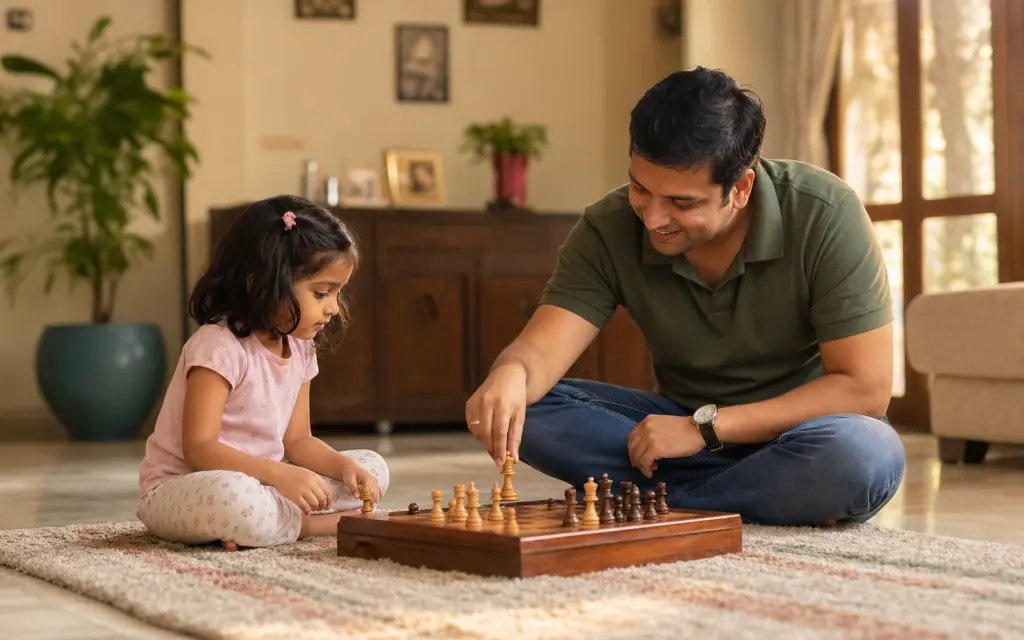
At this stage, your child needs shape recognition and pattern familiarity, not full tactical depth. Use capture races, mini-game rules and board movement games. The right learning signal is joy + engagement.
Common mistake: starting formal notation too early. In my sessions with younger learners, a child who can physically move pieces well but loses language attention after ten minutes is usually better with a longer play runway than a weekly competitive curriculum.
For this stage, parent-supported exposure at home and small demo sessions are better than full commitments. Try teaching chess to a 4-year-old and then test with a free guided entry.
Ages 5–7: good age for foundational learning#
Most children in this band can enter structured rule-based learning if they can sit steadily for the class duration. They are ready for check and checkmate, piece moves, legal move discipline and simple tactical concepts.
Your coaching goals should be:
- Correct piece movement and board orientation.
- Build patience around one move thinking.
- Introduce small game records so they learn what happened and why.
If your child has a high-energy profile, keep sessions shorter and consistent. In this age band, consistency beats duration.
Ages 7–10: structure phase#
This is where many children become technically consistent. They can handle full games, basic tactics and regular homework.
At this stage:
- Openings can be introduced as patterns (“control centre,” “develop pieces,” “castle early”).
- Endgames become meaningful because children can understand king activity.
- Tournament exposure begins, often via low-pressure school events.
If your child is in school systems like CBSE or ICSE, this phase maps well because weekly routine is already building. Use chess-learning-path-for-kids and chess-rules-for-kids as the parent support layer.
Ages 10–12: accelerated cognitive uptake#
By 10–12 many children understand reason-based play much faster than younger kids. That does not make them “late starters.” It often means they can absorb strategy concepts earlier and ask sharper questions.
This is the right moment to evaluate whether a child should move into small-group or private support depending on focus profile. A child who responds well to feedback and can do independent homework can remain in group; one with persistent blunders may need one-on-one intervention.
Ages 13 and above: still normal, still useful#
A child who starts at 12 or 13 can become a strong player when coaching is realistic and focused. The work is mostly habits, time use and decision quality. Older children often benefit from online peer games and analysis sessions on Chess.com or Lichess because they can stay in a long work loop.
The key here is identity and pressure. Older learners often test their self-image more. A coach with transparent goals and respectful pace helps them stay consistent.
What about prodigy benchmarks?#
No serious coaching decision should be based on prodigy age milestones alone. Anand, Praggnanandhaa and Gukesh are all valid and inspiring, but they are examples of high variance outcomes. A parent copying their exact age claims often sets a child up for avoidable pressure.
The safer model is stage-based. Ask if your child is prepared to learn and enjoy regular improvement. That is the actual coaching decision, not the date of birth.
What FIDE, AICF and school systems actually say about starting age#
Direct answer: no official body sets a “best age” to start chess. FIDE, the international federation, governs the title and rating framework, but it prescribes category ages for competition, not a learning start age. The two are different, and parents often confuse them.
Here is the practical distinction. The Elo rating system measures a player’s strength relative to opponents, so a rating tells you how a child performs against others, not whether the child was old enough to begin. The All India Chess Federation runs age-category events (Under-7, Under-9, Under-11 and upward), which means a young child can technically enter rated tournaments early. Eligibility to enter, though, is not the same as readiness to learn well — a six-year-old can be entered in an Under-7 section and still not hold a two-step instruction, which is the gate that actually matters for a first course.
School systems shape the real starting point for most Indian families. Many CBSE and ICSE schools now run chess as a co-curricular activity, so a large share of children first meet the board at school somewhere between ages six and eight. That early classroom exposure is useful for interest, but it rarely tests the three readiness signals in this guide. We could not find any federation or exam board that publishes a single recommended starting age; they set category ages, which is a scheduling rule, not a readiness rule. Treat published tournament categories as opportunities, not as instructions about when your child “should” have started.
How ChessWize handles age and readiness#
ChessWize coaches children aged 5–15, online only — there is no physical centre. The reason age is a side note in our process is structural: classes run in small groups of up to six, so a coach can watch each child’s focus, follow-through and reaction to a mistake in real time rather than guessing from a birthday. Every child keeps the same coach each session, and parents get a weekly WhatsApp report, so the readiness signals in this article are tracked over weeks, not assumed once at sign-up.
Entry starts with a complimentary 30-minute demo, which we use as the readiness check described in the deep dive below — not as a sales call. If a child is not ready, we say so and suggest returning after more home exposure. Pricing is published so families can decide without booking: the Starter Pack is ₹2,500 for 8 classes (₹313 per session). You can review the full plans on courses and read each coach’s FIDE credential and age specialty on coaches before you decide which track fits your child’s stage.
Deep dive: one demo-based decision framework (400–600 words)#
I’ll use the same framework I apply in demo calls. We keep it short, observable, and repeatable. The first 15 minutes are not about openings. They are about learning capacity.
First, I run a focus check using a simple mini-task. If the child can stay in one task long enough to complete two to three steps, we continue. If they repeatedly abandon tasks at the first friction point, formal coaching usually starts later.
Second, I run an instruction check. I ask for a two-step instruction chain and watch if they can hold both steps. The gap here is huge: some children who look “very interested” cannot yet hold sequence memory consistently. In coached classes, this becomes the base of tactical training.
Third, I do a pressure check with one simple loss simulation. The child does not need to “win.” I need to see if they recover. A child who quits mentally after one mistake needs shorter sessions and more success spacing. A child who tries again may be ready for a more direct curriculum immediately.
From these three markers, I assign one of three lanes:
- Lane 1 (exposure-led): playful board exposure and free online repetition.
- Lane 2 (light structure): short structured group with weekly routine and periodic review.
- Lane 3 (intensive coaching): one-on-one planning for consistency, correction, and early competition.
No lane is permanent. The important part is making the call from real behaviour, not parent fear. This is why we offer a complimentary 30-minute demo as an entry test and then map the right lane.
I also track city context: school load, exam season and family screen limits all affect readiness for older children. A child in middle school exam season may need lower intensity but can still progress if homework is short and consistent.
If you apply this framework, age becomes a side note. Your coaching choice becomes a decision rooted in how your child thinks and recovers, which is the point of this entire guide.
Expert tips for timing the first enrollment#
- Expose first, then enrol. A child who sees chess at home and asks to play will stay longer in any format.
- Use a short demo result, not your family pressure. If your child cannot complete the demo rhythm, it is not a coaching rejection; it is a timing decision.
- For 5–8 years, keep lessons simple and emotional safety high. Rushing strategy too early backfires on retention.
- For 10+ years, ask fewer questions about “genius potential” and more about homework follow-through and calm after losses.
- When in doubt, start small and review monthly. Chess progress is measured over weeks and behavior, not instant ratings.
FAQ#
Can a 4-year-old learn chess?#
A 4-year-old can learn piece identity and basic play patterns through playful exercises. Full formal rules usually work better when readiness signs are stable.
Is 10 too old to start chess?#
No. Starting at 10 can be ideal because many children think in clearer patterns by then. A child can still build strong fundamentals and competitive strength.
How do I know if my child is ready?#
Use sustained attention, instruction follow-through and emotional response after mistakes as practical gates. Then do a short demo session.
Should I wait for my child to ask for chess?#
Interest usually appears after exposure. Parent-guided introduction is how most children start.
Are later starters less likely to become strong?#
Not for most realistic family goals. Starting older is common when a child receives good coaching and routine support.
What coaching format should I choose at my child’s age?#
Use readiness first. Younger children often fit a structured group with playful rhythm; older children with clear goals often do best with clear private milestones.
Sources#
- FIDE and Elo context — https://en.wikipedia.org/wiki/FIDE, https://en.wikipedia.org/wiki/Elo_rating_system
- AICF participation and federation context — https://aicf.in/
- Anand and Indian chess pathways context — https://en.wikipedia.org/wiki/Viswanathan_Anand
- Lichess free learning tools — https://lichess.org/about
- Chess.com training and play tools — https://www.chess.com/
Back to the parent hub: best age and learning path.
See also: chess rules for kids, teaching chess to a 4-year-old, online chess coaching for kids in India.
Your 30-day family implementation checklist#
- Week 1: no forcing. Keep two playful sessions only and one structured class after lunch or early evening.
- Week 2: introduce a short rules checklist: legal move, response check, and one move-before-action habit.
- Week 3: watch one mini-game with your child and ask what they wanted to do in their last two moves.
- Week 4: review for three signs — focus, calm, and follow-through at home.
This keeps early pressure low and gives you readable signals before any long commitment. If your child shows stable attention and joy, continue with small-group or private based on how many corrections are still needed. If engagement drops, pause and revisit exposure first.
A practical note for family routines: in high-school-pressure months, reduce tactical load and keep one short routine only. The objective is not “more” chess, but durable habit. Long routines without retention are not a sign of weak teaching; they are a sign of poor dosage.
If you are ready to map this to real products, review the chess learning path, courses, coaches, and the full age-relevant class comparison. For city-specific planning, start from online chess classes in Bengaluru and online chess classes in Mumbai.

Aryan Pal
ChessWize's content lead and coach for early learners. Specialises in making chess feel intuitive for first-time players. Designs the explainer videos, exercise sets, and parent-facing learning materials every student receives.
View FIDE ProfileReferences & Sources
- [01] FIDE is the international governing body of chess and maintains the rating framework used by national federations — https://en.wikipedia.org/wiki/FIDE , 16 Jul 2026
- [02] Elo is the rating scale used to compare player strength in many chess contexts, including school and federation events — https://en.wikipedia.org/wiki/Elo_rating_system , 16 Jul 2026
- [03] Viswanathan Anand is a widely reported early starter whose path is not a standard benchmark for every child — https://en.wikipedia.org/wiki/Viswanathan_Anand , 16 Jul 2026
- [04] Praggnanandhaa and Gukesh are examples of exceptional early-start pathways, not universal templates for school-age progression — ChessBase India coverage and public federation reporting context, 16 Jul 2026
- [05] AICF is the official federation platform for structured tournament pathways in India — https://aicf.in/ , 16 Jul 2026
- [06] Lichess offers free structured analysis, tactics and learning tools for beginner routines — https://lichess.org/about , 16 Jul 2026
- [07] Chess.com provides online board tools used by learners for move practice and game replay review — https://www.chess.com/ , 16 Jul 2026